


The wrongful execution of a soldier convicted of sexually abusing and murdering a five-year-old girl in 1996 was officially closed yesterday and the real suspect was indicted, the Supreme Prosecutor’s Office said yesterday.
Special Investigation Panel (SIP) spokesman Chen Hung-ta (陳宏達) told a press conference that Hsu Jung-chou (許榮洲) was charged with the murder of the girl, surnamed Hsieh (謝), and that prosecutors requested that the Taipei District Court sentence him to 20 years in prison.
Chen said Hsu was a pedophile and that he should receive lengthy medical treatment after he completes his sentence.
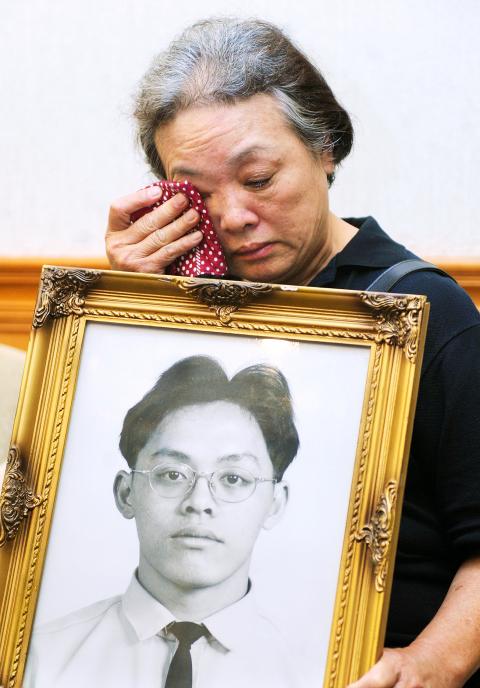
Photo: Liao Chen-huei, Taipei Times
The case sparked controversy earlier this year when a new investigation determined that Chiang Kuo-ching (江國慶), who served in Air Force Command in 1996 and was found guilty of murdering Hsieh after a month-long military investigation and executed the following year, was found innocent of the crime.
Chiang was 21 years old when he was executed.
The Military Supreme Court Prosecutors’ Office filed an extraordinary appeal with the Supreme Court in May last year to reopen the case, following findings by the Control Yuan that Chiang was tortured by military investigators.
Prosecutors’ documents said former air force counterintelligence officials Ko Chung-ching (柯仲慶), Teng Chun-huan (鄧震環), Lee Shu-chiang (李書強) and Lee Chih-Jen (李植仁), as well as Ho Tsu-yao (何祖耀), who is still in active service, had used inappropriate methods to coerce Chiang’s statement.
However, because the 10-year statute of limitation had expired, prosecutors did not indict them.
Prosecutors said no sufficient evidence was found to indicate that former minister of national defense Chen Chao-min (陳肇敏), who was then-chief of Air Force Command, Tsao Chai-sheng (曹嘉生), former Air Force Command legal department director, or former military prosecutors Chao Tai-shen (趙台生) and Huang Jui-peng (黃瑞鵬) violated criminal law in the case.
The prosecution said Chen Chao-min had disregarded the fact that military prosecutors were handling the criminal investigation and ordered the counterintelligence unit to take over.
Although the decision was not criminal per se, it was inappropriate, the prosecutors’ documents said.
Prosecutors said Chiang was tortured during questioning, including exposure to strong lights and being forced to watch a video of the girl’s autopsy. He was also threatened with an electric prod and deprived of sleep while being forced to undergo strenuous physical activity.
Prosecutors said that on Sept. 12, 1996, Hsu, who was also in Air Force Command, saw Hsieh watching TV alone at a restaurant at the base. He is believed to have led the girl to a washroom and then allegedly took off her clothes before brutally assaulting and raping her. To stifle the girl’s cries, he allegedly smothered her by putting his hand over her mouth and nose.
Prosecutors said Hsu left bloody palm prints at the scene of the crime, which a DNA test confirmed were his.
Chiang’s mother, Wang Tsai-lien (王彩蓮), and her attorney, Greg Yo (尤伯祥), held a press conference after the ruling yesterday.
“Chiang Kuo-ching’s reputation is finally cleared,” she said.
“However, the military officials involved in the investigation are too cold-blooded,” Wang said. “I can’t accept that Chen Chao-min was not indicted. I will sue him.”
Yo said Chen Chao-min was the mastermind behind the botched investigation. He ordered the counterintelligence unit to take over the case to force Chiang to confess to a crime he never committed.
Ministry of National Defense spokesman Lo Shao-ho (羅紹和) said prosecutors had determined that Chiang was wrongfully executed.
President Ma Ying-jeou (馬英九) apologized to Chiang Kuo-ching and his family in February.
The military court is currently reviewing the case and if the court formally acquits Chiang, his family could apply for maximum national compensation of NT$30 million (US$1.04 million).
ADDITIONAL REPORTING BY CNA
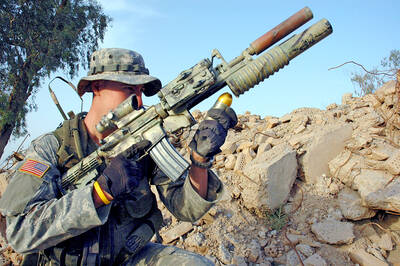
PREPAREDNESS: Given the difficulty of importing ammunition during wartime, the Ministry of National Defense said it would prioritize ‘coproduction’ partnerships A newly formed unit of the Marine Corps tasked with land-based security operations has recently replaced its aging, domestically produced rifles with more advanced, US-made M4A1 rifles, a source said yesterday. The unnamed source familiar with the matter said the First Security Battalion of the Marine Corps’ Air Defense and Base Guard Group has replaced its older T65K2 rifles, which have been in service since the late 1980s, with the newly received M4A1s. The source did not say exactly when the upgrade took place or how many M4A1s were issued to the battalion. The confirmation came after Chinese-language media reported
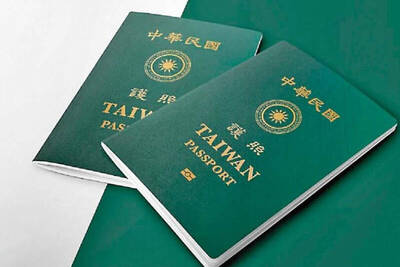
The Taiwanese passport ranked 33rd in a global listing of passports by convenience this month, rising three places from last month’s ranking, but matching its position in January last year. The Henley Passport Index, an international ranking of passports by the number of designations its holder can travel to without a visa, showed that the Taiwan passport enables holders to travel to 139 countries and territories without a visa. Singapore’s passport was ranked the most powerful with visa-free access to 192 destinations out of 227, according to the index published on Tuesday by UK-based migration investment consultancy firm Henley and Partners. Japan’s and
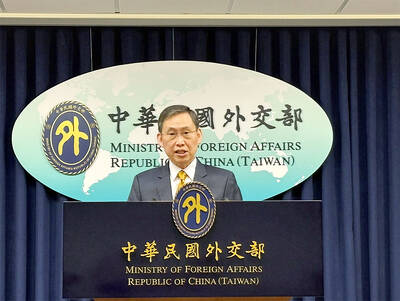
A Ministry of Foreign Affairs official yesterday said that a delegation that visited China for an APEC meeting did not receive any kind of treatment that downgraded Taiwan’s sovereignty. Department of International Organizations Director-General Jonathan Sun (孫儉元) said that he and a group of ministry officials visited Shenzhen, China, to attend the APEC Informal Senior Officials’ Meeting last month. The trip went “smoothly and safely” for all Taiwanese delegates, as the Chinese side arranged the trip in accordance with long-standing practices, Sun said at the ministry’s weekly briefing. The Taiwanese group did not encounter any political suppression, he said. Sun made the remarks when
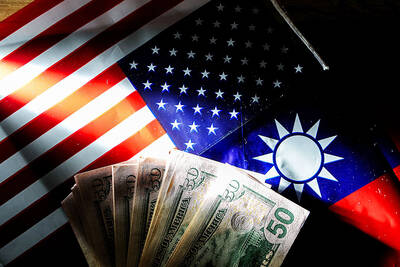
BROAD AGREEMENT: The two are nearing a trade deal to reduce Taiwan’s tariff to 15% and a commitment for TSMC to build five more fabs, a ‘New York Times’ report said Taiwan and the US have reached a broad consensus on a trade deal, the Executive Yuan’s Office of Trade Negotiations said yesterday, after a report said that Washington is set to reduce Taiwan’s tariff rate to 15 percent. The New York Times on Monday reported that the two nations are nearing a trade deal to reduce Taiwan’s tariff rate to 15 percent and commit Taiwan Semiconductor Manufacturing Co (TSMC, 台積電) to building at least five more facilities in the US. “The agreement, which has been under negotiation for months, is being legally scrubbed and could be announced this month,” the paper said,


 RSS
RSS