


Former first lady Wu Shu-jen (吳淑珍) was taken home from a prison hospital yesterday after Taichung Prison declined to admit her because of her poor health.
The Kaohsiung Prosecutors’ Office ordered Wu’s son, Greater Kaohsiung Councilor Chen Chih-chung (陳致中), to take his wheelchair-bound mother home after a medical team at Pei Teh Hospital concluded that Wu was not well enough to serve her sentence.
The office also ruled that Wu could not change her residence in Greater Kaohsiung without permission and was prohibited from leaving the country.
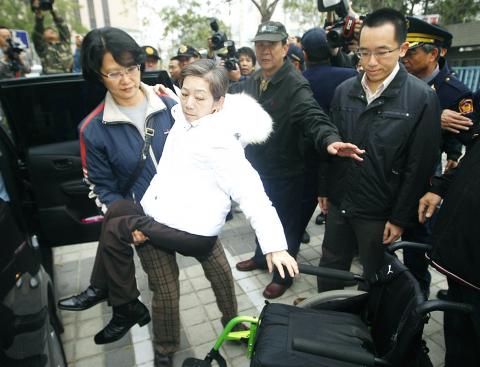
Photo: CNA
The office said in a statement that it would send staff to visit Wu regularly to see if her health had improved enough to enable her to begin her sentence.
Wang Chun-li (王俊力), a senior prosecutor at the office, said that as there was no home detention system in Taiwan, Wu’s prison term remains unchanged.
“Wu’s incarceration has only been postponed indefinitely,” Wang said, adding that her appearance at the office and the prison hospital yesterday would not be deducted from her sentence.
Wang said Wu would be summoned to start serving her full 17-and-a-half-year jail term whenever the prosecutors’ office decides she is well enough to stay behind bars.
Wu was sent to the Taichung Prison-run Pei Teh Hospital earlier in the day to assess her health.
Wu, who has been paralyzed from the waist down since she was run over by a truck 27 years ago, was greeted by hundreds of supporters as she arrived at the hospital amid tight security.
Many shouted: “A-Chen is innocent” — referring to her by her nickname, and briefly scuffled with police as they tried to get past barricades to enter the hospital.
A team composed of 14 physicians from China Medical University in Taichung assessed the state of Wu’s health in 10 categories as part of a series of examinations that lasted from 10am to 2pm.
Yang Mei-tu (楊美都), deputy superintendent of the university, who took part in the assessment, said Wu suffers from low blood pressure, an autonomic nervous system disorder and heart disease.
“The medical team concluded that Wu’s chances of survival are unpredictable, that she cannot take care of herself on a day-to-day basis and that it is difficult to provide care for her,” Yang said.
Based on the team’s assessment, the Taichung Prison said it decided not to admit Wu, in accordance with Article 11 of the Prison Act (監獄行刑法).
The decision to suspend her sentence triggered an angry response from Chinese Nationalist Party (KMT) Legislator Chiu Yi (邱毅), who was among the first to allege corruption against the Chen family.
“There are other people with chronic serious illnesses who are currently serving their prison terms, and this is very unfair to them. Many people are angry and this could trigger a political storm,” Chiu said.
Wu and her husband, former president Chen Shui-bian (陳水扁), were each sentenced to a total of 19 years in jail by the Supreme Court in November last year for taking bribes when Chen Shui-bian was president.
However, the Taiwan High Court ruled in December that Wu and Chen Shui-bian should each serve 17-and-a-half years.
The former president, who had been held at a detention center since late 2008, was transferred to Taipei Prison in Taoyuan County on Dec. 2 to begin serving his sentence.

LEVERAGE: China did not ‘need to fire a shot’ to deny Taiwan airspace over Africa when it owns ‘half the continent’s debt,’ a US official said, calling it economic warfare The EU has raised concerns about overflight rights following the delay of President William Lai’s (賴清德) planned state visit to the Kingdom of Eswatini after three African nations denied overflight clearance for his charter at the last minute. Taiwanese allies Paraguay and Saint Kitts and Nevis, as well as several US lawmakers and the Inter-Parliamentary Alliance on China (IPAC) condemned China for allegedly pressuring the countries. Lai was scheduled to fly directly to Taiwan’s only African ally from yesterday to Sunday to celebrate the 40th anniversary of King Mswati III’s accession and his 58th birthday, but Seychelles, Mauritius and Madagascar suddenly revoked
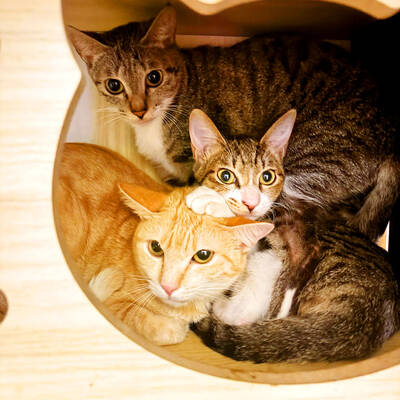
The number of pet cats in Taiwan surpassed that of pet dogs for the first time last year, reaching 1,742,033, a 32.8 percent increase from 2023, the Ministry of Agriculture said yesterday, citing a survey. By contrast, the number of pet dogs declined slightly by 1.2 percent over the same period to 1,462,528, the ministry said. Despite the shift, households with dogs still slightly outnumber those with cats by 1.2 percent. However, while the number of households with multiple dogs has remained relatively stable, households keeping more than two cats have increased, contributing to the overall rise in the feline population. The trend

China on Wednesday teased in a video an aircraft carrier that could be its fourth, and the first using nuclear power, while making an allusion to Taiwan and vowing to further build up its islands, as it looks to boost maritime power, secure resources and bolster territorial claims. The video, issued on the eve of the 77th founding anniversary of the Chinese People’s Liberation Army Navy, featured fictional officers with names that are homophones of three commissioned aircraft carriers, the Liaoning (遼寧), Shandong (山東) and Fujian (福建). Titled Into the Deep, it showed a 19-year-old named “Hejian” (何劍) joining the group, sparking
BIG YEAR: The company said it would also release its A12 chip the same year to keep a ‘reliable stream of new silicon technologies’ flowing to its customers Taiwan Semiconductor Manufacturing Co (TSMC, 台積電) yesterday said its newest A13 chip is to enter volume production in 2029 as the chipmaker seeks to hold onto its tech leadership and demand for next-generation chips used in artificial intelligence (AI), high-performance-computing (HPC) and mobile applications. TSMC, the world’s biggest contract chipmaker, also unveiled its A12 chip at its annual technology symposium in Santa Clara, California. The A12 chip, which features TSMC’s super-power-rail technology to provide backside power delivery for AI and HPC applications, is also to enter volume production in 2029, a year after the scheduled release of the A14 chip. The technology moves


 RSS
RSS