


The Presidential Office and Chinese Nationalist Party (KMT) yesterday welcomed their new secretaries-general as former Presidential Office secretary-general Liao Liou-yi (廖了以) took up his new post in the KMT and was replaced by former Examination Yuan vice president Wu Jin-lin (伍錦霖).
Vice President Vincent Siew (蕭萬長), who presided over the handover ceremony at the Presidential Office in the morning, described Liao as a man who paid attention to detail.
Citing the example of an oil painting in the Rainbow Room, where the ceremony was held, Siew said the only reason it was on display again was because of Liao.
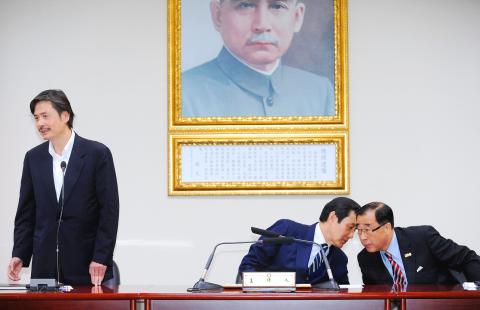
Photo: Chang Chia-ming, Taipei Times
Shortly after Liao assumed the Presidential Office post last September, he became curious about a painting stored in the presidential warehouse in Sansia (三峽), New Taipei City (新北市). After discovering the damaged painting was a national treasure, Liao asked the National Taiwan Museum of Fine Arts to restore it and it was unveiled on Jan. 24. The painting had been a gift from an art association for then-president Chiang Kai-shek (蔣介石) in 1960 to celebrate his third inauguration as president of the Republic of China.
Yesterday afternoon, President Ma Ying-jeou (馬英九) presented Liao with the Order of the Brilliant Star, first class, for his contributions to the country.
Siew praised Wu’s extensive political experience and management skills, adding that he had read a newspaper report that described Wu as someone “who does not make trouble.”
“I think he is someone who resolves trouble,” Siew said. “Wherever he is, the problems will be resolved.”
Wu said he hoped to work with the presidential staff under the principles of honesty, loyalty, efficiency and professionalism.
KMT secretary-general King Pu-tsung (金溥聰), who handed over his seal to Liao at KMT headquarters in the morning, said he was like a basketball player taking a break at the third quarter, who would return to play whenever the opportunity arose.
King also likened the KMT post to a relay race, saying he had done his best durng his stint and now it was Liao’s turn to carry the baton.
King resigned after leading the KMT to victory in last November’s special municipality elections. The KMT retained three mayoral seats, but lost the popular vote to the Democratic Progressive Party, which held onto two of the cities.
Liao vowed to commit himself to party reform, saying only through reform could the KMT have a “rebirth from fire.” He called for unity and sacrifice for the party when necessary.
Liao drew some laughs when he said King had called him yesterday morning and he thought King was going to tell him not to bother showing up at KMT headquarters to take over the new job.
Ma, who doubles as KMT chairman, said he hoped King and Liao would continue to dedicate themselves to serving the people and the party.
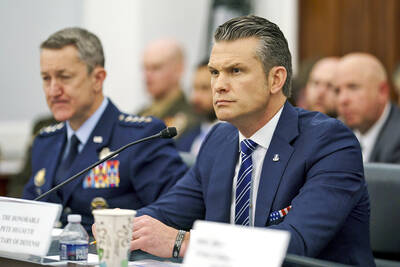
BUILDUP: US General Dan Caine said Chinese military maneuvers are not routine exercises, but instead are ‘rehearsals for a forced unification’ with Taiwan China poses an increasingly aggressive threat to the US and deterring Beijing is the Pentagon’s top regional priority amid its rapid military buildup and invasion drills near Taiwan, US Secretary of Defense Pete Hegseth said on Tuesday. “Our pacing threat is communist China,” Hegseth told the US House of Representatives Appropriations Subcommittee on Defense during an oversight hearing with US General Dan Caine, chairman of the Joint Chiefs of Staff. “Beijing is preparing for war in the Indo-Pacific as part of its broader strategy to dominate that region and then the world,” Hegseth said, adding that if it succeeds, it could derail

CHIP WAR: The new restrictions are expected to cut off China’s access to Taiwan’s technologies, materials and equipment essential to building AI semiconductors Taiwan has blacklisted Huawei Technologies Co (華為) and Semiconductor Manufacturing International Corp (SMIC, 中芯), dealing another major blow to the two companies spearheading China’s efforts to develop cutting-edge artificial intelligence (AI) chip technologies. The Ministry of Economic Affairs’ International Trade Administration has included Huawei, SMIC and several of their subsidiaries in an update of its so-called strategic high-tech commodities entity list, the latest version on its Web site showed on Saturday. It did not publicly announce the change. Other entities on the list include organizations such as the Taliban and al-Qaeda, as well as companies in China, Iran and elsewhere. Local companies need
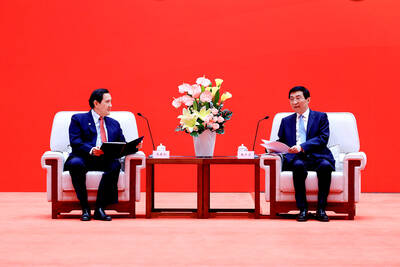
CRITICISM: It is generally accepted that the Straits Forum is a CCP ‘united front’ platform, and anyone attending should maintain Taiwan’s dignity, the council said The Mainland Affairs Council (MAC) yesterday said it deeply regrets that former president Ma Ying-jeou (馬英九) echoed the Chinese Communist Party’s (CCP) “one China” principle and “united front” tactics by telling the Straits Forum that Taiwanese yearn for both sides of the Taiwan Strait to move toward “peace” and “integration.” The 17th annual Straits Forum yesterday opened in Xiamen, China, and while the Chinese Nationalist Party’s (KMT) local government heads were absent for the first time in 17 years, Ma attended the forum as “former KMT chairperson” and met with Chinese People’s Political Consultative Conference Chairman Wang Huning (王滬寧). Wang
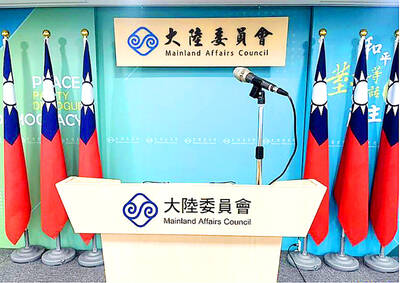
CROSS-STRAIT: The MAC said it barred the Chinese officials from attending an event, because they failed to provide guarantees that Taiwan would be treated with respect The Mainland Affairs Council (MAC) on Friday night defended its decision to bar Chinese officials and tourism representatives from attending a tourism event in Taipei next month, citing the unsafe conditions for Taiwanese in China. The Taipei International Summer Travel Expo, organized by the Taiwan Tourism Exchange Association, is to run from July 18 to 21. China’s Taiwan Affairs Office spokeswoman Zhu Fenglian (朱鳳蓮) on Friday said that representatives from China’s travel industry were excluded from the expo. The Democratic Progressive Party government is obstructing cross-strait tourism exchange in a vain attempt to ignore the mainstream support for peaceful development


 RSS
RSS