


Minister of National Defense Kao Hua-chu (高華柱) yesterday assured lawmakers across party lines that the military would be able to track Chinese missiles or satellite rockets in motion after the nation’s NT$30 billion (US$967.4 million) long-range early warning radar system is completed.
Kao made the remarks in response to questioning from Chinese Nationalist Party (KMT) Legislator Liao Wan-ju (廖婉汝) on whether the Ministry of National Defense (MND) has the capability to monitor the trajectory of China’s missiles or satellite rockets.
Liao, head of the legislature’s Foreign and National Defense Committee, raised her concerns after the Chinese-language Liberty Times (the Taipei Times’ sister paper) yesterday quoted National Space Organization Systems Engineering Director Chen Yen-sen (陳彥升) as saying that a fireball in the sky over eastern Taiwan about 7pm on Oct. 1 was the discarded second-stage rocket of China’s Chang’e 2 satellite.
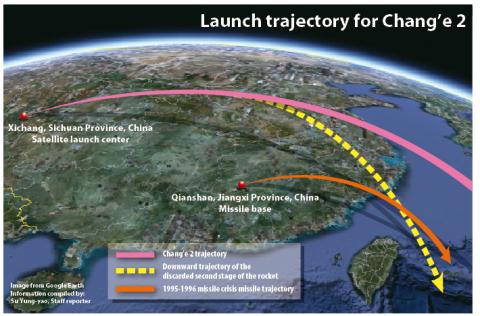
Chen was quoted as saying that the trajectory of the rocket was similar to that of China’s missiles falling off the east coast during the Taiwan Strait Crisis between July 1995 and March 1996.
Kao said the rocket and the missiles had different heights and trajectories, adding that the National Science Council had dismissed Chen’s speculation as his personal opinion rather than an official statement by the council.
In another question-and-answer session, Democratic Progressive Party (DPP) Legislator Lee Chun-yee (李俊毅) also grilled defense officials over the matter.
Lee accused the ministry of refusing to make public that a Chinese rocket flew dangerously close to a location where China once lobbed rockets near Taiwan.
Lee pressed Kao by questioning whether the ministry had protested to Beijing for allowing the rocket to fly over Taiwanese airspace.
“If not, does this mean that Taiwan’s satellites or missile tests can fly over China’s airspace?” Lee asked.
Kao did not answer, but told Lee that he would tell him in private after the open session.
Kao’s response, however, prompted further criticism from Lee, who called the defense minister “irresponsible.”
At a separate setting, ministry officials said that given that the trajectory of China’s satellite Chang’e 2 was hundreds of kilometers above the earth, it generally does not consider it an intrusion of airspace.
The ministry said it therefore dismissed the launch of Chang’e 2 as a concern for Taiwan’s national security or as an intrusion of the nation’s airspace.
ADDITIONAL REPORTING BY HSU SHAO-HSUAN AND VINCENT Y. CHAO
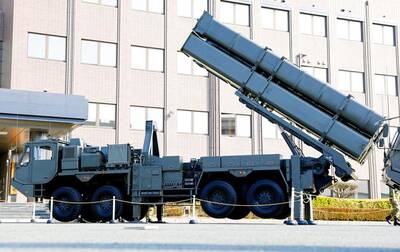
Japan has deployed long-range missiles in a southwestern region near China, the Japanese defense minister said yesterday, at a time when ties with Beijing are at their lowest in recent years. The missiles were installed in Kumamoto in the southern region of Kyushu, as Japan is attempting to shore up its military capacity as China steps up naval activity in the East China Sea. “Standoff defense capabilities enable us to counter the threat of enemy forces attempting to invade our country ... while ensuring the safety of our personnel,” Japanese Minister of Defense Shinjiro Koizumi said. “This is an extremely important initiative for

Chinese Nationalist Party (KMT) Chairwoman Cheng Li-wun (鄭麗文) today accepted an invitation from Chinese President Xi Jinping (習近平) to lead a delegation to China next month, saying she hopes to promote the peaceful development of cross-strait relations and bring stability to the Taiwan Strait. “I am grateful and happy to accept this invitation,” Cheng said in a statement from the KMT chairperson’s office. Cheng said she hopes both sides can work together to promote the peaceful development of cross-strait relations, enhance exchange and cooperation, bring stability to the Taiwan Strait and improve people’s livelihoods. At today's news conference, Cheng said any efforts to
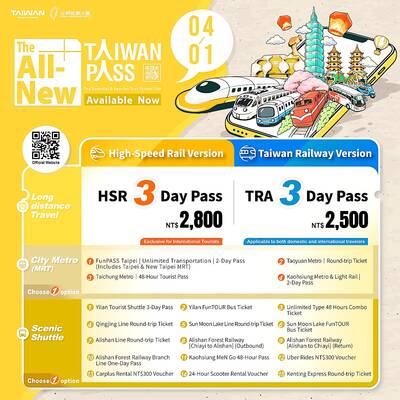
MORE POPULAR: Taiwan Pass sales increased by 59 percent during the first quarter compared with the same period last year, the Tourism Administration said The Tourism Administration yesterday said that it has streamlined the Taiwan Pass, with two versions available for purchase beginning today. The tourism agency has made the pass available to international tourists since 2024, allowing them to access the high-speed rail, Taiwan Railway Corp services, four MRT systems and four Taiwan Tourist Shuttles. Previously, five types of Taiwan Pass were available, but some tourists have said that the offerings were too complicated. The agency said only two types of Taiwan Pass would be available, starting from a three-day pass with the high-speed rail and a three-day pass with Taiwan Railway Corp. The former costs NT$2,800

The nation’s fastest supercomputer, Nano 4 (晶創26), is scheduled to be launched in the third quarter, and would be used to train large language models in finance and national defense sectors, the National Center for High-Performance Computing (NCHC) said. The supercomputer, which would operate at about 86.05 petaflops, is being tested at a new cloud computing center in the Southern Taiwan Science Park in Tainan. The exterior of the server cabinet features chip circuitry patterns overlaid with a map of Taiwan, highlighting the nation’s central position in the semiconductor industry. The center also houses Taiwania 2, Taiwania 3, Forerunner 1 and


 RSS
RSS