


US Secretary of State Hillary Rodham Clinton opened direct Middle East peace talks in Washington yesterday, saying the presence of the two sides was itself a step toward peace.
“By being here today, you each have taken an important step toward freeing your peoples from the shackles of a history we cannot change and moving toward a future of peace and dignity that only you can create,” Clinton said at the start of talks between Israeli Prime Minister Benjamin Netanyahu and Palestinian President Mahmoud Abbas at the State Department.
Meanwhile, Israeli and Palestinian forces scoured the occupied West Bank for gunmen in the second attack claimed by Hamas, a staunch opponent of the negotiations, in as many days.
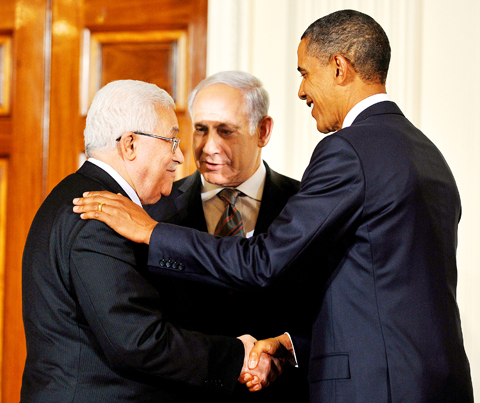
PHOTO: AFP
An Israeli military official hailed the cooperation with the Palestinian security forces, which he said was at its highest level since the 1993 Oslo accords launched the Middle East peace process.
Despite the flare-up of violence, US President Barack Obama on Wednesday called on both sides not to let slip a fleeting opportunity for peace, a Palestinian state and a secure Israel within a year, as he gathered the two leaders with King Abdullah II of Jordan and Egyptian President Hosni Mubarak at the White House.
“This moment of opportunity may not soon come again,” said Obama, who met the leaders separately on Wednesday, and then hosted a dinner that also included Clinton and diplomatic Quartet representative and former British prime minister Tony Blair.
The normally hawkish Netanyahu vowed to forge a “historic” peace with the Palestinians and Abbas responded by calling for an end to bloodshed after the latest Hamas attacks, but also demanded a halt to Israel settlement activity.
“President Abbas, you are my partner in peace,” Netanyahu said during a press appearance in the East Room of the White House on Wednesday. “I came here today to find an historic compromise that will enable both our peoples to live in peace and security and dignity.”
Netanyahu vowed to obtain security assurances, warning “terrorists” would not block the path to peace.
“We left Lebanon, we got terror. We left Gaza, we got terror. We want to ensure that territory we concede will not be turned into a third Iranian-sponsored terror enclave aimed at the heart of Israel,” he said.
Turning to Netanyahu, Abbas condemned Tuesday’s attack that killed four Israelis and Wednesday’s strike in which two more were injured.
“We do not want at all that any blood be shed ... one drop of blood on the part of Israelis and Palestinians,” he said.
The Palestinian leader also demanded a total freeze on settlement activity.
“We are under no illusions. Passions run deep. Each side has legitimate and enduring interests. Years of mistrust will not disappear overnight,” Obama said.
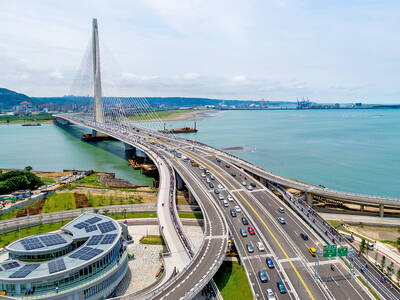
The Ministry of Transportation and Communications yesterday inaugurated the Danjiang Bridge across the Tamsui River in New Taipei City, saying that the structure would be an architectural icon and traffic artery for Taiwan. Feted as a major engineering achievement, the Danjiang Bridge is 920m long, 211m tall at the top of its pylon, and is the longest single-pylon asymmetric cable-stayed bridge in the world, the government’s Web site for the structure said. It was designed by late Iraqi-British architect Zaha Hadid. The structure, with a maximum deck of 70m, accommodates road and light rail traffic, and affords a 200m navigation channel for boats,
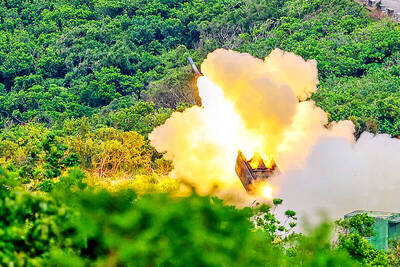
PRECISION STRIKES: The most significant reason to deploy HIMARS to outlying islands is to establish a ‘dead zone’ that the PLA would not dare enter, a source said A High Mobility Artillery Rocket System (HIMARS) would be deployed to Penghu County and Dongyin Island (東引) in Lienchiang County (Matsu) to force the Chinese military to retreat at least 100km from the coastline, a military source said yesterday. Taiwan has been procuring HIMARS and Army Tactical Missile Systems (ATACMS) from the US in batches. Once all batches have been delivered, Taiwan would possess 111 HIMARS units and 504 ATACMS, which have a range of 300km. Considering that “offense is the best defense,” the military plans to forward-deploy the systems to outlying islands such as Penghu and Dongyin so that

WHAT WAS ALL THAT FOR? Jaw Shaw-kong said that Cheng Li-wen had pushed for more drastic cuts and attacked him, just for the outcome to be nearly identical to his bill The legislature yesterday passed a supplementary budget bill to fund the purchase of separate packages of US military equipment, with the combined amount of spending capped at NT$780 billion (US$24.8 billion). The Chinese Nationalist Party (KMT) and Taiwan People’s Party (TPP) used their legislative majority to pass the bill, which runs until 2033 and has two main funding provisions. One was for NT$300 billion of arms sales already approved by the US for Taiwan on Dec. 17 last year, the other was for NT$480 billion for another arms package expected to be announced by Washington. The bill, which fell short of the NT$1.25

‘CLEAR MESSAGE’: The bill would set up an interagency ‘tiger team’ to review sanctions tools and other economic options to help deter any Chinese aggression toward Taiwan US Representative Young Kim has introduced a bill to deter Chinese aggression against Taiwan, calling for an interagency “tiger team” to preplan coordinated sanctions and economic measures in response to possible Chinese military or political action against Taiwan. “[Chinese President] Xi Jinping [習近平] has directed the People’s Liberation Army to be ready to invade Taiwan by 2027. China has a plan. America should have one too,” Kim said in a news release on Thursday last week. She introduced the “Deter PRC [People’s Republic of China] aggression against Taiwan act” to “ensure the US has a coordinated sanctions strategy ready should


 RSS
RSS