


Authorities in China’s southern city of Guangzhou will punish people who try and organise any more protests in support of the Cantonese language, a state-run newspaper said yesterday.
Several hundred people took to Guangzhou’s streets on Sunday to demand the government halt efforts to push aside Cantonese.
The protest was prompted by plans to switch most programming on Guangzhou television stations to the country’s official language, Mandarin, feeding fears that the central government wants to phase out Cantonese in official settings.
The China Daily quoted local government official Ouyang Yongsheng as telling a news conference that those who “spread rumors” about Cantonese or organize “illegal rallies” would be punished.
The newspaper quoted unnamed police sources as saying they had detained a person surnamed Yu who “spread the rumor online to call people to attend a rally in support of Cantonese.”
Police broke up the peaceful protest, saying it was illegal.
Ouyang said that Guangzhou would in fact work harder to promote Cantonese and not seek to marginalize it.
“The city government will continue to spare no effort to promote ... Cantonese opera and Cantonese pop music in the coming years,” he was quoted as saying.
The China Daily said that Guangzhou television had promised to continue broadcasting Cantonese shows.
Beijing has promoted Mandarin for decades to unite a nation with numerous languages.
Cantonese is still widely spoken in the booming southern province of Guangdong, thanks in part to the spillover influence of Hong Kong’s wildly successful and racy vernacular pop culture, but some people fear for its future.
An influx of outsiders seeking work in China’s coastal export hubs has added to the onslaught on local languages.

DEFENDING DEMOCRACY: Taiwan shares the same values as those that fought in WWII, and nations must unite to halt the expansion of a new authoritarian bloc, Lai said The government yesterday held a commemoration ceremony for Victory in Europe (V-E) Day, joining the rest of the world for the first time to mark the anniversary of the end of World War II in Europe. Taiwan honoring V-E Day signifies “our growing connections with the international community,” President William Lai (賴清德) said at a reception in Taipei on the 80th anniversary of V-E Day. One of the major lessons of World War II is that “authoritarianism and aggression lead only to slaughter, tragedy and greater inequality,” Lai said. Even more importantly, the war also taught people that “those who cherish peace cannot
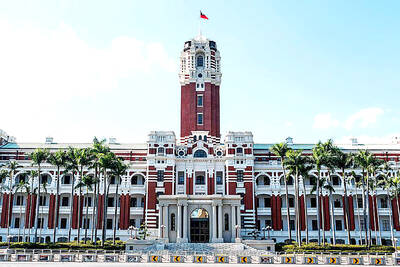
STEADFAST FRIEND: The bills encourage increased Taiwan-US engagement and address China’s distortion of UN Resolution 2758 to isolate Taiwan internationally The Presidential Office yesterday thanked the US House of Representatives for unanimously passing two Taiwan-related bills highlighting its solid support for Taiwan’s democracy and global participation, and for deepening bilateral relations. One of the bills, the Taiwan Assurance Implementation Act, requires the US Department of State to periodically review its guidelines for engagement with Taiwan, and report to the US Congress on the guidelines and plans to lift self-imposed limitations on US-Taiwan engagement. The other bill is the Taiwan International Solidarity Act, which clarifies that UN Resolution 2758 does not address the issue of the representation of Taiwan or its people in

Taiwanese Olympic badminton men’s doubles gold medalist Wang Chi-lin (王齊麟) and his new partner, Chiu Hsiang-chieh (邱相榤), clinched the men’s doubles title at the Yonex Taipei Open yesterday, becoming the second Taiwanese team to win a title in the tournament. Ranked 19th in the world, the Taiwanese duo defeated Kang Min-hyuk and Ki Dong-ju of South Korea 21-18, 21-15 in a pulsating 43-minute final to clinch their first doubles title after teaming up last year. Wang, the men’s doubles gold medalist at the 2020 and 2024 Olympics, partnered with Chiu in August last year after the retirement of his teammate Lee Yang
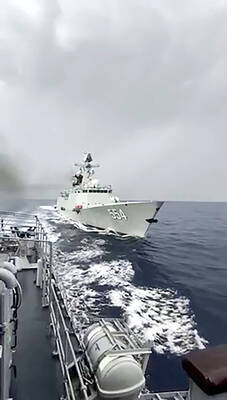
The Philippines yesterday criticized a “high-risk” maneuver by a Chinese vessel near the disputed Scarborough Shoal (Huangyan Island, 黃岩島) in a rare incident involving warships from the two navies. The Scarborough Shoal — a triangular chain of reefs and rocks in the contested South China Sea — has been a flash point between the countries since China seized it from the Philippines in 2012. Taiwan also claims the shoal. Monday’s encounter took place approximately 11.8 nautical miles (22km) southeast” of the Scarborough Shoal, the Philippine military said, during ongoing US-Philippine military exercises that Beijing has criticized as destabilizing. “The Chinese frigate BN 554 was


 RSS
RSS