


Four people on death row were executed yesterday evening, the Ministry of Justice announced last night.
The ministry made the announcement after the four people were shot with pistols at 7:30pm at four different prisons.
The four had been given death sentences and were executed in accordance with the law, the ministry said.
The four were Chang Wen-wei (張文蔚), Ko Shih-ming (柯世銘), Chang Wei-long (張慰龍) and Hong Chen-yao (洪晨耀).
Chang Wen-wei was given a death sentence for the kidnapping and murder of a 16-year-old in Taichung County. He committed the crime while he was out on parole.
Ko had been handed two death sentences for killing a man in a business dispute in Tainan County, as well as a woman who witnessed the murder.
Chang Wei-long kidnapped his friend’s seven-year-old daughter in Taoyuan County and murdered her after he was paid a ransom.
Hong was found guilty of murdering three people over debt disputes in Hsinchu County. He told police he killed them because he was upset.
Until yesterday’s executions, the Ministry of Justice had not approved an execution since December 2005.
Saying that Taiwan is a country of law and order where all procedures are conducted in accordance with the law, Presidential Office Spokesman Lo Chih-chiang (羅智強) last night said there must be a legal base for a stay of execution, otherwise the Ministry of Justice should proceed according to the law.
More discussion is needed before the public reaches a consensus on whether the death penalty should be abolished, he said.
The issue of abolishing the death penalty came to the fore in March when then-minister of justice Wang Ching-feng (王清峰) openly stated her objections to capital punishment and said she would not approve any executions as minister. Her statements led to public criticism, especially by victims’ families and opposition legislators and Wang later resigned.
New Justice Minister Tseng Yung-fu (曾勇夫) has said he would approve the executions of prisoners on death row if they have exhausted the appeals process.
In view of the controversial issue, the ministry recently held hearings to gather the public’s opinions on the matter.
At a hearing held in Banciao (板橋), Taipei County, on April 21, Tseng said the ministry would review the cases of all 44 inmates now on death row, and exhaust all relief measures before carrying out any executions.
“Carrying out the death sentences will not drag to the end of this year,” Tseng said at the time.

South Korea has adjusted its electronic arrival card system to no longer list Taiwan as a part of China, a move that the Ministry of Foreign Affairs said would help facilitate exchanges between the two sides. South Korea previously listed “Taiwan” as “Taiwan (China)” in the drop-down menus of its online arrival card system, where people had to fill out where they came from and their next destination. The ministry had requested South Korea make a revision and said it would change South Korea’s name on Taiwan’s online immigration system from “Republic of Korea” to “Korea (South),” should the issue not be

Tainan, Taipei and New Taipei City recorded the highest fines nationwide for illegal accommodations in the first quarter of this year, with fines issued in the three cities each exceeding NT$7 million (US$220,639), Tourism Administration data showed. Among them, Taipei had the highest number of illegal short-term rental units, with 410. There were 3,280 legally registered hotels nationwide in the first quarter, down by 14 properties, or 0.43 percent, from a year earlier, likely indicating operators exiting the market, the agency said. However, the number of unregistered properties rose to 1,174, including 314 illegal hotels and 860 illegal short-term rental
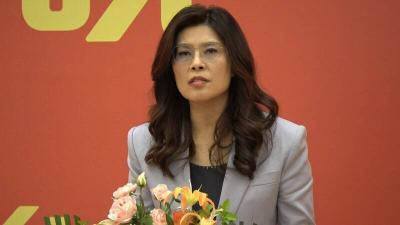
Both sides of the Taiwan Strait share a political foundation based on the “1992 consensus” and opposition to Taiwanese independence, Chinese Nationalist Party (KMT) Chairwoman Cheng Li-wun (鄭麗文) today said during her meeting with Chinese President Xi Jinping (習近平). Both sides of the Strait should plan and build institutionalized and sustainable mechanisms for dialogue and cooperation based on that foundation to make peaceful development across the Strait irreversible, she said. Peace is a shared moral value across the Strait, and both sides should move beyond political confrontation to seek institutionalized solutions to prevent war, she said. Mutually beneficial cross-strait relations are what the

ECONOMIC COERCION: Such actions are often inconsistently applied, sometimes resumed, and sometimes just halted, the Presidential Office spokeswoman said The government backs healthy and orderly cross-strait exchanges, but such arrangements should not be made with political conditions attached and never be used as leverage for political maneuvering or partisan agendas, Presidential Office spokeswoman Karen Kuo (郭雅慧) said yesterday. Kuo made the remarks after China earlier in the day announced 10 new “incentive measures” for Taiwan, following a landmark meeting between Chinese President Xi Jinping (習近平) and Chinese Nationalist Party (KMT) Chairwoman Cheng Li-wun (鄭麗文) in Beijing on Friday. The measures, unveiled by China’s Xinhua news agency, include plans to resume individual travel by residents of Shanghai and China’s Fujian


 RSS
RSS