


President Ma Ying-jeou (馬英九) arrived in San Francisco on Monday evening for a stopover en route to Honduras for an official visit.
Pan-blue supporters mobilized hundreds of Chinese Nationalist Party (KMT) members in the US to welcome Ma. As it was raining, Ma met the group inside the hotel where he was staying.
The president shook hands with members of the group, but did not make any comment.
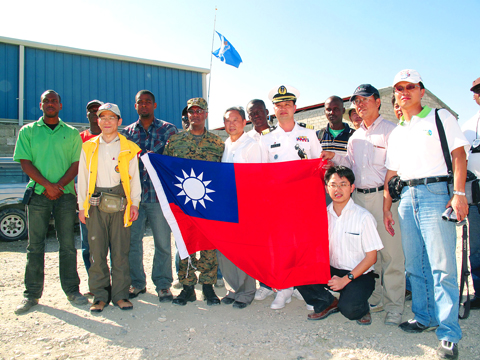
PHOTO: CNA
Unlike Ma’s two previous stopovers in San Francisco, pan-green supporters did not stage a protest outside the hotel.
Edward Hsin (辛義德), chairman of the California chapter of the Taiwanese Association of America, said since Ma’s popularity has dropped to 23 percent and his political influence has dwindled, they did not want to stage a protest and raise his media exposure.
Instead, they placed advertisements in Chinese-language newspapers to express their opposition to the KMT government’s China-leaning policies and its plan to sign an economic cooperation framework agreement (ECFA) with Beijing.
Ma also met Democratic Representative David Wu (吳振偉) at his hotel on Monday night.
Wu expressed the hope that Taiwan would obtain F-16C/D fighter jets from Washington.
Ma was expected to talk to more US lawmakers by telephone yesterday morning and take lunch with members of the Committee of 100, a group of prominent Chinese Americans, as well as have some free time in the afternoon. He was to have dinner with overseas Taiwanese.
Ma is also widely believed to be planning a visit to the Hoover Institution at Stanford University, which would be his first public activity on US soil.
Ma was greeted in San Francisco by American Institute in Taiwan Chairman Raymond Burghardt, who apologized for the rainy weather, but said he was very glad to see Ma.
When Burghardt welcomed Ma in August 2008 in Los Angeles, Burghardt likened Taiwan-US relations to the weather. Burghardt told Ma that when he welcomed then-president Chen Shui-bian (陳水扁), it was in Alaska in January. He was glad to welcome Ma in Los Angeles’ 27ºC weather.
Ma and his delegation were to leave for Honduras last night.
During the flight to the US, Ma said he had a telephone conversation with Haitian President Rene Preval on Friday and hoped to see Preval during his trip to the Dominican Republic tomorrow.
Ma told reporters that he realized Preval was preoccupied with relief efforts in his country and that it would be up to Preval to decide whether he has time to meet.
If they were to meet in the Dominican Republic, Ma said he would like to discuss how Taiwan could help Haiti with the relief effort.
The main purpose of Ma’s trip is to attend the inauguration of Honduran president-elect Porfirio Lobo Sosa today.
A trip to the Dominican Republic tomorrow was added at the last minute so the president can deliver relief supplies to quake-hit Haiti and extend Taiwan’s support for victims of the quake.
Ma said he planned to meet Dominican President Leonel Fernandez Reyna to discuss assistance for Haiti.
Ma will not visit Ambassador to Haiti Hsu Mien-sheng (徐勉生), because he has been transferred to a hospital in Miami, Florida.
Hsu sustained head injuries, facial lacerations, a broken rib and some chest and back injuries during the Haitian earthquake.
Consul to Haiti Chi Wang-teh (齊王德) has also checked out of the hospital in the Dominican Republic’s capital, Santo Domingo.
Hsu and Chi were sent to Santo Domingo to receive medical attention after being pulled out from debris in Haiti’s capital, Port-au-Prince.
They had been trapped for six hours before rescuers found them.
As rescue operations in Haiti draw to a close, the president said reconstruction and relocation projects will ensue, which he said could take five to 10 years or even longer.
As a diplomatic ally and member of the global community, Ma said Taiwan was duty-bound to assist Haiti to get back on its feet, adding that the country has a lot to offer after Typhoon Morakot lashed central and southern Taiwan last August, killing hundreds.
“This is just the beginning,” the president said.
“We are glad to offer a helping hand to any country in need, especially our diplomatic ally,” he said.
Ma’s presidential jet is carrying 10 tonnes of relief goods, including medical supplies, milk powder, cookies and canned corn.
They will be transported by land from the Dominican Republic to Haiti on arrival, Ma said.
Ma lauded the country’s rescue teams in Haiti, which he said has attracted international attention for their outstanding performance.
“I kept saying over the past year that we don’t want to conduct ‘dollar diplomacy’ any more,” he said. “Let’s use our soft power, trade, culture, humanitarian assistance and human rights to make friends.”
Ma said his trip consists of two themes: celebration (attending Lobo’s inauguration) and humanity (delivering aid goods).
During his stay in Honduras, Ma said he hoped he could pick up where he left off last June.
Ma had planned to visit Honduras during a visit to the region last year but canceled at the last minute because of escalating tensions there, which he described yesterday as “a surprising political dispute.”
Ma said the Ministry of Foreign Affairs was cautious in responding to the Honduran crisis at first but later joined the international community in condemning the coup.
The interim government encountered many difficulties at the beginning, but Taiwan had stood by it all along, he said.
Ma said he was happy to see a new government elected in November, helping the country return to the path to democracy.
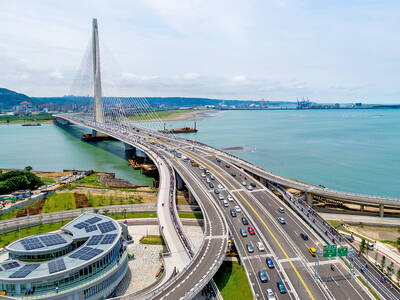
The Ministry of Transportation and Communications yesterday inaugurated the Danjiang Bridge across the Tamsui River in New Taipei City, saying that the structure would be an architectural icon and traffic artery for Taiwan. Feted as a major engineering achievement, the Danjiang Bridge is 920m long, 211m tall at the top of its pylon, and is the longest single-pylon asymmetric cable-stayed bridge in the world, the government’s Web site for the structure said. It was designed by late Iraqi-British architect Zaha Hadid. The structure, with a maximum deck of 70m, accommodates road and light rail traffic, and affords a 200m navigation channel for boats,
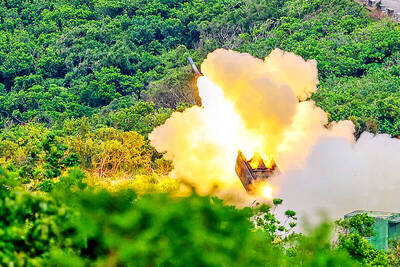
PRECISION STRIKES: The most significant reason to deploy HIMARS to outlying islands is to establish a ‘dead zone’ that the PLA would not dare enter, a source said A High Mobility Artillery Rocket System (HIMARS) would be deployed to Penghu County and Dongyin Island (東引) in Lienchiang County (Matsu) to force the Chinese military to retreat at least 100km from the coastline, a military source said yesterday. Taiwan has been procuring HIMARS and Army Tactical Missile Systems (ATACMS) from the US in batches. Once all batches have been delivered, Taiwan would possess 111 HIMARS units and 504 ATACMS, which have a range of 300km. Considering that “offense is the best defense,” the military plans to forward-deploy the systems to outlying islands such as Penghu and Dongyin so that

Taiwan Semiconductor Manufacturing Co (TSMC, 台積電), the world’s largest foundry service provider, yesterday said that global semiconductor revenue is projected to hit US$1.5 trillion in 2030, after the figure exceeds US$1 trillion this year, as artificial intelligence (AI) demand boosts consumption of token and compute power. “We are still at the beginning of the AI revolution, but we already see a significant impact across the whole semiconductor ecosystem,” TSMC deputy cochief operating officer Kevin Zhang (張曉強) said at the company’s annual technology symposium in Hsinchu City. “It is fair to say that in the past decade, smartphones and other mobile devices were
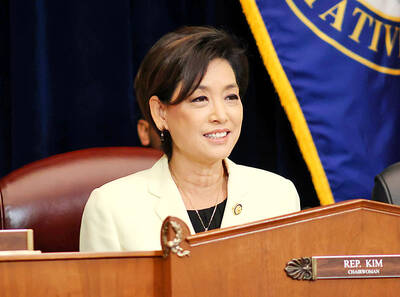
‘CLEAR MESSAGE’: The bill would set up an interagency ‘tiger team’ to review sanctions tools and other economic options to help deter any Chinese aggression toward Taiwan US Representative Young Kim has introduced a bill to deter Chinese aggression against Taiwan, calling for an interagency “tiger team” to preplan coordinated sanctions and economic measures in response to possible Chinese military or political action against Taiwan. “[Chinese President] Xi Jinping [習近平] has directed the People’s Liberation Army to be ready to invade Taiwan by 2027. China has a plan. America should have one too,” Kim said in a news release on Thursday last week. She introduced the “Deter PRC [People’s Republic of China] aggression against Taiwan act” to “ensure the US has a coordinated sanctions strategy ready should


 RSS
RSS