


A recent reshuffle of personnel at the Chinese-language China Times has sparked speculation of political interference after a headline story published last month was rumored to have upset the Chinese government.
The newspaper announced on Saturday that its editor-in-chief, Hsia Chen (夏珍), would take over as president of China Times Weekly magazine, while the magazine’s president, Wang Mei-yu (王美玉), is to become the new China Times editor-in-chief.
Speculation emerged that the shift was made because a report upset Beijing. A headline story published in the China Times last month quoted a Straits Exchange Foundation (SEF) official as calling China’s Association for Relations Across the Taiwan Strait Chairman Chen Yunlin (陳雲林) a “C-list” politician.
Want Want China Times Group chairman Tsai Eng-meng (蔡衍明) reportedly ordered the personnel shift to appease China.
In the report published on Dec. 26, the China Times quoted an anonymous SEF official as saying that describing heavyweights from the pan-blue political camp as eager to meet Chen was like “A-listers” fighting to meet a “C-lister.”
Both Hsia and Wang declined to comment.
Instead of denying the report, however, Hsia said in an e-mail to China Times employees that it would be “very difficult to comment” on the rumors. In the e-mail, she also urged employees not to believe or spread rumors from inside or outside the newspaper.
When asked for comment, Chen Shun-shaw (陳順孝), a journalism professor at Fujen Catholic University, said that while it was difficult to prove if the personnel shift was triggered by the headline story, it was clear that China’s impact on media outlets in Taiwan is growing.
Chen said more Taiwanese media outlets were trying to avoid reporting on sensitive issues related to China, such as material involving the Falun Gong.
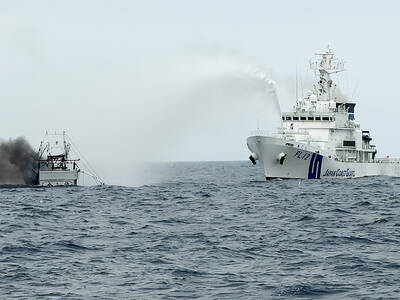
CREDIT-GRABBER: China said its coast guard rescued the crew of a fishing vessel that caught fire, who were actually rescued by a nearby Taiwanese boat and the CGA Maritime search and rescue operations do not have borders, and China should not use a shipwreck to infringe upon Taiwanese sovereignty, the Coast Guard Administration (CGA) said yesterday. The coast guard made the statement in response to the China Coast Guard (CCG) saying it saved a Taiwanese fishing boat. The Chuan Yu No. 6 (全漁6號), a fishing vessel registered in Keelung, on Thursday caught fire and sank in waters northeast of Diaoyutai Islands (釣魚台). The vessel left Keelung’s Badouzih Fishing Harbor (八斗子漁港) at 3:35pm on Sunday last week, with seven people on board — a 62-year-old Taiwanese captain surnamed Chang (張) and six

The Legislative Yuan’s Finance Committee yesterday approved proposed amendments to the Amusement Tax Act (娛樂稅法) that would abolish taxes on films, cultural activities and competitive sporting events, retaining the fee only for dance halls and golf courses. The proposed changes would set the maximum tax rate for dance halls and golf courses at 50 and 20 percent respectively, with local governments authorized to suspend the levies. Article 2 of the act says that “amusement tax shall be levied on tickets sold or fees charged by amusement places, facilities or activities” in six categories: “Cinema; professional singing, story-telling, dancing, circus, magic show, acrobatics

RISKY BUSINESS: The ‘incentives’ include initiatives that get suspended for no reason, creating uncertainty and resulting in considerable losses for Taiwanese, the MAC said China’s “incentives” failed to sway sentiment in Taiwan, as willingness to work in China hit a record low of 1.6 percent, a Ministry of Labor survey showed. The Directorate-General of Budget, Accounting and Statistics (DGBAS) also reported that the number of Taiwanese workers in China has nearly halved from a peak of 430,000 in 2012 to an estimated 231,000 in 2024. That marked a new low in the proportion of Taiwanese going abroad to work. The ministry’s annual survey on “Labor Life and Employment Status” includes questions respondents’ willingness to seek employment overseas. Willingness to work in China has steadily declined from

Tainan, Taipei and New Taipei City recorded the highest fines nationwide for illegal accommodations in the first quarter of this year, with fines issued in the three cities each exceeding NT$7 million (US$220,639), Tourism Administration data showed. Among them, Taipei had the highest number of illegal short-term rental units, with 410. There were 3,280 legally registered hotels nationwide in the first quarter, down by 14 properties, or 0.43 percent, from a year earlier, likely indicating operators exiting the market, the agency said. However, the number of unregistered properties rose to 1,174, including 314 illegal hotels and 860 illegal short-term rental


 RSS
RSS