


Nepal’s top politicians strapped on oxygen tanks yesterday and held a Cabinet meeting in the frigid, thin air of Mount Everest to highlight the danger global warming poses to glaciers ahead of next week’s international climate change talks.
The government billed the stunt as the world’s highest Cabinet meeting. The ministers posed for pictures and signed a commitment to tighten environmental regulations and expand the nation’s protected areas.
“The Everest declaration was a message to the world to minimize the negative impact of climate change on Mount Everest and other Himalayan mountains,” Nepalese Prime Minister Madhav Kumar Nepal later said.
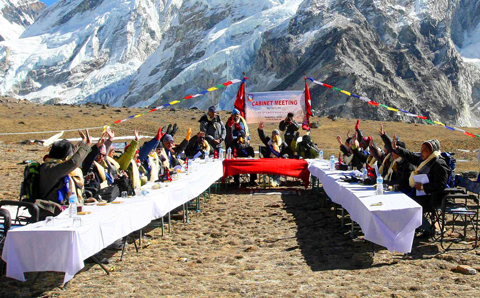
PHOTO: AFP
Global warming, worsened by greenhouse-gas emissions, is melting glaciers from Switzerland to the Himalayas, threatening water and food security for 1.6 billion people in South Asia, an Asian Development Bank study said.
The Himalayas are the source of India’s Ganges River, China’s Yangtze, River; Nepal’s main river the Karnali and Pakistan’s longest, the Indus. More than 40 percent of Earth’s population lives in China and India and relies on the rivers for drinking water and irrigation.
The event came ahead of the international climate change conference that begins on Monday in Copenhagen, Denmark, and was intended “to get the world’s attention on the impact global warming is having on underdeveloped countries like Nepal,” Environment Minister Thakur Sharma said.
Nepal’s negotiation team in Copenhagen will push for wealthy countries to commit 1.5 percent of their earnings to help poorer nations protect the environment, he said.
Getting the ministers to the mountain safely required extensive planning.
The prime minister, his two deputy prime ministers and the 20 Cabinet ministers were examined by doctors before boarding helicopters to Kalapathar, a flat area at an altitude of 5,250m next to Everest base camp, the jumping point for climbers seeking to scale the peak.

Japan has deployed long-range missiles in a southwestern region near China, the Japanese defense minister said yesterday, at a time when ties with Beijing are at their lowest in recent years. The missiles were installed in Kumamoto in the southern region of Kyushu, as Japan is attempting to shore up its military capacity as China steps up naval activity in the East China Sea. “Standoff defense capabilities enable us to counter the threat of enemy forces attempting to invade our country ... while ensuring the safety of our personnel,” Japanese Minister of Defense Shinjiro Koizumi said. “This is an extremely important initiative for
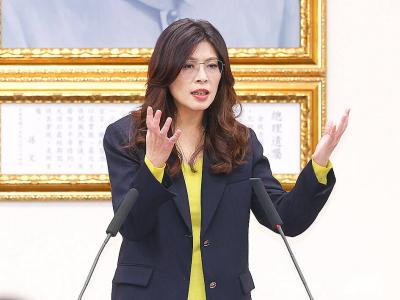
Chinese Nationalist Party (KMT) Chairwoman Cheng Li-wun (鄭麗文) today accepted an invitation from Chinese President Xi Jinping (習近平) to lead a delegation to China next month, saying she hopes to promote the peaceful development of cross-strait relations and bring stability to the Taiwan Strait. “I am grateful and happy to accept this invitation,” Cheng said in a statement from the KMT chairperson’s office. Cheng said she hopes both sides can work together to promote the peaceful development of cross-strait relations, enhance exchange and cooperation, bring stability to the Taiwan Strait and improve people’s livelihoods. At today's news conference, Cheng said any efforts to

MORE POPULAR: Taiwan Pass sales increased by 59 percent during the first quarter compared with the same period last year, the Tourism Administration said The Tourism Administration yesterday said that it has streamlined the Taiwan Pass, with two versions available for purchase beginning today. The tourism agency has made the pass available to international tourists since 2024, allowing them to access the high-speed rail, Taiwan Railway Corp services, four MRT systems and four Taiwan Tourist Shuttles. Previously, five types of Taiwan Pass were available, but some tourists have said that the offerings were too complicated. The agency said only two types of Taiwan Pass would be available, starting from a three-day pass with the high-speed rail and a three-day pass with Taiwan Railway Corp. The former costs NT$2,800

The nation’s fastest supercomputer, Nano 4 (晶創26), is scheduled to be launched in the third quarter, and would be used to train large language models in finance and national defense sectors, the National Center for High-Performance Computing (NCHC) said. The supercomputer, which would operate at about 86.05 petaflops, is being tested at a new cloud computing center in the Southern Taiwan Science Park in Tainan. The exterior of the server cabinet features chip circuitry patterns overlaid with a map of Taiwan, highlighting the nation’s central position in the semiconductor industry. The center also houses Taiwania 2, Taiwania 3, Forerunner 1 and


 RSS
RSS