


A massive power failure blacked out Brazil’s two largest cities and other parts of Latin America’s biggest nation for more than two hours late on Tuesday, leaving millions of people in the dark after a huge hydroelectric dam suddenly went offline. All of neighboring Paraguay also lost power, but for only about 20 minutes.
The huge Itaipu dam straddling the two nations’ border stopped producing 17,000 megawatts of power, resulting in outages in Rio de Janeiro, Sao Paulo and at least several other big Brazilian cities, Brazilian Mines and Energy Minister Edison Lobao said.
He said outages hit nine of the 27 states in a country of more than 190 million people.
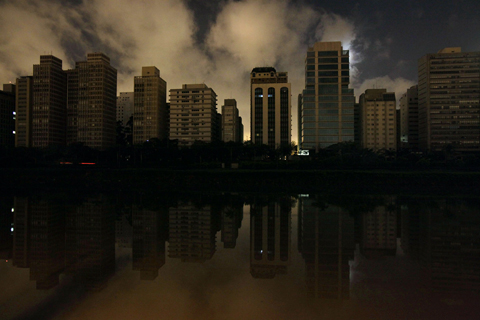
PHOTO: REUTERS
The cause of the failure had not been determined, but Lobao said strong storms uprooted trees near the Itaipu dam just before it went offline and could be to blame. Rio was the hardest hit city, he said.
At 12:37am yesterday, the lights in Rio’s Copacabana neighborhood flashed back to life, prompting cheers and thunderous car honking.
“It’s sad to see such a beautiful city with such a precarious infrastructure,” said Igor Fernandes, a shirtless 22-year-old law student pedaling his bike down a dark Copacabana beach. “This shouldn’t happen in a city that is going to host the Olympic Games.”
Lobao said the hydro plant at the dam itself was working, but there were problems with the power lines that carry electricity across Brazil. Brazil uses almost all of the energy produced by the dam, and Paraguay consumes the rest.
In Paraguay, the national energy agency blamed the blackout on a short-circuit at an electrical station near Sao Paulo, saying that failure shut down the entire power grid supplied by Itaipu. All of Paraguay went dark for about 20 minutes, the nation’s leading newspaper, ABC Color, reported.
Itaipu Binacional, the firm in charge of the dam, said the blackout did not start at the hyrdoelectric complex. It said the most likely cause was a failure at one or more points in the transmission system.
The blackouts came three days after CBS’s 60 Minutes news program reported that several past Brazilian power outages were caused by hackers. Brazilian officials had played down the report before the latest outages, and Lobao did not mention it.
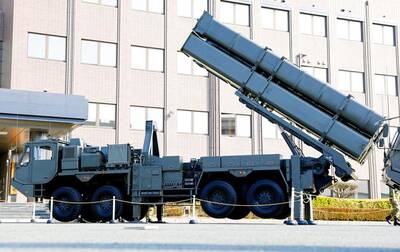
Japan has deployed long-range missiles in a southwestern region near China, the Japanese defense minister said yesterday, at a time when ties with Beijing are at their lowest in recent years. The missiles were installed in Kumamoto in the southern region of Kyushu, as Japan is attempting to shore up its military capacity as China steps up naval activity in the East China Sea. “Standoff defense capabilities enable us to counter the threat of enemy forces attempting to invade our country ... while ensuring the safety of our personnel,” Japanese Minister of Defense Shinjiro Koizumi said. “This is an extremely important initiative for

Chinese Nationalist Party (KMT) Chairwoman Cheng Li-wun (鄭麗文) today accepted an invitation from Chinese President Xi Jinping (習近平) to lead a delegation to China next month, saying she hopes to promote the peaceful development of cross-strait relations and bring stability to the Taiwan Strait. “I am grateful and happy to accept this invitation,” Cheng said in a statement from the KMT chairperson’s office. Cheng said she hopes both sides can work together to promote the peaceful development of cross-strait relations, enhance exchange and cooperation, bring stability to the Taiwan Strait and improve people’s livelihoods. At today's news conference, Cheng said any efforts to

MORE POPULAR: Taiwan Pass sales increased by 59 percent during the first quarter compared with the same period last year, the Tourism Administration said The Tourism Administration yesterday said that it has streamlined the Taiwan Pass, with two versions available for purchase beginning today. The tourism agency has made the pass available to international tourists since 2024, allowing them to access the high-speed rail, Taiwan Railway Corp services, four MRT systems and four Taiwan Tourist Shuttles. Previously, five types of Taiwan Pass were available, but some tourists have said that the offerings were too complicated. The agency said only two types of Taiwan Pass would be available, starting from a three-day pass with the high-speed rail and a three-day pass with Taiwan Railway Corp. The former costs NT$2,800

The nation’s fastest supercomputer, Nano 4 (晶創26), is scheduled to be launched in the third quarter, and would be used to train large language models in finance and national defense sectors, the National Center for High-Performance Computing (NCHC) said. The supercomputer, which would operate at about 86.05 petaflops, is being tested at a new cloud computing center in the Southern Taiwan Science Park in Tainan. The exterior of the server cabinet features chip circuitry patterns overlaid with a map of Taiwan, highlighting the nation’s central position in the semiconductor industry. The center also houses Taiwania 2, Taiwania 3, Forerunner 1 and


 RSS
RSS