


More than 17,000 Penghu residents voted against a plan to allow casino resorts in a referendum yesterday, defeating supporters of the casino plan by about 4,000.
Cheering, clapping and shouting “Penghu is hopeful,” members of the Penghu Alliance Against Casinos celebrated as the Penghu County Election Commission released the official results of the referendum.
With a total of more than 70,000 eligible voters, only about 42 percent, or a little more than 29,000 people, turned out to vote. Of them, 17,359 voted against the casino plan, while 13,397 voted for it.
The binding “gambling referendum” — the first of its kind in the country — was held in accordance with amendments to the Offshore Islands Development Act (離島建設條例), which passed the legislature in January.
Under the amendment, if the majority of voters had said “yes” in the referendum, Penghu would get the green light to authorize gaming groups to build casinos there.
Unlike the Referendum Act (公民投票法), which requires at least 50 percent of eligible voters to cast ballots for the referendum to be valid, the Penghu referendum was valid regardless of voter turnout.
Following the passage of amendments to the Offshore Islands Development Act that allows the nation’s outlying islands to build casino resorts, many local business leaders and politicians, such as Non-Partisan Solidarity Union Legislator Lin Ping-kun (林炳坤), actively promoted the casino plan, saying that resorts could bring large numbers of visitors to Penghu and bring prosperity.
Anti-casino activists had expressed concern that casinos would bring criminal activity and cause environmental damage. They also said that only a handful of people — casino operators and politicians — would benefit from them.
The two sides have been intensively campaigning to mobilize support during the past months.
“The people made a wise decision,” said Yen Chiang-lung (顏江龍), a native of Penghu and the executive director of the Penghu Alliance Against Casinos.
“Now that the people have rejected the plan, the county government should reconsider its development strategy for Penghu and look into some of the proposals we’ve made,” he said.
Green Party Taiwan Secretary-General Pan Han-shen (潘翰聲) welcomed the outcome.
“I’m sure the Japanese, who are having a similar debate about casino resorts, will take a serious look at the Penghu case,” he said.
Penghu County Commissioner Wang Chien-fa (王乾發), who has spoken in favor of casinos, said he respected the residents’ decision.
“I hope everyone in Penghu can stand united from now on for a better future for Penghu,” he said.
Lin declined to comment and left immediately after the results were announced.
ADDITONAL REPORTING BY CNA

NO-LIMITS PARTNERSHIP: ‘The bottom line’ is that if the US were to have a conflict with China or Russia it would likely open up a second front with the other, a US senator said Beijing and Moscow could cooperate in a conflict over Taiwan, the top US intelligence chief told the US Senate this week. “We see China and Russia, for the first time, exercising together in relation to Taiwan and recognizing that this is a place where China definitely wants Russia to be working with them, and we see no reason why they wouldn’t,” US Director of National Intelligence Avril Haines told a US Senate Committee on Armed Services hearing on Thursday. US Senator Mike Rounds asked Haines about such a potential scenario. He also asked US Defense Intelligence Agency Director Lieutenant General Jeffrey Kruse

China’s intrusive and territorial claims in the Indo-Pacific region are “illegal, coercive, aggressive and deceptive,” new US Indo-Pacific Commander Admiral Samuel Paparo said on Friday, adding that he would continue working with allies and partners to keep the area free and open. Paparo made the remarks at a change-of-command ceremony at Joint Base Pearl Harbor-Hickam in Hawaii, where he took over the command from Admiral John Aquilino. “Our world faces a complex problem set in the troubling actions of the People’s Republic of China [PRC] and its rapid buildup of forces. We must be ready to answer the PRC’s increasingly intrusive and

INSPIRING: Taiwan has been a model in the Asia-Pacific region with its democratic transition, free and fair elections and open society, the vice president-elect said Taiwan can play a leadership role in the Asia-Pacific region, vice president-elect Hsiao Bi-khim (蕭美琴) told a forum in Taipei yesterday, highlighting the nation’s resilience in the face of geopolitical challenges. “Not only can Taiwan help, but Taiwan can lead ... not only can Taiwan play a leadership role, but Taiwan’s leadership is important to the world,” Hsiao told the annual forum hosted by the Center for Asia-Pacific Resilience and Innovation think tank. Hsiao thanked Taiwan’s international friends for their long-term support, citing the example of US President Joe Biden last month signing into law a bill to provide aid to Taiwan,
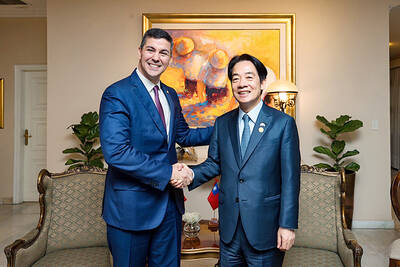
UNWAVERING: Paraguay remains steadfast in its support of Taiwan, but is facing growing pressure at home and abroad to switch recognition to Beijing, Pena said Paraguayan President Santiago Pena has pledged to continue enhancing cooperation with Taiwan, as he and Japanese Prime Minister Fumio Kishida expressed opposition to any unilateral change to the “status quo” in the Taiwan Strait using force, Japanese media reported on Saturday. Kishida yesterday completed a trip to France, Brazil and Paraguay, his first visit to South America since taking office in 2021. After the Japanese leader and Pena spoke for more than an hour on Friday, exchanging views on the situation in East Asia in the face of China’s increasing military pressure on Taiwan, they affirmed that “unilateral attempts to change the


 RSS
RSS