


Politicians across party lines yesterday lauded Kaohsiung Mayor Chen Chu (陳菊) for mentioning “President Ma Ying-jeou (馬英九)” during a meeting with Beijing Mayor Guo Jinlong (郭金龍) in China, even though Chinese TV censors cut her remarks.
Legislative Speaker Wang Jin-pyng (王金平) praised Chen for “upholding the nation’s sovereignty.”
Wang said Taiwanese politicians should learn from Chen as many have not dared to mention the president, the central government or their official titles when visiting China.
Chen, who left for Beijing on Thursday to promote the upcoming World Games, mentioned “President Ma Ying-jeou of the central government” during an open meeting with Guo.
Chen’s visit to Beijing and Shanghai has been interpreted by the media as an “ice-breaking” trip, as she is the highest-ranking Democratic Progressive Party (DPP) government official to have ever visited China.
Chen told reporters on Thursday that she would not object to such an interpretation, but said that she would not communicate with Chinese authorities on behalf of DPP Chairperson Tsai Ing-wen (蔡英文) during the trip.
In Taiwan, the Taiwan Southern Society, the Taiwan Society Hakka and a number of pro-independence groups, which had urged Chen to rethink her plan to visit China, said they would boycott Chen’s re-election bid next year.
But Chen maintained that her political stance had not changed.
“Our insistence on protecting the interests of Taiwan during exchanges [with China] remains unchanged. We are still opposed to [the KMT’s] over-reliance on China,” she told reporters in Beijing.
KMT caucus deputy secretary-general Lu Hsueh-chang (呂學樟) said Chen could serve as a model for other DPP politicians, while KMT Legislator Kuo Su-chun (郭素春) urged China and the DPP to enhance their mutual understanding.
DPP Legislator William Lai (賴清德) said China Central Television (CCTV) had no choice but to censor Chen because that was the only way they could prevent her from publicly standing up for Taiwan’s sovereignty.
“China is fully aware they could not silence Chen, so they had to resort to such tactics. They knew she could not be controlled like Lien Chan (連戰) and Chiang Pin-kung (江丙坤), who meekly submit to Beijing’s every demand,” Lai said, lauding the mayor for her courage.
Tsai Huang-liang (蔡煌瑯), another DPP lawmaker, said CCTV’s censorship clearly showed that Beijing has not and will never relent on the issue of Taiwan’s sovereignty. Any talk of cross-strait rapprochement or China’s goodwill toward Taiwan was merely the Ma administration’s “one-sided fantasy,” he said.
Meanwhile, KMT Chairman Wu Poh-hsiung (吳伯雄) said that it was natural for Chen to refer to Ma as “President Ma” when meeting Beijing’s mayor.
“I think it is natural to use such a title ... I hope members of all parties can pass on more opinions to the mainland and develop better understanding with the other side,” Wu said.
Wu, who is leaving for Nanjing on Monday, refused to say whether or not he would refer to Ma as “president” during his visit.
Wu is leading a delegation to attend the 80th anniversary of the burial of Sun Yat-sen (孫逸仙) at a mausoleum in Nanjing on June 1, following the removal of Sun’s body from its original resting place in Beijing.
Wu is also scheduled to meet Chinese President Hu Jintao (胡錦濤) in Beijing during his trip. He will return to Taiwan on June 1 and plans to return to China in July to attend a KMT-Chinese Communist Party (CCP) forum.
Wu dismissed a report from the Chinese-language China Times Weekly report that said he would take over as premier and urged local press not to engage in groundless speculation.
Wu denied planning to take over as premier if Ma decided to double as KMT chairman next month. He said he and Ma would remain silent on the issue until the middle of next month.
Wu also recently denied rumors that he would take over as Straits Exchange Foundation chairman.

Japan has deployed long-range missiles in a southwestern region near China, the Japanese defense minister said yesterday, at a time when ties with Beijing are at their lowest in recent years. The missiles were installed in Kumamoto in the southern region of Kyushu, as Japan is attempting to shore up its military capacity as China steps up naval activity in the East China Sea. “Standoff defense capabilities enable us to counter the threat of enemy forces attempting to invade our country ... while ensuring the safety of our personnel,” Japanese Minister of Defense Shinjiro Koizumi said. “This is an extremely important initiative for
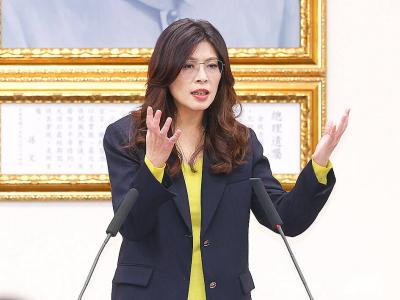
Chinese Nationalist Party (KMT) Chairwoman Cheng Li-wun (鄭麗文) today accepted an invitation from Chinese President Xi Jinping (習近平) to lead a delegation to China next month, saying she hopes to promote the peaceful development of cross-strait relations and bring stability to the Taiwan Strait. “I am grateful and happy to accept this invitation,” Cheng said in a statement from the KMT chairperson’s office. Cheng said she hopes both sides can work together to promote the peaceful development of cross-strait relations, enhance exchange and cooperation, bring stability to the Taiwan Strait and improve people’s livelihoods. At today's news conference, Cheng said any efforts to

MORE POPULAR: Taiwan Pass sales increased by 59 percent during the first quarter compared with the same period last year, the Tourism Administration said The Tourism Administration yesterday said that it has streamlined the Taiwan Pass, with two versions available for purchase beginning today. The tourism agency has made the pass available to international tourists since 2024, allowing them to access the high-speed rail, Taiwan Railway Corp services, four MRT systems and four Taiwan Tourist Shuttles. Previously, five types of Taiwan Pass were available, but some tourists have said that the offerings were too complicated. The agency said only two types of Taiwan Pass would be available, starting from a three-day pass with the high-speed rail and a three-day pass with Taiwan Railway Corp. The former costs NT$2,800

The nation’s fastest supercomputer, Nano 4 (晶創26), is scheduled to be launched in the third quarter, and would be used to train large language models in finance and national defense sectors, the National Center for High-Performance Computing (NCHC) said. The supercomputer, which would operate at about 86.05 petaflops, is being tested at a new cloud computing center in the Southern Taiwan Science Park in Tainan. The exterior of the server cabinet features chip circuitry patterns overlaid with a map of Taiwan, highlighting the nation’s central position in the semiconductor industry. The center also houses Taiwania 2, Taiwania 3, Forerunner 1 and


 RSS
RSS