


Taiwan yesterday went on full alert against the swine flu outbreak, forming a central command center and ordering onboard inspection of airline passengers from North America before they disembark.
The Department of Health (DOH) also instructed all cities and counties to set up their own centers to monitor possible cases as the virus continues to spread around the world.
The DOH took the step after the WHO raised its flu pandemic alert level from three to four on Monday night — signaling a “significant increase in the risk of a pandemic.”
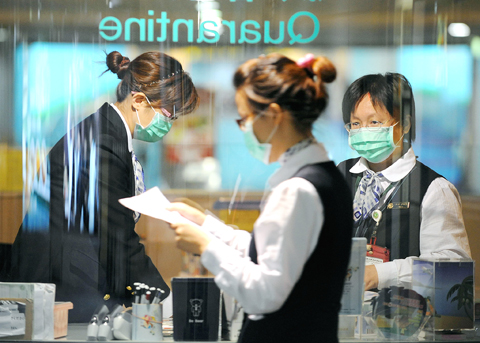
PHOTO: SAM YEH, AFP
Established at a meeting of officials from several government agencies, the central command center will focus on bolstering surveillance for swine flu at border control points, Department of Health Minister Yeh Ching-chuan (葉金川) said.
In addition, anti-epidemic personnel will board all flights from affected areas to screen passengers for swine flu, Centers for Disease Control (CDC) spokesman Shih Wen-yi (施文儀) said.
“We do not have direct flights from Mexico, but there are about 12 to 20 flights from North America every day,” Shih said.
Passengers with flu symptoms will be kept for further tests and registration for follow-up assistance, he said.
Although no cases of the disease have been reported in Taiwan, Yeh said it was likely that the virus would eventually find its way into the country and that Taiwan had to be well prepared for the worst-case scenario.
The government has also mapped out a national flu pandemic strategy in response to the threat, which includes establishing a channel to coordinate the replenishment of medication and vaccine stockpiles among various government agencies, he added.
Yeh reiterated that people would not become infected with the flu by eating pork.
The virus is transmitted by people coming in physical contact with people who are infected with swine flu, he said.
Yeh said Taiwan had a sufficient supply of surgical masks and vaccine to deal with the flu.
The DOH has around 50 million to 60 million masks in stock and local manufacturers will be able to produce 200,000 doses of vaccine a month, he added.
Healthcare and ambulance workers as well as customs officials would be given top priority to receive vaccinations, the minister said.
He said Tamiflu was the best available medicine against the H1N1 flu strain and that the nation currently had enough to treat up to 2.3 million people.
Three domestic manufacturers were capable of producing more Tamiflu if necessary, he said.
The DOH gave local governments 24 hours to establish regional task forces that would fall under the central command center, Yeh said.
The government will also earmark a special budget, use TV channels and set up command centers in all cities and counties to promote information and measures on flu prevention, he said.
Earlier yesterday, Premier Liu Chao-shiuan (劉兆玄) inspected the swine flu monitoring mechanism at Taiwan Taoyuan International Airport.
All epidemic control personnel at the airport are equipped with ear thermometers, while passengers entering the country will have their temperature taken to prevent the virus from slipping through, Department of Health Deputy Minister Chen Tzay-jinn (陳再晉) said.
Preventive measures at the border are the most important safeguards to prevent the disease from taking a foothold and spreading, Liu said.
“[Taiwan] is categorized as highly prepared in case of major outbreaks of communicable diseases by the WHO. However, as the epidemic situation varies from minute to minute, we have to maintain a high degree of vigilance and cannot lower our guard,” he said.
Shih told a press conference yesterday afternoon that two suspected swine flu cases had been reported in Taiwan in the past 72 hours.
The Taiwanese man and a Greek man who had fever had recently visited Mexico. They were later confirmed not to be suffering from swine flu, he said.
Over the past three days, Shih said, there had been more than 50 flights that carried more than 15,000 passengers from North America, and inspectors at the airport screened five passengers with high body temperatures.
These five were also confirmed not to be suffering from swine flu, he said.
All confirmed cases of swine flu in Taipei City will be sent for quarantine and treatment at Taipei Municipal Hoping Hospital, said Allen Chiu (邱文祥), commissioner of Taipei City’s Health Department.
A SARS outbreak was reported at Taipei Hoping Hospital in April 2003, and the city government kept the hospital in quarantine for more than 10 days after hospital workers were infected. The outbreak caused seven deaths and 59 hospital workers were infected. The city government later designated the hospital as the city’s main treatment facility for infectious disease control.
Taipei Mayor Hau Lung-bin (郝龍斌) told a press conference that the city would use experience it gained in combating SARS to prevent an outbreak of swine flu in Taiwan.
“Taipei is an international city with many visitors from around the world, and so we should be alert and prepared. There is no need to panic, because the city government is well prepared,” he said.
Meanwhile, Deputy Kaohsiung Mayor Lee Yung-te (李永得) said the Organizing Committee of the World Games would establish a swine flu prevention task force during the Games in July.
Kaohsiung City’s Department of Health Deputy Director-General Su Chuan-chuan (蘇娟娟) said the city government would launch a study to decide whether athletes from flu-hit areas would be placed under quarantine when they arrive in July.
ADDITIONAL REPORTING BY SHIH HSIU-CHUAN, MO YAN-CHIH AND FLORA WANG
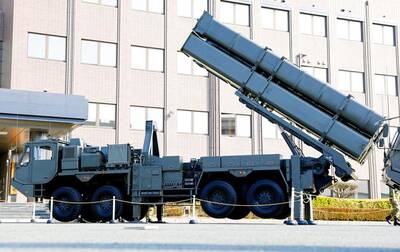
Japan has deployed long-range missiles in a southwestern region near China, the Japanese defense minister said yesterday, at a time when ties with Beijing are at their lowest in recent years. The missiles were installed in Kumamoto in the southern region of Kyushu, as Japan is attempting to shore up its military capacity as China steps up naval activity in the East China Sea. “Standoff defense capabilities enable us to counter the threat of enemy forces attempting to invade our country ... while ensuring the safety of our personnel,” Japanese Minister of Defense Shinjiro Koizumi said. “This is an extremely important initiative for
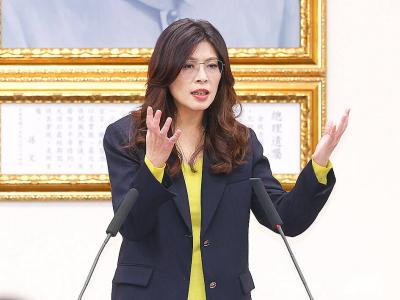
Chinese Nationalist Party (KMT) Chairwoman Cheng Li-wun (鄭麗文) today accepted an invitation from Chinese President Xi Jinping (習近平) to lead a delegation to China next month, saying she hopes to promote the peaceful development of cross-strait relations and bring stability to the Taiwan Strait. “I am grateful and happy to accept this invitation,” Cheng said in a statement from the KMT chairperson’s office. Cheng said she hopes both sides can work together to promote the peaceful development of cross-strait relations, enhance exchange and cooperation, bring stability to the Taiwan Strait and improve people’s livelihoods. At today's news conference, Cheng said any efforts to
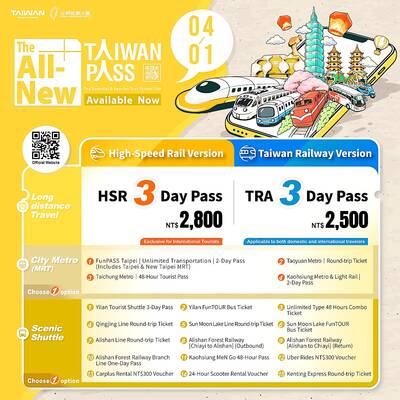
MORE POPULAR: Taiwan Pass sales increased by 59 percent during the first quarter compared with the same period last year, the Tourism Administration said The Tourism Administration yesterday said that it has streamlined the Taiwan Pass, with two versions available for purchase beginning today. The tourism agency has made the pass available to international tourists since 2024, allowing them to access the high-speed rail, Taiwan Railway Corp services, four MRT systems and four Taiwan Tourist Shuttles. Previously, five types of Taiwan Pass were available, but some tourists have said that the offerings were too complicated. The agency said only two types of Taiwan Pass would be available, starting from a three-day pass with the high-speed rail and a three-day pass with Taiwan Railway Corp. The former costs NT$2,800

The nation’s fastest supercomputer, Nano 4 (晶創26), is scheduled to be launched in the third quarter, and would be used to train large language models in finance and national defense sectors, the National Center for High-Performance Computing (NCHC) said. The supercomputer, which would operate at about 86.05 petaflops, is being tested at a new cloud computing center in the Southern Taiwan Science Park in Tainan. The exterior of the server cabinet features chip circuitry patterns overlaid with a map of Taiwan, highlighting the nation’s central position in the semiconductor industry. The center also houses Taiwania 2, Taiwania 3, Forerunner 1 and


 RSS
RSS