


A recent announcement by the Research, Development and Evaluation Commission (RDEC) that trips made by civil servants to China do not constitute overseas travel drew fire from lawmakers across party lines yesterday.
“[RDEC] Minister Jiang Yi-huah [江宜樺] has to resign over an announcement that sells out Taiwan,” Democratic Progressive Party (DPP) Legislator Lee Chun-yee (李俊毅) said as a group of DPP lawmakers lodged a protest at the RDEC offices yesterday.
The protest was prompted by a Liberty Times (the Taipei Times’ sister newspaper) report yesterday that said on April 1 the commission posted an announcement on the government’s intranet informing government agencies that “given that going to the ‘mainland area’ is not tantamount to ‘going abroad,’” civil servants are no longer required to register on the commission’s Web site. Local government chiefs, however, would still have to submit reports should they visit China, it added.
Jiang did not meet with the DPP lawmakers yesterday.
“We will come back anytime and find you ... unless you [Jiang] plan to hide from us for the rest of your life,” Lee said.
The DPP lawmakers shouted slogans such as “Jiang Yi-huah, step down” and “Taiwan is our country,” before leaving the RDEC offices.
DPP Legislator Hsueh Ling (薛凌) slammed the announcement as an attempt to obscure civil servants’ sense of national identity and as “a precursor to eventual unification [with China].”
Chinese Nationalist Party (KMT) caucus secretary-general Yang Chiung-ying (楊瓊瓔) also urged the commission not to “mistake a foreign country as our country” because “the Republic of China is an independent sovereign state.”
“In accordance with the legislature’s budget review and the the Act Governing the Relations between People of the Taiwan Area and the Mainland Area (兩岸人民關係條例), trips to China are still considered trips abroad,” she said.
In response, RDEC Deputy Minister Yeh Kuang-shih (葉匡時) said yesterday that the announcement was only posted on the intranet because its technicians were testing a new system for civil servants to use when uploading reports on trips to China, as opposed to the existing one for civil servants for uploading reports on other overseas travel.
We find it regrettable that the announcement, not a finalized one, was distorted by the media, who quoted a phrase or two out of context on purpose to make it into a unification-independence issue,” Yeh said.
In view of increasing cross-strait exchanges involving civil servants, Yeh said the commission was planning to separate reporting by civil servants for their trips to China and to other countries on two separate systems.
The RDEC considered it necessary not to make public the contents of some of the reports on civil servants’ trips to China, Yeh said.
“It is still in the review stage,” he said.
Regulations state that when civil servants take an overseas trip, they are required to complete a report when they return and the reports are then made public online.
Regulations on government cross-strait activities state that civil servants are required to submit their itineraries and travel details to their superiors and the Mainland Affairs Council (MAC), but are not required to upload the information online.
Commenting on the controversy, MAC Deputy Minister Liu Te-shun (劉德勳) said yesterday that the phrasing in the announcement that “going to the ‘mainland area’ is not tantamount to ‘going abroad’” should not be blown up into a big issue because “cross-strait relations are a special case.”
Liu said that was the reason why a law called the Act Governing Relations Between People of the Taiwan Area and the Mainland Area was originally passed.
ADDITIONAL REPORTING BY FLORA WANG
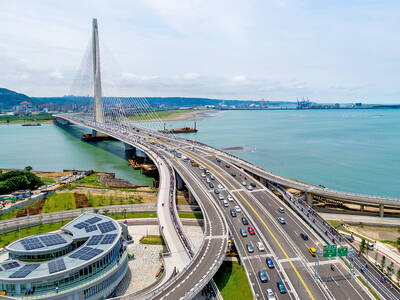
The Ministry of Transportation and Communications yesterday inaugurated the Danjiang Bridge across the Tamsui River in New Taipei City, saying that the structure would be an architectural icon and traffic artery for Taiwan. Feted as a major engineering achievement, the Danjiang Bridge is 920m long, 211m tall at the top of its pylon, and is the longest single-pylon asymmetric cable-stayed bridge in the world, the government’s Web site for the structure said. It was designed by late Iraqi-British architect Zaha Hadid. The structure, with a maximum deck of 70m, accommodates road and light rail traffic, and affords a 200m navigation channel for boats,
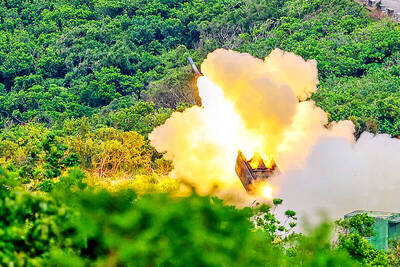
PRECISION STRIKES: The most significant reason to deploy HIMARS to outlying islands is to establish a ‘dead zone’ that the PLA would not dare enter, a source said A High Mobility Artillery Rocket System (HIMARS) would be deployed to Penghu County and Dongyin Island (東引) in Lienchiang County (Matsu) to force the Chinese military to retreat at least 100km from the coastline, a military source said yesterday. Taiwan has been procuring HIMARS and Army Tactical Missile Systems (ATACMS) from the US in batches. Once all batches have been delivered, Taiwan would possess 111 HIMARS units and 504 ATACMS, which have a range of 300km. Considering that “offense is the best defense,” the military plans to forward-deploy the systems to outlying islands such as Penghu and Dongyin so that

Taiwan Semiconductor Manufacturing Co (TSMC, 台積電), the world’s largest foundry service provider, yesterday said that global semiconductor revenue is projected to hit US$1.5 trillion in 2030, after the figure exceeds US$1 trillion this year, as artificial intelligence (AI) demand boosts consumption of token and compute power. “We are still at the beginning of the AI revolution, but we already see a significant impact across the whole semiconductor ecosystem,” TSMC deputy cochief operating officer Kevin Zhang (張曉強) said at the company’s annual technology symposium in Hsinchu City. “It is fair to say that in the past decade, smartphones and other mobile devices were

‘CLEAR MESSAGE’: The bill would set up an interagency ‘tiger team’ to review sanctions tools and other economic options to help deter any Chinese aggression toward Taiwan US Representative Young Kim has introduced a bill to deter Chinese aggression against Taiwan, calling for an interagency “tiger team” to preplan coordinated sanctions and economic measures in response to possible Chinese military or political action against Taiwan. “[Chinese President] Xi Jinping [習近平] has directed the People’s Liberation Army to be ready to invade Taiwan by 2027. China has a plan. America should have one too,” Kim said in a news release on Thursday last week. She introduced the “Deter PRC [People’s Republic of China] aggression against Taiwan act” to “ensure the US has a coordinated sanctions strategy ready should


 RSS
RSS