


Samak Sundaravej was poised yesterday to return as Thailand’s prime minister two days after a court removed him from the post, angering protesters who vowed to press their campaign to oust him.
Thailand’s army issued a statement shortly after the announcement, urging both sides to compromise and saying the government should lift a state of emergency imposed across Bangkok 10 days ago.
However, the ruling People Power Party (PPP) said Samak had accepted its nomination, just two days after the Constitutional Court stripped him of his office over his hosting of TV cooking shows.
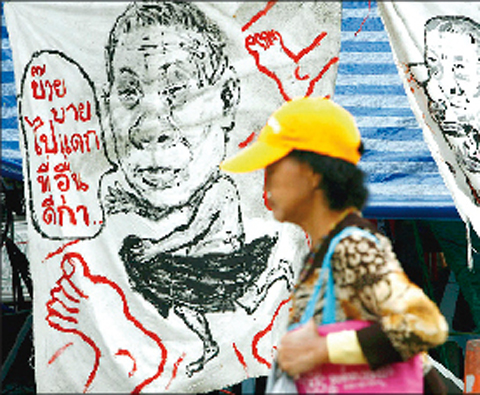
PHOTO: EPA
“Samak has accepted his nomination for prime minister,” PPP spokesman Suthin Klangsang said.
“Samak said he is confident that parliament will find him fit for office, and that he is happy to accept the post,” Suthin said.
Samak, a fiery-tongued 73-year-old, has remained out of public view since the court ruling and has yet to comment publicly on his nomination.
The decision added a new twist to Thailand’s chaotic politics and incensed protesters occupying the grounds of Government House, where a finely manicured garden has been reduced to a smelly mudpit dotted with tents and drying laundry.
“Our stand remains the same, we will not accept Samak or anyone proposed from the PPP because the party lacks legitimacy,” media mogul and protest leader Sondhi Limthongkul said.
“They violated the Constitution and lack morals,” he said.
Protesters have occupied the main government complex for more than two weeks. Samak imposed a state of emergency after the protests turned violent last week, leaving one government supporter dead and dozens of people injured after clashes in the streets.
The army in a statement urged both sides to compromise, warning that the state of emergency in Bangkok was hurting confidence in Thailand’s economy.
“The Thai army believes that to maintain state of emergency will do more harm than good,” it said. “If the state of emergency is lifted soon, that would be positive.”
“The army is ready to support the police in maintaining law and order,” it said.
The decision over whether to endorse Samak’s return as prime minister created splits within the PPP and its five coalition partners, with some factions arguing that another candidate could better withstand the protests.
Sondhi’s group of protesters, which calls itself the People’s Alliance for Democracy (PAD), accuses Samak’s government of acting as a proxy for ousted prime minister Thaksin Shinawatra.
The alliance spearheaded months of protests against Thaksin in 2006, leading to a military coup by generals who accused the tycoon of widespread corruption.
Thaksin now lives in exile in Britain to evade legal charges that he says are politically motivated.
After the coup, Thaksin tapped Samak to rally his supporters, leading the PPP to victory in elections last December.
Aside from demanding Samak’s ouster, the protesters are pushing a broad agenda to scale back Thailand’s democracy by demanding a parliament in which only 30 percent of the seats are elected.
By making 70 percent of the seats appointed, they hope to weaken the voting power of Thailand’s poor but populous heartland, where Thaksin earned steadfast support by providing universal health care and low-interest loans.
“Whoever becomes prime minister now, the PAD is not going to stop,” political analyst Thitinan Pongsudhirak said.
“They want to move away from electoral politics toward a more privileged appointment” system, he said

‘NO SECURITY RISK’: The Railway Bureau reassured the public that the technicians’ activities were limited to technical guidance and did not involve sensitive systems The Railway Bureau yesterday said it had invited eight Chinese technicians to assist with an airport MRT construction project. The bureau issued the confirmation after an Internet user said Chinese nationals had entered the construction zone of Taiwan Taoyuan International Airport’s Terminal 3 project. They asked why “individuals from an enemy state” were allowed access to such a major national infrastructure project, which raised serious concerns over Taiwan’s industrial safety, sensitive systems and information security. The bureau’s Northern Region Engineering Branch Office said subcontractor Taiwan Handle Industrial Co (台灣手把工業) of the Taoyuan airport MRT’s “Contract No. CU05 Project A14 Station Civil, MEP &

The National Chungshan Institute of Science and Technology yesterday showcased its locally developed variants of the Vision 60 robotic patrol dog, which it plans to deploy on the nation’s outlying territories in the South China Sea. The variants were produced under the Joint Lab project — created by the institute and domestic companies — and assembled with domestically produced motors, lenses and artificial intelligence (AI) systems alongside licensed tech from the US, Missile and Rocket Systems Research Division deputy director Jen Kuo-kang (任國光) told the media event at a military base in Taipei’s Dazhi (大直) area. Taiwan has built up its strengths

RIGHT DIRECTION: Taiwan’s efforts to prevent forced labor include a proposal to ‘fully prohibit’ employers from withholding workers’ documents, an official said Taiwan is to establish a mechanism to restrict imports of goods linked to forced labor, the Executive Yuan said yesterday, after the US proposed imposing additional tariffs on Taiwanese goods over labor concerns. “The Ministry of Labor and the Ministry of Economic Affairs are to establish an interministerial review procedure,” Executive Yuan spokesperson Michelle Lee (李慧芝) said at a news briefing in Taipei. “The government is to use the Foreign Trade Act [貿易法] as the legal basis to restrict imports of goods produced with forced labor” and bring its supply chain governance more in line with international standards on human rights, resilience

NOT IMMEDIATE: Taiwan has a chance to appeal the proposed 10 percent tariff before it starts, while other countries face a 12.5 percent tariff from the trade office Taiwan is among 60 economies determined by the US to have failed to impose or enforce a ban on the importation of goods produced with forced labor, according to a notice released on Tuesday by the Office of the US Trade Representative (USTR), which proposed imposing an additional 10 percent or more tariff on them. The USTR in a statement said that following an investigation, it had determined under Section 301 of the Trade Act of 1974 that the failure of the 60 economies to impose and effectively enforce a prohibition on the importation of goods produced with forced labor is


 RSS
RSS