


Yeh Sheng-mao (葉盛茂), former head of the Ministry of Justice’s Investigation Bureau, was indicted yesterday for withholding information about former president Chen Shui-bian’s (陳水扁) possible involvement in money laundering.
Taipei District Prosecutors’ Office spokesman Lin Chin-chun (林錦村) said prosecutors were seeking a jail term of two years and six months for Yeh.
Lin said Yeh, who stepped down from his post as bureau chief on July 16, withheld information about overseas bank accounts in the names of Chen’s family members.
Lin said Yeh was supposed to relay the information — which the bureau’s Anti-Money Laundering Center obtained on Jan. 27 from the international anti-money laundering Egmont Group — to the Supreme Prosecutor Office.
But the Supreme Prosecutor Office never received the information, Lin said.
The director of the Anti-Money Laundering Center asked Yeh about the information in March and was told that Yeh would give it to Prosecutor-General Chen Tsung-ming (陳聰明) in person, Lin said, but the prosecutor-general said that he had never received the information.
Yeh later said he had forgotten to pass on the information to Chen Tsung-min because the country was in the middle of a fiercely contested presidential election and he stepped down two months after the new administration took office on May 20.
Lin said a search of Yeh’s home in Muzha (木柵), Taipei City, last week yielded a photocopy of the information from Egmont, but not the original document.
“The fact that Yeh was careful to keep a photocopy of the information disproves his claim that he completely forgot about the whole matter,” Lin said.
Late last month, two Swiss prosecutors asked Taiwanese authorities for help investigating a case of suspected money laundering, with US$21 million reportedly placed in Swiss bank accounts in the name of Chen Shui-bian’s daughter-in-law.
Lin said it was not the first time that Yeh, who was appointed in 2001 by Chen Shui-bian to head the bureau, had withheld information about the former first family.
In 2006, the bureau failed to pass on to prosecutors information it had obtained about possible money laundering by first lady Wu Shu-jen (吳淑珍), Lin said.
Lin said Yeh maintained that he had conveyed the information in 2006 to then prosecutor-general Wu Ying-chao (吳英昭), a claim Wu has rebutted.
In related news, Chen Shui-bian’s office yesterday criticized the judiciary for leaking details of the case and expressed regret over media reports that the office said distorted the facts.
In a statement, the office expressed displeasure with leaks of what had been said by witnesses in interviews and suggested that prosecutors might have deliberately leaked the information to reporters.
“We would like to call on the public to stop and condemn such an act,” the statement said.
The office also criticized media outlets that they said had drawn false conclusions and distorted the testimony of witnesses.
The statement followed a report in yesterday’s Chinese-language China Times that said the testimony given by former Presidential Office treasurer Chen Cheng-hui (陳鎮慧) was detrimental to Chen Shui-bian’s case and contradicted his statements.
The office dismissed the report, saying that Chen Cheng-hui knew nothing about the campaign funds in question because as the treasurer at the campaign headquarters for the 2000 and 2004 presidential elections, she was only in charge of the headquarters’ finances.
The money Chen Cheng-hui handled was declared in full and there were no leftover funds, the statement said. In addition, prosecutors had not asked Chen Cheng-hui about the leftover campaign funds Chen Shui-bian’s wife wired overseas, the statement said.
The statement also rebutted reports that witnesses had told prosecutors that Chen Shui-bian contributed NT$40 million to former premier Frank Hsieh’s (謝長廷) Taipei mayoral campaign and NT$20 million to former premier Su Tseng-chang’s (蘇貞昌) campaign for Taipei County commissioner. The issue was mentioned by prosecutors, but not confirmed by witnesses, the statement said.
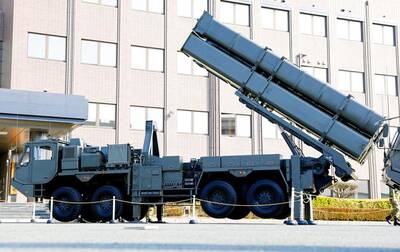
Japan has deployed long-range missiles in a southwestern region near China, the Japanese defense minister said yesterday, at a time when ties with Beijing are at their lowest in recent years. The missiles were installed in Kumamoto in the southern region of Kyushu, as Japan is attempting to shore up its military capacity as China steps up naval activity in the East China Sea. “Standoff defense capabilities enable us to counter the threat of enemy forces attempting to invade our country ... while ensuring the safety of our personnel,” Japanese Minister of Defense Shinjiro Koizumi said. “This is an extremely important initiative for
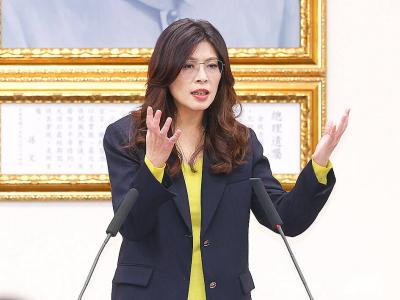
Chinese Nationalist Party (KMT) Chairwoman Cheng Li-wun (鄭麗文) today accepted an invitation from Chinese President Xi Jinping (習近平) to lead a delegation to China next month, saying she hopes to promote the peaceful development of cross-strait relations and bring stability to the Taiwan Strait. “I am grateful and happy to accept this invitation,” Cheng said in a statement from the KMT chairperson’s office. Cheng said she hopes both sides can work together to promote the peaceful development of cross-strait relations, enhance exchange and cooperation, bring stability to the Taiwan Strait and improve people’s livelihoods. At today's news conference, Cheng said any efforts to
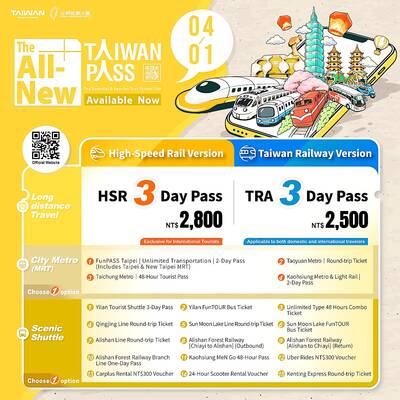
MORE POPULAR: Taiwan Pass sales increased by 59 percent during the first quarter compared with the same period last year, the Tourism Administration said The Tourism Administration yesterday said that it has streamlined the Taiwan Pass, with two versions available for purchase beginning today. The tourism agency has made the pass available to international tourists since 2024, allowing them to access the high-speed rail, Taiwan Railway Corp services, four MRT systems and four Taiwan Tourist Shuttles. Previously, five types of Taiwan Pass were available, but some tourists have said that the offerings were too complicated. The agency said only two types of Taiwan Pass would be available, starting from a three-day pass with the high-speed rail and a three-day pass with Taiwan Railway Corp. The former costs NT$2,800

The nation’s fastest supercomputer, Nano 4 (晶創26), is scheduled to be launched in the third quarter, and would be used to train large language models in finance and national defense sectors, the National Center for High-Performance Computing (NCHC) said. The supercomputer, which would operate at about 86.05 petaflops, is being tested at a new cloud computing center in the Southern Taiwan Science Park in Tainan. The exterior of the server cabinet features chip circuitry patterns overlaid with a map of Taiwan, highlighting the nation’s central position in the semiconductor industry. The center also houses Taiwania 2, Taiwania 3, Forerunner 1 and


 RSS
RSS