


Former president Chen Shui-bian’s (陳水扁) son Chen Chih-chung (陳致中) and daughter-in-law Huang Jui-ching (黃睿靚) made their first public appearance yesterday since being named defendants in an investigation into alleged money laundering by the former first family when the couple boarded an EVA Airways flight at New Jersey’s Newark International Airport bound for Taiwan.
EVA Flight BR031 is scheduled to arrive in Taiwan at 5:30am today.
Speaking to reporters yesterday, Chen Chih-chung proclaimed his innocence and said that he and his wife were only figureheads, while rebutting accusations that he was directly involved in handling the money.
“We are purely figureheads in this [money wiring] case. Things were done in our name, but we are not clear on everything else [pertaining to the investigation],” he said. “We will go back [to Taiwan] and cooperate with the investigation.”
“I didn’t know about [having been used as a figurehead] until I arrived in the US and heard about it from the media,” Huang said. “Being named a defendant is a little over the top.”
Turning to their “disappearance,” the couple said that since Chen Chih-chung had initially intended to pursue a doctorate in law at the University of Virginia this fall, they had had to pack, cancel their rental car and end their apartment lease before returning
Chen Chih-chung’s return would be in time for a summons issued for him and his wife last week.
On Friday, Chu Chao-liang (朱朝亮), a spokesperson for the Supreme Prosecutor Office’s Special Investigation Panel, confirmed that prosecutors had issued a second summons ordering the couple in for questioning, adding that although it was the second summons, it was the first time the couple had been named defendants in the case.
Reacting to news of the couple’s return, Chu said the panel was glad they had decided to come back, adding that they would be asked to appear as defendants on Friday.
The couple would not be summoned at an earlier date, unless they requested it themselves, Chu said.
Chen Chih-chung said yesterday that the University of Virginia had been mistaken when it said he did not have a student ID, producing a University of Virginia student ID with his photograph and name from his wallet.
“I was at the student orientation activity for international students on [Aug. 11]; where I received my student ID and paid my tuition … The university said I did not have a student ID. This is inaccurate, because I do,” he said.
Last Monday, “I phoned the school to discuss what to do next, but they told me that if I wanted to attend school I would have to reapply next year,” he said.
Asked if the couple thought that the university was acting under pressure, Huang said: “The school had a drastic change in attitude … We felt that something was weird. We were quite surprised.”
Chen Chih-chung was speaking in response to comments by a public relations official from the school last week, who claimed that Chen Chih-chung had called last Monday to excuse himself from compulsory orientation, adding that his failure to show up had resulted in his losing his place in class.
As Chen Chih-chung did not complete the enrollment process, he failed to obtain a student ID, the spokesperson said.
The school denied that Taiwanese media had pressured it or suggested that Chen Chih-chung should not be allowed into the program.
Chen Shui-bian said on Friday the university had told his son not to attend because it could not stand the pressure from Taiwanese media.
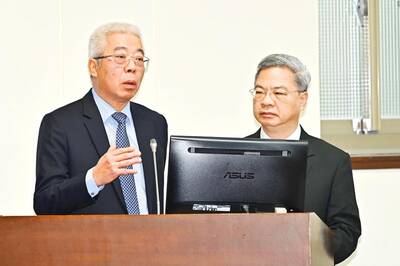
Taiwan has arranged for about 8 million barrels of crude oil, or about one-third of its monthly needs, to be shipped from the Red Sea this month to bypass the Strait of Hormuz and ease domestic supply pressures, CPC Corp, Taiwan (CPC, 台灣中油) said yesterday. The state-run oil company has worked with Middle Eastern suppliers to secure routes other than the Strait of Hormuz, through which about 20 percent of the world’s oil and liquefied natural gas typically passes, CPC chairman Fang Jeng-zen (方振仁) said at a meeting of the legislature’s Economics Committee in Taipei. Suppliers in Saudi Arabia have indicated they
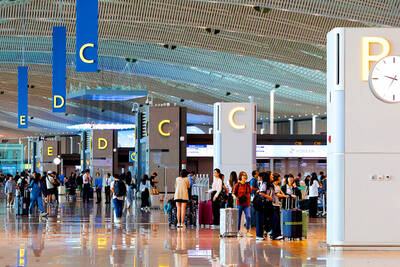
South Korea has adjusted its electronic arrival card system to no longer list Taiwan as a part of China, a move that the Ministry of Foreign Affairs said would help facilitate exchanges between the two sides. South Korea previously listed “Taiwan” as “Taiwan (China)” in the drop-down menus of its online arrival card system, where people had to fill out where they came from and their next destination. The ministry had requested South Korea make a revision and said it would change South Korea’s name on Taiwan’s online immigration system from “Republic of Korea” to “Korea (South),” should the issue not be
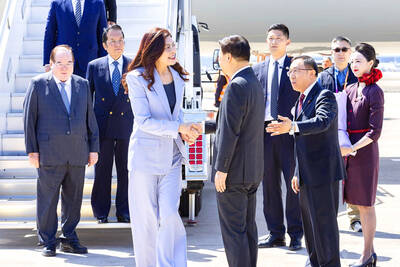
CCP ‘PAWN’? Beijing could use the KMT chairwoman’s visit to signal to the world that many people in Taiwan support the ‘one China’ principle, an academic said Chinese Nationalist Party (KMT) Chairwoman Cheng Li-wun (鄭麗文) yesterday arrived in China for a “peace” mission and potential meeting with Chinese President Xi Jinping (習近平), while a Taiwanese minister detailed the number of Chinese warships currently deployed around the nation. Cheng is visiting at a time of increased Chinese military pressure on Taiwan, as the opposition-dominated Legislative Yuan stalls a government plan for US$40 billion in extra defense spending. Speaking to reporters before going to the airport, Cheng said she was going on a “historic journey for peace,” but added that some people felt uneasy about her trip. “If you truly love Taiwan,
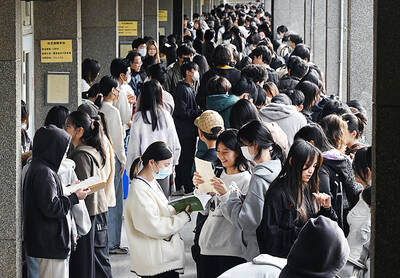
A global survey showed that 60 percent of Taiwanese had attained higher education, second only to Canada, the Ministry of the Interior said. Taiwan easily surpassed the global average of 43 percent and ranked ahead of major economies, including Japan, South Korea and the US, data from the Organisation for Economic Co-operation and Development (OECD) for 2024 showed. Taiwan has a high literacy rate, data released by the ministry showed. As of the end of last year, Taiwan had 20.617 million people aged 15 or older, accounting for 88.5 percent of the total population, with a literacy rate of 99.4 percent, the data


 RSS
RSS