


Writer, human rights activist and former political prisoner Bo Yang (柏楊), who infuriated both the Chinese Nationalist Party (KMT) and the Chinese Communist Party with his tart critiques of Chinese culture, abusive leaders and anti-democratic behavior, died early yesterday morning of complications from pneumonia. He was 88.
Bo had been receiving treatment for pneumonia at the Cardinal Tien Hospital in Sindian (新店), Taipei County, since February.
Born in 1920 in Henan Province, China, Bo authored more than 200 works. One of the most prominent was The Ugly Chinaman (醜陋的中國人), in which he pilloried Chinese culture as dirty, noisy, divisive, obsequious and vainglorious.
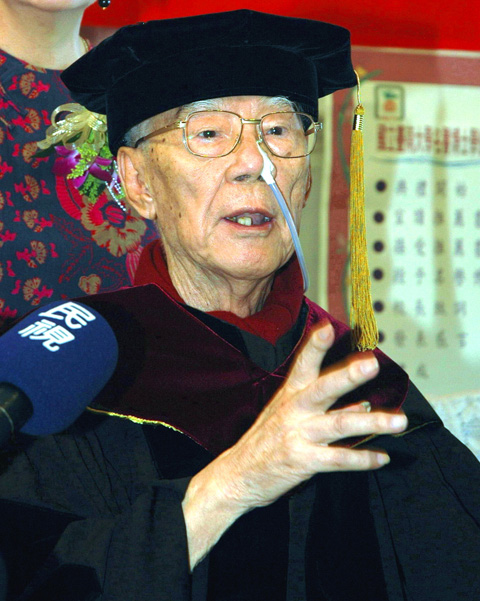
PHOTO: CNA
The book came as a shock when it was first published in Taiwan in 1984. Although it was banned in China until 2000, underground copies were widely available.
Last August, Bo began planning a comic-strip version of the book, saying that it could reach out to young people today who tend not to read.
The New York Times once called Bo “China’s Voltaire.”
Bo, whose real name was Kuo Yi-tung (郭衣洞), followed the KMT government to Taiwan after the KMT lost the Chinese civil war.
He found work as a columnist for the Independence Evening Post, a small liberal newspaper, but quickly ran foul of the KMT dictatorship after he blasted Chiang Kai-shek’s (蔣介石) government over corruption and abuse of power. One of his more controversial pieces of writing at the time was Foreign Land (異域), a study of the KMT soldiers stranded in what would become the Golden Triangle after they were unable to join their compatriots in Taiwan. His reporting on their destitution embarrassed senior military officials who escaped from the area.
He was then jailed in 1968 following a translation of the American comic strip Popeye, which was interpreted as criticizing Chiang’s refusal to conduct free presidential elections.
He served nine years in prison, mostly on Green Island (綠島), after being convicted of acting as a communist spy — a government catchall for dealing with troublemakers during the Martial Law era.
Aside from managing a prolific writing career, which included historical studies, short fiction, journalism and translations of classical Chinese works, Bo was keen to advocate human rights and served as Amnesty International’s Taiwan office director from 1994 to 1996.
Bo’s health began to deteriorate in September 2006 and he had been in and out of hospital several times since then, eventually forcing him to stop writing.
Despite his illness, Bo followed politics closely.
He said he was disappointed at the record of the Democratic Progressive Party administration, but also worried about the KMT’s return to power.
President Chen Shui-bian (陳水扁) yesterday expressed his “deepest regret” over Bo’s death.
Chen said he would confer a posthumous medal on Bo and asked government agencies to assist Bo’s family with funeral arrangements.
The Presidential Office statement described Bo as a modern thinker who had been eminently capable of representing Taiwan. The president said Bo exerted a great influence on contemporary Taiwanese literature and was held in high esteem in literary circles, both domestic and international.
The statement added that Chen was grateful for the advice Bo gave him during his stint as senior presidential adviser.
The president visited Bo in hospital on Saturday. Bo’s wife, the poet Chang Hsiang-hua (張香華), told Chen at that time that he was the only president to express respect toward him.
President-elect Ma Ying-jeou (馬英九) also visited Bo in hospital on April 16.
Bo is survived by his wife and two sons and three daughters from previous marriages.

‘NO SECURITY RISK’: The Railway Bureau reassured the public that the technicians’ activities were limited to technical guidance and did not involve sensitive systems The Railway Bureau yesterday said it had invited eight Chinese technicians to assist with an airport MRT construction project. The bureau issued the confirmation after an Internet user said Chinese nationals had entered the construction zone of Taiwan Taoyuan International Airport’s Terminal 3 project. They asked why “individuals from an enemy state” were allowed access to such a major national infrastructure project, which raised serious concerns over Taiwan’s industrial safety, sensitive systems and information security. The bureau’s Northern Region Engineering Branch Office said subcontractor Taiwan Handle Industrial Co (台灣手把工業) of the Taoyuan airport MRT’s “Contract No. CU05 Project A14 Station Civil, MEP &

The National Chungshan Institute of Science and Technology yesterday showcased its locally developed variants of the Vision 60 robotic patrol dog, which it plans to deploy on the nation’s outlying territories in the South China Sea. The variants were produced under the Joint Lab project — created by the institute and domestic companies — and assembled with domestically produced motors, lenses and artificial intelligence (AI) systems alongside licensed tech from the US, Missile and Rocket Systems Research Division deputy director Jen Kuo-kang (任國光) told the media event at a military base in Taipei’s Dazhi (大直) area. Taiwan has built up its strengths

NOT IMMEDIATE: Taiwan has a chance to appeal the proposed 10 percent tariff before it starts, while other countries face a 12.5 percent tariff from the trade office Taiwan is among 60 economies determined by the US to have failed to impose or enforce a ban on the importation of goods produced with forced labor, according to a notice released on Tuesday by the Office of the US Trade Representative (USTR), which proposed imposing an additional 10 percent or more tariff on them. The USTR in a statement said that following an investigation, it had determined under Section 301 of the Trade Act of 1974 that the failure of the 60 economies to impose and effectively enforce a prohibition on the importation of goods produced with forced labor is

TIT-FOR-TAT: The US allegedly revoked the visa of a Chinese national working at Xinhua News Agency in the US in response to Beijing’s expulsion of Vivian Wang The Presidential Office yesterday condemned China for expelling a New York Times correspondent from Beijing following the newspaper’s interview with President William Lai (賴清德), saying the move highlighted Beijing’s suppression of press freedom and its threat to international news media. Taiwan has noted a series of recent incidents in which Beijing used similar tactics to “threaten and pressure international media outlets and journalists,” Presidential Office spokeswoman Karen Kuo (郭雅慧) said in a statement. “This concerns not only press freedom and freedom of expression, but also the safety of journalists, and Taiwan and relevant partners are paying close attention to the situation,” she


 RSS
RSS