


Philippine security forces have arrested three suspects from the Middle East allegedly involved in a plot to bomb the US, British and Australian embassies in Manila, officials said yesterday.
Philippine Executive Secretary Eduardo Ermita confirmed that two men were arrested last month in the southern island of Mindanao and were being interrogated by military intelligence.
A third man, believed to be a Jordanian, was arrested recently in Manila, said a government security official who did not want to be named.
"Indications are that they were part of a plot to bomb at least four foreign embassies in Manila," the source said.
He said that the US, British and Australian embassies were believed to have been among the targets, although he gave no further details.
"There is intelligence information that they are probably terrorists," Ermita told reporters during a security conference in Manila. "Their objective was to create chaos."
Asked if they had links to the Jemaah Islamiyah and Abu Sayyaf militant groups, he said "most likely" but declined to give any further details.
A source at a Western embassy said the embassy was aware of the claims and was still trying to verify the reliability of the information.
A security consultant, who did not want to be named, said: "Despite the alleged bomb plot, security around the three embassies had not been increased."
Similar allegations surfaced on Feb. 14 when the government announced it had uncovered a plot by Islamic militants linked to the al-Qaeda network to assassinate Philippine President Gloria Arroyo and bomb foreign embassies.
In December, an Egyptian teacher was arrested for allegedly plotting a Christmas bomb attack in the southern Philippines. He was later freed on bail and was said to have been escorted out of the country by Egyptian embassy officials.
FINANCING
Meanwhile, a security expert said yesterday that proceeds from the sale of counterfeit cigarettes, medicines, CDs and DVDs that are regularly smuggled into the southern Philippines could be helping fund al-Qaeda-linked militants in the region.
Jeffrey Williams, managing director of private security and investigation firm Orion Support Inc, warned innocent purchases from Internet sites and street markets of fake Nike merchandise, counterfeit CDs and DVDs could be funding militant attacks.
"Terrorist organizations are attracted to counterfeiting and piracy because it's a lucrative business, but also allows terrorists to remain anonymous," Williams told an anti-terrorism forum in Manila.
"It's a high profit and low-risk operation that has grown exponentially," he said.
Citing a study made by Singapore's International Center for Political Violence and Terrorism Research, Williams said trade in counterfeit products was estimated to have reached US$650 billion annually, exceeding the global narcotics trade at US$322 billion.
The Paris-based International Chamber of Commerce has estimated that the global counterfeit market accounts for more than 9 percent of today's world trade, Williams said.
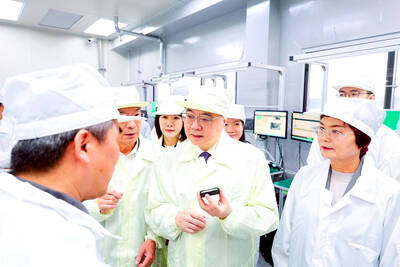
KEY INDUSTRY: The vice premier discussed a plan to create a non-red drone supply chain by next year, which has been allocated a budget of more than NT$7.2 billion The government has budgeted NT$44.2 billion (US$1.38 billion) to cultivate Taiwan’s uncrewed aerial vehicle (UAV) industry over the next five years, which would make the nation a major player in the industry’s democratic supply chain in the Asia-Pacific region, Premier Cho Jung-tai (卓榮泰) said yesterday. Cho made the remarks during a visit to the facilities of Cub Elecparts Inc (為升電裝). Democratic Progressive Party (DPP) Legislator Chen Su-yueh (陳素月) and Chinese Nationalist Party (KMT) Legislator Hsieh Yi-fong (謝依鳳) also participated in the trip. Cub Elecparts has transitioned from the automotive industry to the defense industry, which is the top priority among the nation’s
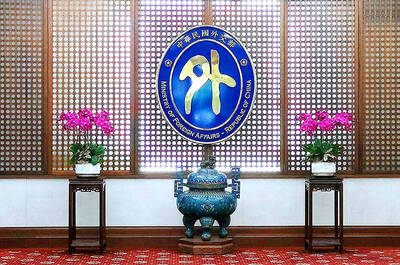
SOUTH KOREA DISPUTE: If Seoul continues to ignore its request, Taiwan would change South Korea’s designation on its arrival cards, the foreign ministry said If South Korea does not reply appropriately to a request to correct Taiwan’s name on its e-Arrival card system before March 31, the government would take corresponding measures to change how South Korea is labeled on the online Taiwan Arrival Card system, the Ministry of Foreign Affairs said yesterday. South Korea’s e-Arrival card system lists Taiwan as “China (Taiwan)” in the “point of departure” and “next destination” fields. Taipei has asked Seoul to change the wording. Since March 1, South Koreans who hold government-issued Alien Resident Certificates (ARC) have been identified as from “South Korea” rather than the “Republic of Korea,” the
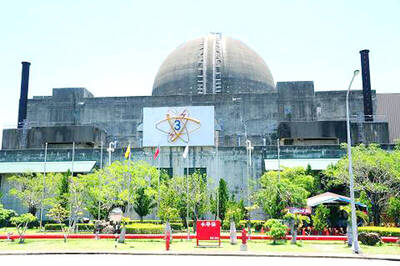
SUFFICIENT: The president said Taiwan has enough oil for next month, with reserves covering more than 100 days and natural gas enough for 12 to 14 days A restart plan for the Guosheng Nuclear Power Plant in New Taipei City’s Wanli District (萬里) and the Ma-anshan Nuclear Power Plant in Pingtung County’s Hengchun Township (恆春) would be submitted to the Nuclear Safety Commission by the end of the month, President William Lai (賴清德) said yesterday, reversing the government’s policy to abolish nuclear energy. On May 17 last year, Taiwan shut down its last nuclear reactor and became the first non-nuclear nation in East Asia, fulfilling the Democratic Progressive Party (DPP) government’s pledge of a “nuclear-free homeland.” Even without nuclear power, Taiwan can maintain a stable electricity supply until 2032,
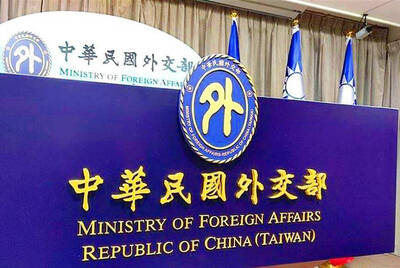
DEROGATORY: WTO host Cameroon’s designation of Taiwan as a ‘province of China’ seriously undermines the nation’s status and rights as a WTO member, MOFA said The Ministry of Foreign Affairs (MOFA) yesterday condemned Cameroon for listing Taiwan as “Taiwan, Province of China” in visa documents for an upcoming WTO ministerial conference, a move that led to Taiwan’s withdrawal from the event. The designation “seriously undermined” Taiwan’s status and rights as a WTO member, the ministry said in a statement. It is the first time since 2001 that Taiwan has declined to attend a WTO Ministerial Conference. The conference is scheduled to take place from Thursday to Sunday next week in Yaounde, the capital of Cameroon. Taiwan had planned to send a delegation led by Minister Without Portfolio


 RSS
RSS