


Thousands of Serbs chanting "Kosovo is Serbia" marched to a bridge dividing them from ethnic Albanians while others torched UN border checkpoints and cars to protest Kosovo's declaration of independence.
NATO troops later closed down the roads leading to the checkpoints on Tuesday, cutting off the only link between northern Kosovo and Serbia, UN spokesman Besim Hoti said.
The move appeared to be because of fears that the reduction of UN control of the border could allow Serbian militants to return to fight in Kosovo, a land Serb nationalists consider the cradle of their state and religion.
Smoke billowed from two posts separating Kosovo from Serbia and flames engulfed several UN vehicles set ablaze in protest against Kosovo's weekend proclamation of independence and because of anger over international recognition of the new nation.
For two days, Kosovo's Serbs have shown their determination to shun the declaration by destroying UN and NATO property, setting off small bombs and staging noisy rallies through the Serb stronghold of Kosovska Mitrovica.
The attacks on UN border crossings showed the protesters' willingness to use violence to hold on to Kosovo.
In Belgrade, the Serbian government minister for Kosovo, Slobodan Samardzic, hailed the attacks, saying "today's action is in accordance with the general [Serbian] government policies."
"Belgrade has the intention to take over the customs in northern Kosovo," Samardzic told private B92 television. "The customs points were intended to become part of [Kosovo's] state border and we are not going to let that happen."
The divided town of Kosovska Mitrovica in Kosovo's north has been tense since the ethnic Albanian leadership in Pristina unilaterally declared independence from Serbia on Sunday -- widely expected after internationally mediated talks on the province's future fell apart last year.
Overnight, three loud explosions shook the town; one damaged several cars near a UN building. Two hand grenades hit deserted homes that belonged to ethnic Albanians who fled this Serb stronghold after the 1999 war.
A UN vehicle was also torched overnight in a nearby village.
No injuries were reported, and Kosovo Serb authorities said they were investigating the bombings.
In Jarnije and Banja, 30km north of Kosovska Mitrovica, protesters used plastic explosives and bulldozers to wreck the two border checkpoint posts.
Protesters tipped over metal sheds that housed Kosovo's customs service and sent them sliding down a hill and into a river. They vandalized and set fire to passport control booths.
EU foreign policy chief Javier Solana visited Kosovo on Tuesday, a day after a majority of EU nations said they would formally launch diplomatic ties with the continent's newest country.
Solana met with Kosovo Prime Minister Hashim Thaci, who described the protests in Kosovska Mitrovica as "isolated incidents" that would not spoil Kosovo's independence festivities.
"NATO is there and everything is under control," Thaci said after meeting with Solana.
China will send a fresh deployment of peacekeeping police to Kosovo, state media said yesterday.
The contingent, 15 men and three women, will be sent to Kosovo early next month after three weeks of intense training, Xinhua news agency reported, citing the public security ministry.
They were picked among 70,000 police officers on the basis of their English, shooting and driving skills, and will be carrying out criminal investigations, traffic policing and VIP protection in Kosovo, the agency said.
China has been involved in the UN peacekeeping mission in Kosovo since 2004 and the latest deployment will be the nation's fifth contingent of forces.
They will replace a contingent of Chinese police who have been there since October 2006.
Also See: EDITORIAL: One rule for Kosovo, one for Taiwan
Also See: Europe's newest country will face economic challenges

‘NO SECURITY RISK’: The Railway Bureau reassured the public that the technicians’ activities were limited to technical guidance and did not involve sensitive systems The Railway Bureau yesterday said it had invited eight Chinese technicians to assist with an airport MRT construction project. The bureau issued the confirmation after an Internet user said Chinese nationals had entered the construction zone of Taiwan Taoyuan International Airport’s Terminal 3 project. They asked why “individuals from an enemy state” were allowed access to such a major national infrastructure project, which raised serious concerns over Taiwan’s industrial safety, sensitive systems and information security. The bureau’s Northern Region Engineering Branch Office said subcontractor Taiwan Handle Industrial Co (台灣手把工業) of the Taoyuan airport MRT’s “Contract No. CU05 Project A14 Station Civil, MEP &

A US uncrewed surface vessel (USV) encountered multiple Chinese warships during an autonomous transit of the Taiwan Strait, US defense company Seasats said in a statement on Wednesday. Seasats announced that a Lightfish USV had completed the first autonomous transit of the Taiwan Strait. Over five days, the USV traversed the entire length of the Strait while constantly monitoring surface vessel traffic, the company said. The Lightfish encountered multiple Chinese warships, one of which was a Chinese People’s Liberation Army Navy (PLAN) Type 056 corvette, it said. The Chinese vessels were operating “well within Taiwan’s exclusive economic zone without transmitting their identity via the
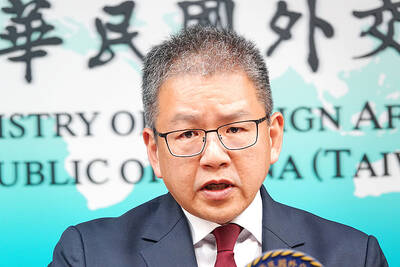
Taiwan is still in the process of assessing the possibility of recruiting workers from Eswatini, the Ministry of Foreign Affairs said yesterday, adding that its goal is to help Eswatini upgrade its vocational training centers. If there are plans to recruit workers from Eswatini, safeguarding national security, protecting public health and ensuring the employment rights of Taiwanese would be prerequisites, Department of West Asian and African Affairs Director-General Yen Chia-liang (顏嘉良) told a news conference. Key considerations would also include filling labor shortages in specific industries, and fostering bilateral professional and technical exchanges, he said. Yen was asked about the progress of labor

‘BOOMING’: ’ The number of partners we have here is incredible. You can see from their stock prices. They’re doing so well, they’re so happy,’ Jensen Huang said Nvidia Corp’s spending in Taiwan has ballooned to about US$150 billion a year, 10 times the US$10 billion to US$15 billion the company spent five years ago, Nvidia chief executive officer Jensen Huang (黃仁勳) said yesterday, suggesting Taiwan’s strategic importance in the global artificial intelligence (AI) supply chain. “Taiwan is the epicenter of the AI revolution. This is where the chips come, packaging comes. This is where the systems are made. This is where AI supercomputers were created,” Huang said at a meeting for the company’s employees in Beitou-Shilin Technology Park (北投士林科技園區) in Taipei, the planned site of Nvidia’s Taipei headquarters. “Taiwan


 RSS
RSS