


It's noon on a weekday, and Kosovo fashion designer Krenare Rugova's sewing machines are strangely silent.
Rugova, young and US-educated, is trying to build an upscale clothing business in her homeland. But she can't work because the power has gone out for the second time this morning.
"These blackouts are killing me," she said, fussing over fabrics at her studio in Vucitrn, a drab and dusty town of three-story brick houses tucked behind high walls 45km north of the capital, Pristina.
"They just shut me down. I'm thinking, `OK, I'll get all these wedding dresses finished in an hour,' and then `zap.' It's very frustrating," she said.
Her dilemma underscores the daunting economic challenges confronting Europe's newest country -- an impoverished, underdeveloped corner of the continent that experts warn could be a handout-dependent hardship case for years to come.
As Kosovo seeks international recognition of its declaration of independence, the round-the-clock rumble of thousands of portable power generators threatens to drown out the celebratory fireworks.
And its problems go far beyond an electricity grid so unreliable that just keeping the lights on can be a daily struggle.
Roads are badly rutted or unpaved. Joblessness runs close to 50 percent, and much of the work force is uneducated. The average monthly salary is a paltry US$220.
By virtually every measure, Kosovo joins the family of nations with the dubious distinction of being one of Europe's poorest.
It doesn't even have its own international telephone country code: Kosovo shares Monaco's, a holdover from the days when French Foreign Minister Bernard Kouchner was the top UN administrator here and Alcatel was chosen to develop the phone network.
"Everyone knows it's going to be hard," said Alex Anderson, Kosovo project director for the Brussels, Belgium-based International Crisis Group, which keeps tabs on trouble spots in the Balkans. "No one has the idea that it's going to be the land of milk and honey overnight."
Kosovo's late leader Ibrahim Rugova used to present visitors with crystals and other gems offered as proof of its untapped mineral wealth. Many snickered, but Rugova -- a distant relative of the fashion designer -- may have been on to something, said Shpend Ahmeti, executive director of the Policy Analysis Group, a think tank in Pristina.
Geologists conducting a thorough survey of Kosovo's resources say the province has vast amounts of high-quality lignite coal. They say it also has deposits of nickel, lead, zinc, bauxite and even small seams of gold that could be tapped in the future.
"Kosovo is richer than we thought," Ahmeti said.
But officials caution that Kosovo first desperately needs to improve its shoddy infrastructure -- battered by its 1998 to 1999 war between Yugoslav forces and ethnic Albanian rebels -- if it is to have a decent shot at an economic future for its 2 million people.
The government has been reviewing bids for a US$4 billion contract to build a lignite coal-fired power plant that officials say would end the electricity outages. But the plant won't be fully operational until 2012 at the earliest.
Eight in 10 business owners point to the lack of reliable energy as their biggest obstacle, Ahmeti said -- bigger than high taxes or rampant corruption.
For the foreseeable future, an independent Kosovo will remain heavily dependent on handouts from the UN and the EU, which plans to convene an international donors' conference in June.
Last year, the UN budget for Kosovo was US$220 million. Kosovo's economy was propped up with another US$540 million in remittances from Kosovars living abroad, according to estimates from the International Monetary Fund -- cash the young country probably won't be able to do without for years to come.
Kosovo also risks a hard economic hit from Serbia, which fiercely opposes its independence bid. About 20 percent of Kosovo's trade is with Serbia.
Even so, Anderson contends the untold story is Kosovo's potential, which he thinks is formidable. Its modest metal processing sector is boosting its productivity, "beginning to lead not a revolution but an evolution," he said.
And with half the population under the age of 25, there's a strong and viable work force.
Krenare Rugova's fashion studio, which turns out creations inspired by European and New York attitudes which proudly bear "Made in Kosovo" labels, nicely mirrors that trend.
Rugova, a 27-year-old graduate of Parsons School of Design in New York City, employs nearly a dozen mostly young workers and hopes eventually to hire 30. She's an ethnic Albanian, but has a couple of Serbs on her payroll.
"As long as they can sew, I don't care," she said.
"Independence will just create more opportunities," Rugova said. "Things will change. Maybe not right away. But in five years, it will be a different Kosovo."
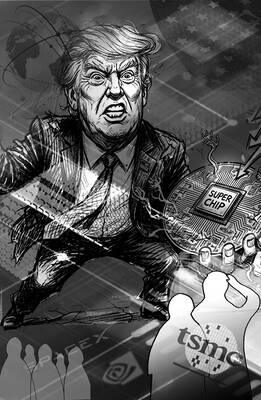
The White House’s decision to take a 9.9 percent stake in Intel Corp is looking like very shrewd business indeed. Since the government bought in at US$20.47 a share last August, the US chipmaker’s surging stock price has delivered the US a US$43 billion return. One of the reasons the investment has so far proved so sound is that the White House has made sure of it. According to The Wall Street Journal, Howard personally pushed deals on Intel’s behalf with some of the most lucrative clients imaginable. They include Nvidia Corp, the company at the heart of the AI
In a Taiwanese university classroom, a lecturer asks in English: “Can anyone give me an example from Taiwan?” Students look down. No one answers. After class, one student writes on the course platform in Mandarin: “I understood the concept, but I didn’t know how to answer in English.” That moment highlights a key issue in Taiwan’s English-medium instruction (EMI) reform: It is not just about more English-taught courses, but whether students can learn, participate and belong. EMI expansion is part of the Bilingual 2030 policy and the Ministry of Education’s BEST Program, aiming to improve English ability, support EMI teaching
A single photograph can cut through a lot of noise, but it can also be used to misrepresent the truth. At the very least, it can concentrate the mind on something that requires further investigation. On Monday last week, Ma Ying-jeou Foundation CEO Tai Hsia-ling (戴遐齡) and former National Security Council secretary-general King Pu-tsung (金溥聰) held a news conference in which they showed a photograph of former foundation CEO Hsiao Hsu-tsen (蕭旭岑), now Chinese Nationalist Party (KMT) deputy chairman. In the image Hsiao is seated next to Xiamen Taiwan Businessmen Association chairman Han Ying-huan (韓螢煥). The two men were holding
The Ministry of the Interior, working with the navy and coast guard, is organizing Taiwan’s first joint exercise simulating escort tankers carrying liquefied natural gas (LNG) and oil through a Chinese blockade. The drills simulate fuel transport along three maritime corridors leading toward Japan, the Philippines and the US. Deputy Minister of the Interior Sawyer Mars (馬士元) said that a blockade of the Taiwan Strait would amount to “almost a 100 percent blockade of the regional energy supply.” Minister of National Defense Wellington Koo said planning to counter a blockade is standard practice in Taipei. While the exercise is limited in


 RSS
RSS