


North and South Korea began regular cargo train service across their heavily armed border yesterday for the first time in more than a half century, in another symbolic step in their reconciliation.
The 12-car train carried construction materials to a North Korean border station, and then returned home carrying shoes, underwear and other items produced at a South-North joint industrial complex in Kaesong.
The service is one of the tangible results of an October summit between North Korean leader Kim Jong-il and South Korean President Roh Moo-hyun that outlined a series of joint projects. It comes months after the two sides conducted a one-time test run of passenger trains on two reconnected tracks on the western and eastern sides of the Korean Peninsula.
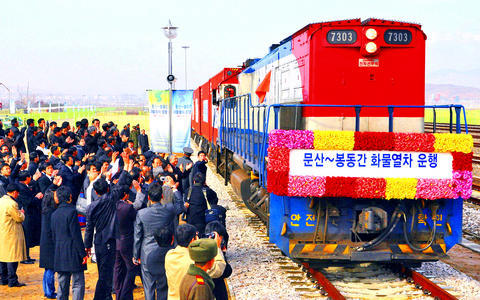
PHOTO: AP/YONHAP
The cargo train is to make a 16.5km round trip every weekday to North Korea. It remains unclear whether regular passenger train service will start anytime soon, but one of the train's engineers was hopeful yesterday.
"I expect a day will come when South Koreans visit North Korean tourist attractions freely by train," Shin Jang-chul, whose parents are from what is now North Korea, told reporters before departing.
South Korea hopes the inter-Korean railway will ultimately be linked through North Korea to Russia's Trans-Siberian railroad and allow an overland route connecting the peninsula to Europe.
"Though we start with a cargo train, it will lead to a passenger train service and will soon be linked to the continental trains," Lee Chul, president of Korea Railroad, told reporters. "The economic benefits are countless."
The cargo rail service is likely to give a further boost to the sprawling Kaesong complex, which marries South Korean technology and management expertise with the North's cheap labor.
Currently, 64 South Korean companies operate factories there, employing about 21,600 North Korean workers and producing a range of goods including watches, clothing and shoes.
Meanwhile, South Korea's navy rescued five North Korean fisherman who drifted for 27 days after their ship's engine failed and ended up in Southern waters, Yonhap news agency reported yesterday.
The five were being treated for hypothermia and malnutrition, and would be allowed to return to the North if they so wished, Yonhap quoted a South Korean navy official as saying.
In other news, Pyongyang accused the US yesterday of being reckless criminals trying to stir up war with its recent deployment of fighter jets and other armaments in and around South Korea.
"Such moves are a part of the US conservative hardliners' invariable hostile policy toward the DPRK [North Korea] and a reckless criminal act of chilling the denuclearization process in the Korean Peninsula and driving the situation into the brink of war," said the communist party mouthpiece, Rodong Sinmun.
The report comes just days after US President George W. Bush made his first direct appeal to Kim Jong-il in a letter delivered last week. Bush urged Kim to make good on his country's pledge to disable its nuclear arms complex and declare all of its nuclear activities.
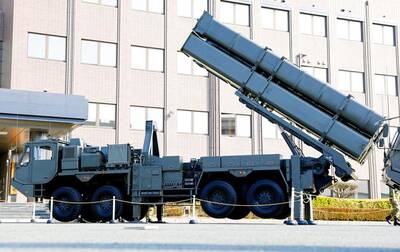
Japan has deployed long-range missiles in a southwestern region near China, the Japanese defense minister said yesterday, at a time when ties with Beijing are at their lowest in recent years. The missiles were installed in Kumamoto in the southern region of Kyushu, as Japan is attempting to shore up its military capacity as China steps up naval activity in the East China Sea. “Standoff defense capabilities enable us to counter the threat of enemy forces attempting to invade our country ... while ensuring the safety of our personnel,” Japanese Minister of Defense Shinjiro Koizumi said. “This is an extremely important initiative for
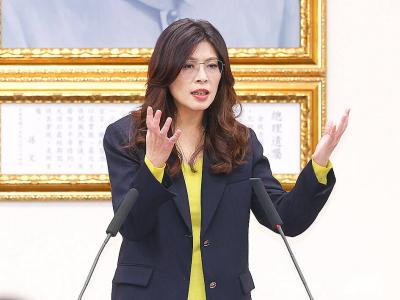
Chinese Nationalist Party (KMT) Chairwoman Cheng Li-wun (鄭麗文) today accepted an invitation from Chinese President Xi Jinping (習近平) to lead a delegation to China next month, saying she hopes to promote the peaceful development of cross-strait relations and bring stability to the Taiwan Strait. “I am grateful and happy to accept this invitation,” Cheng said in a statement from the KMT chairperson’s office. Cheng said she hopes both sides can work together to promote the peaceful development of cross-strait relations, enhance exchange and cooperation, bring stability to the Taiwan Strait and improve people’s livelihoods. At today's news conference, Cheng said any efforts to
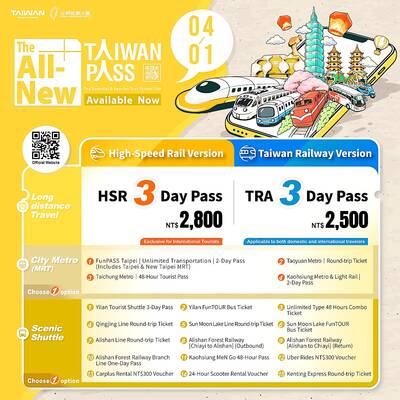
MORE POPULAR: Taiwan Pass sales increased by 59 percent during the first quarter compared with the same period last year, the Tourism Administration said The Tourism Administration yesterday said that it has streamlined the Taiwan Pass, with two versions available for purchase beginning today. The tourism agency has made the pass available to international tourists since 2024, allowing them to access the high-speed rail, Taiwan Railway Corp services, four MRT systems and four Taiwan Tourist Shuttles. Previously, five types of Taiwan Pass were available, but some tourists have said that the offerings were too complicated. The agency said only two types of Taiwan Pass would be available, starting from a three-day pass with the high-speed rail and a three-day pass with Taiwan Railway Corp. The former costs NT$2,800

The nation’s fastest supercomputer, Nano 4 (晶創26), is scheduled to be launched in the third quarter, and would be used to train large language models in finance and national defense sectors, the National Center for High-Performance Computing (NCHC) said. The supercomputer, which would operate at about 86.05 petaflops, is being tested at a new cloud computing center in the Southern Taiwan Science Park in Tainan. The exterior of the server cabinet features chip circuitry patterns overlaid with a map of Taiwan, highlighting the nation’s central position in the semiconductor industry. The center also houses Taiwania 2, Taiwania 3, Forerunner 1 and


 RSS
RSS