


Japan's main opposition leader Ichiro Ozawa headed to China yesterday, upstaging the prime minister amid a deadlock in the divided parliament over support for the US-led "war on terror."
Ozawa is expected to meet with President Hu Jintao (
The visit comes before an expected first trip to China by Prime Minister Yasuo Fukuda, a veteran centrist who took over in September and is known for his advocacy of warmer relations with Beijing.
Fukuda subtly criticized Ozawa's visit. The prime minister has been pushing for the opposition-led upper house to pass a bill by the end of parliament's session on Dec. 15 to resume a naval mission supporting US-led forces in Afghanistan.
"Does this mean he doesn't feel any pressure?" Fukuda asked about Ozawa. "I have nothing to say as long as they pass the bill without any problems."
Nobutaka Machimura, the chief spokesman for Fukuda's Liberal Democratic Party-led (LDP) government, was more open about his displeasure.
"So many of his party members left the country when the parliament session is coming to an important stage in debate. The LDP would have never allowed it," he said. "The LDP has better principles, better standards of judgment."
Ozawa is accompanied by 44 members of his Democratic Party of Japan (DPJ), including his deputy Naoto Kan, along with some 400 members of the public invited for a grassroots exchange, a party official said.
Ozawa, who has visited China annually since 1989 with his exchange program, said to reporters ahead of his departure only: "I've done this every year."
Relations with China have become a major political issue in Japan, with business leaders expressing concern about upsetting the country's largest commercial partner.
China cut off all high-level dialogue with Japan during the premiership of Junichiro Koizumi, who infuriated Beijing and Seoul by visiting a shrine to war dead associated with Japan's past militarism.
Koizumi's successor, Shinzo Abe, despite a conservative ideology and past support for the Yasukuni shrine, moved to repair ties with China during his one-year tenure, which was marred by domestic scandals and an election defeat.
Fukuda has pledged not to visit the shrine, saying the pilgrimage was needlessly provocative.
Ozawa went ahead with the visit even though DPJ secretary- general Yukio Hatoyama last month met Tibet's exiled spiritual leader the Dalai Lama and expressed support for his cause.
Fukuda's government refused to see the Nobel peace laureate, whose visits overseas are regularly condemned by China.
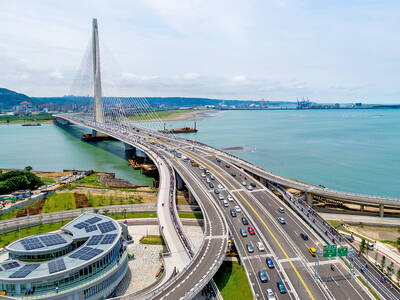
The Ministry of Transportation and Communications yesterday inaugurated the Danjiang Bridge across the Tamsui River in New Taipei City, saying that the structure would be an architectural icon and traffic artery for Taiwan. Feted as a major engineering achievement, the Danjiang Bridge is 920m long, 211m tall at the top of its pylon, and is the longest single-pylon asymmetric cable-stayed bridge in the world, the government’s Web site for the structure said. It was designed by late Iraqi-British architect Zaha Hadid. The structure, with a maximum deck of 70m, accommodates road and light rail traffic, and affords a 200m navigation channel for boats,
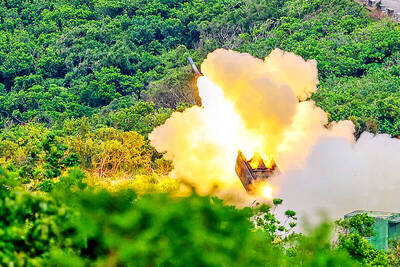
PRECISION STRIKES: The most significant reason to deploy HIMARS to outlying islands is to establish a ‘dead zone’ that the PLA would not dare enter, a source said A High Mobility Artillery Rocket System (HIMARS) would be deployed to Penghu County and Dongyin Island (東引) in Lienchiang County (Matsu) to force the Chinese military to retreat at least 100km from the coastline, a military source said yesterday. Taiwan has been procuring HIMARS and Army Tactical Missile Systems (ATACMS) from the US in batches. Once all batches have been delivered, Taiwan would possess 111 HIMARS units and 504 ATACMS, which have a range of 300km. Considering that “offense is the best defense,” the military plans to forward-deploy the systems to outlying islands such as Penghu and Dongyin so that
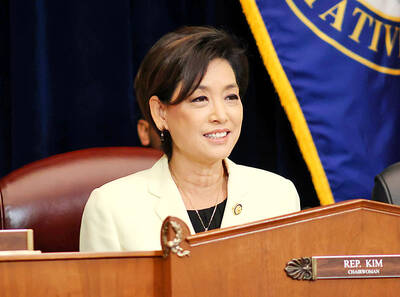
‘CLEAR MESSAGE’: The bill would set up an interagency ‘tiger team’ to review sanctions tools and other economic options to help deter any Chinese aggression toward Taiwan US Representative Young Kim has introduced a bill to deter Chinese aggression against Taiwan, calling for an interagency “tiger team” to preplan coordinated sanctions and economic measures in response to possible Chinese military or political action against Taiwan. “[Chinese President] Xi Jinping [習近平] has directed the People’s Liberation Army to be ready to invade Taiwan by 2027. China has a plan. America should have one too,” Kim said in a news release on Thursday last week. She introduced the “Deter PRC [People’s Republic of China] aggression against Taiwan act” to “ensure the US has a coordinated sanctions strategy ready should

TAIWAN ISSUE: US treasury secretary Scott Bessent said on the first day of meetings that ‘it wouldn’t be a US-China summit without the Taiwan issue coming up’ There were no surprises on the first day of the summit between US President Donald Trump and Chinese President Xi Jinping (習近平), the Mainland Affairs Council (MAC) said yesterday, as the government reiterated that cross-strait stability is crucial to the Asia-Pacific region, as well as the world. As the two presidents met for a highly anticipated summit yesterday, Chinese state media reported that Xi warned Trump that missteps regarding Taiwan could push their two countries into “conflict.” Trump arrived in China with accolades for his host, calling Xi a “great leader” and “friend,” and extending an invitation to visit the White House


 RSS
RSS