


The captured chief cleric of the Red Mosque led funeral prayers for his slain brother yesterday and forecast that the death of the mosque's militant defenders would push Pakistan toward an "Islamic revolution."
The army crackdown on the radical mosque has raised the standing of President General Pervez Musharraf among moderates and foreign backers worried about rising extremism in Pakistan. But it has given hard-liners a rallying point and new martyrs to mourn, prompting calls from al-Qaeda and Taliban for revenge attacks.
Troops combing the Islamabad mosque and its adjoining seminary for girls found Abdul Rashid Ghazi's body among the remains of at least 73 people after the 35-hour assault ended on Wednesday.
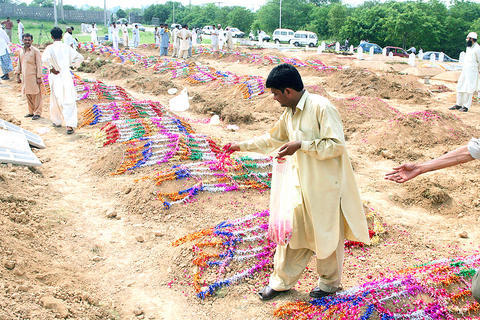
PHOTO: AFP
The remains of dozens of militants were lowered into temporary graves in Islamabad early yesterday.
Officials released Ghazi's body directly to his relatives, who carried it to his ancestral village in Punjab Province for burial yesterday.
Police escorted Maulana Abdul Aziz, who was caught during the eight-day siege while trying to flee disguised as a woman, to Basti Abdullah so that he could attend his brother's funeral at a seminary set up by his father.
The brother took over the running of the Red Mosque in the capital after their father's assassination in a sectarian attack in 1998.
"Hundreds of our mothers, sisters, sons and daughters have rendered sacrifices," said Aziz, a gray-bearded man dressed in white clothes and a checkered head scarf, before leading prayers attended by about 3,000 people.
"Whatever happened in the past days is not hidden from anyone. God willing, Pakistan will have an Islamic revolution soon. The blood of martyrs will bear fruit," he said.
"We can let our necks be severed but we cannot bow down before oppressive rulers. Our struggle will continue. There are many Ghazis living to be martyred," he said.
About two dozen police commandos led Aziz into the madrasah compound and escorted him back after the funeral prayers and drove him away in a white police pickup truck.
Some 700 police were deployed for security at the gathering, area police chief Maqsoodul Hassan Chaudhry said.
Official reports said that 106 people died in eight days of fighting around the Red Mosque.
Meanwhile, al-Qaeda's deputy leader joined the militant outcry against Musharraf, calling on Pakistanis to wage holy war to avenge the army assault.
In a video, Ayman al-Zawahri told Pakistanis their president "rubbed your honor in the dirt."
Ghazi's death was a "dirty, despicable crime" that can "only be washed away by repentance or blood," said al-Zawahri, who is believed to be hiding near the Pakistan-Afghanistan border.

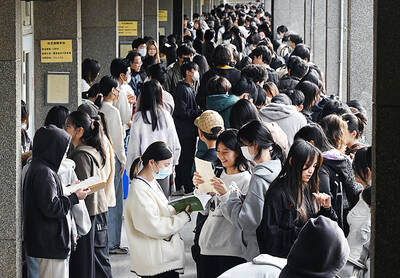
A global survey showed that 60 percent of Taiwanese had attained higher education, second only to Canada, the Ministry of the Interior said. Taiwan easily surpassed the global average of 43 percent and ranked ahead of major economies, including Japan, South Korea and the US, data from the Organisation for Economic Co-operation and Development (OECD) for 2024 showed. Taiwan has a high literacy rate, data released by the ministry showed. As of the end of last year, Taiwan had 20.617 million people aged 15 or older, accounting for 88.5 percent of the total population, with a literacy rate of 99.4 percent, the data

NEW LOW: The council in 2024 based predictions on a pessimistic estimate for the nation’s total fertility rate of 0.84, but last year that rate was 0.69, 17 percent lower An expected National Development Council (NDC) report expects the nation’s population to drop below 12 million by 2065, with the old-age dependency ratio to top 100 percent sooner than 2070, sources said yesterday. The council is slated to release its latest population projections in August, using an ultra-low fertility model, the sources said. The previous report projected that Taiwan’s population would fall to 14.37 million by 2070, but based on a new estimate of the total fertility rate (TFR) — the average number of children born to a woman over her lifetime — the population is expected to reach 12 million by

COUNTERING HOSTILITY: The draft bill would require the US to increase diplomatic pressure on China and would impose sanctions on those who sabotage undersea cable networks US lawmakers on Thursday introduced a bipartisan bill to bolster the resilience of Taiwan’s submarine cables to counter China’s hostile activities. The proposal, titled the critical undersea infrastructure resilience initiative act, was cosponsored by Republican representatives Mike Lawler and Greg Stanton, and Democratic Representative Dave Min. US Senators John Curtis and Jacky Rosen also introduced a companion bill in the US Senate, which has passed markup at the chamber’s Committee on Foreign Relations. The House’s version of the bill would prioritize the deployment of sensors to detect disruptions or potential sabotage in real-time and enhance early warning capabilities through global intelligence sharing frameworks,
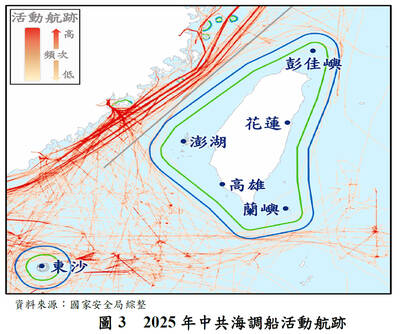
INTENSIFYING THREATS: Beijing’s tactics include massive attacks on the government service network, aircraft and naval vessel incursions and damaging undersea cables China is prepared to interfere in November’s nine-in-one local elections by launching massive attacks on the Taiwanese government’s service network (GSN), a report published by the National Security Bureau showed. The report was submitted to the Legislative Yuan ahead of the bureau’s scheduled briefing at the Foreign Affairs and National Defense Committee tomorrow. The national security team has identified about 13,000 suspicious Internet accounts and 860,000 disputed messages, the bureau said of China’s cognitive warfare against Taiwan. The disputed messages focus on major foreign affairs, national defense and economic issues, which were produced using generative artificial intelligence (AI) and distributed through Chinese


 RSS
RSS