


Swiss authorities on Wednesday returned US$34 million in frozen bank deposits to Taiwan that were believed to be kickbacks connected to the purchase of six Lafayette-class frigates from France in 1991, Swiss officials said.
Officials at the Swiss Department of Justice said the funds belonged to two different account holders but declined to identify them, saying only that one of them was a Taiwanese official.
The officials said that according to Switzerland's Federal Act on International Mutual Assistance in Criminal Matters, frozen capital assets can be released to foreign governments if they are related to criminal activities.
The funds were handed over to Taiwanese officials on the condition that legal proceedings against the two people concerned would comply with human rights principles, they said.
The sum is part of a total of US$520 million that Taiwan has sought to recover from a number of frozen Swiss bank accounts belonging to several Taiwanese involved in the scandal, including fugitive arms dealer Andrew Wang (
Proceedings for the retrieval of the remaining funds are ongoing, the officials said.
Kickbacks
Wang was a Taiwanese agent for French arms supplier Thompson-CSF. He fled the country following the death of Navy Captain Yin Ching-feng (尹清楓) under suspicious circumstances in late 1993. It is believed that Yin was poised to blow the whistle on colleagues who had received kickbacks from the Lafayette deal.
Wang has been wanted by Taiwanese prosecutors on a murder charge since September 2000.
Concluding a second-phase investigation into the arms procurement scandal in September last year, a special judicial panel in Taiwan indicted Wang and his wife, Yeh Hsiu-chen (葉秀貞), as well as their four children and the Kuo brothers on charges of collecting kickbacks from the Lafayette deal.
According to the indictment, the Wangs opened more than 60 bank accounts in Europe and Asia to launder US$520 million in illicit gains from the deal.
Taiwan began to seek assistance from the Swiss government in 2001 to retrieve funds frozen in several Swiss banks.
Through a judicial aid agreement with Switzerland, Taiwanese prosecutors acquired a collection of bank files from a Swiss federal judge in November 2005. After nearly 10 months of examination of the files, Taiwan petitioned in September last year for the return of US$520 million from a total of US$730 million frozen in the Swiss banks.
Additional reporting by AP
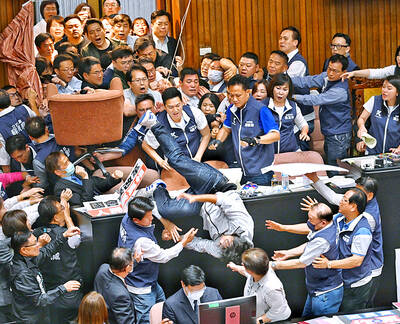
MUSICAL INTERLUDE: During the altercations, KMT Legislator Hsu Chiao-hsin at one point pulled out a flute and started to play the national anthem A massive brawl erupted between governing and opposition lawmakers in the main chamber of the legislature in Taipei yesterday over legislative reforms. President-elect William Lai (賴清德) is to be inaugurated on Monday, but his Democratic Progressive Party (DPP) lost its majority in the legislature and the Chinese Nationalist Party (KMT) has been working with the Taiwan People’s Party (TPP) to promote their mutual ideas. The opposition parties said the legislative reforms would enable better oversight of the Executive Yuan, including a proposal to criminalize officials who are deemed to make false statements in the legislature. “The DPP does not want this to be
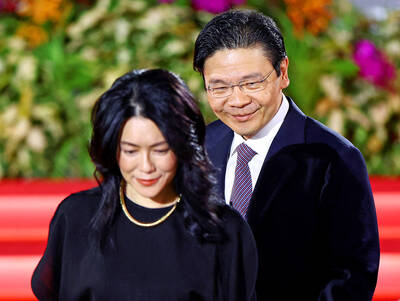
Singapore yesterday swore in Lawrence Wong (黃循財) as the city-state’s new prime minister in a ceremony broadcast live on television after Lee Hsien Loong (李顯龍) stepped down following two decades in office. Wong, formerly deputy prime minister, was inaugurated at the Istana government office shortly after 8pm to become the second person outside the Lee family to lead the nation. “I ... do solemnly swear that I will at all times faithfully discharge my duties as prime minister according to law, and to the best of my knowledge and ability, without fear or favor, affection or ill-will. So help me God,” the
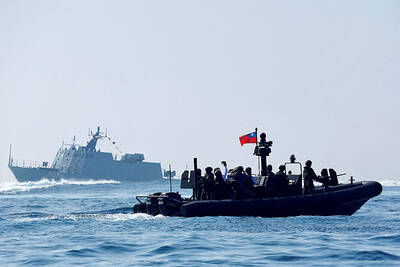
BASIC OPERATIONS: About half a dozen navy ships from both countries took part in the days-long exercise based on the Code for Unplanned Encounters at Sea An unpublicized joint military exercise between Taiwan and the US in the Pacific Ocean last month was carried out in accordance with an international code, the Ministry of National Defense (MND) said yesterday. According to a Reuters report citing four unnamed sources, the two nations’ navies last month conducted joint drills in the Western Pacific. The drills were not made public at the time, but “about half-a-dozen navy ships from both sides, including frigates and supply and support vessels, participated in the days-long exercises,” Reuters reported, citing the sources. The drills were designed to practice “basic” operations such as communications, refueling and resupplies,

A group of 30 foreign academics yesterday released a statement condemning legislative reforms proposed by opposition lawmakers, saying they are unconstitutional and undermine the objective of good governance. The statement publicized at a news conference in Taipei is cosigned by international academics, journalists and politicians, including former American Institute in Taiwan directors William Stanton and Stephen Young, and Formosan Association for Public Relations president Bob Yang (楊英育). The Chinese Nationalist Party (KMT) and Taiwan People’s Party (TPP) have put forward a set of legislative reforms that would introduce “contempt of legislature” charges, require the president to answer lawmakers’ questions and expand the


 RSS
RSS