


Trains from North and South Korea yesterday crossed the heavily fortified border for the first time since the 1950-1953 war, in what both sides called a milestone for reconciliation.
One train from the South crossed the Military Demarcation Line at 12:17pm on the western side of the peninsula. A train from the North traversed the border along the east coast minutes later.
"A new chapter for peace is opening in Korean history," the South's Unification Minister Lee Jae-joung said.
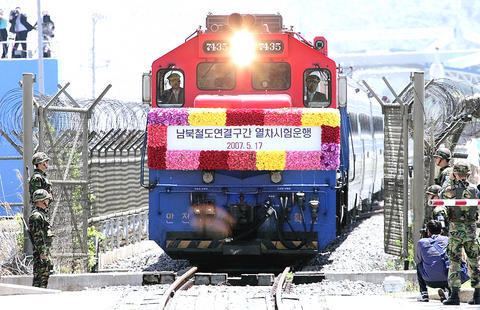
PHOTO: AP
"This will be a turning point for overcoming the legacy of the Cold War era, tearing down the wall of division and opening a new era for peace and reunification," Lee said.
His Northern counterpart, Kwon Ho-ung, in an apparent reference to the US, said the division had been "forced upon us by foreign forces."
He said both sides would strive "to ensure that the train for reunification driven by the North and South rushes forward along the track for peace and solidarity."
Relatives of people kidnapped by the North staged a small protest at Munsan Station in the South, accusing the government of ignoring their plight.
But officials at the station would let nothing ruin the celebration as they saw their train off. Firecrackers exploded, balloons soared and crowds waved white-and-blue Korean "reunification" flags.
"The Iron Horse gallops again!" read one message.
The five-car train left Munsan for Kaesong in the North along a 27km stretch of track. The other train left Mount Kumgang Station for the South's Jejin Station on a 25km track.
Each carried 100 South Koreans and 50 North Koreans.
"It took more than half a century to cross this short ... distance. We have to prevent anyone from blocking the railways. They were so hard to reconnect," North Korean railway minister Kim Yong-sam said at Jejin.
The South's train slowed to a crawl as it neared a high fence topped with barbed wire at the edge of the 4km-wide Demilitarized Zone bisecting the peninsula.
A gate was swung shut again after the train passed and went on to cross the border in the middle of the zone.
Yesterday's trips were one-off test runs, as the North refuses to give a longer-lasting security guarantee.
The South wants regular trips to serve an inter-Korean industrial estate at Kaesong and a tourist resort at Mount Kumgang. Cross-border roads alongside the railways opened in 2005.
The rail project was agreed at a 2000 summit, the first and only one between two states which are still technically at war. Workers have spent years re-laying the track -- with the South footing the bill for work in the North -- and clearing minefields.
A planned test run last year was canceled by the North at the last minute. Relations soured further after Pyongyang's missile launches last July and nuclear test in October.
But ties improved after the North agreed in principle at six-nation negotiations in February to scrap its atomic programs.
JoongAng Ilbo newspaper, tallying the cost of aid and track-laying in the North, said the "ticket" of each South Korean passenger on the trains had cost 2.1 billion won (US$2.2 million).
At Munsan, between 20 and 30 relatives of abductees held a banner proclaiming, "The Inter-Korean railway is nothing more than a castle built on sand."
Seoul says 485 of its citizens have been kidnapped by the North in the past half century. But the North says it holds no Southerners against their will.

‘NO SECURITY RISK’: The Railway Bureau reassured the public that the technicians’ activities were limited to technical guidance and did not involve sensitive systems The Railway Bureau yesterday said it had invited eight Chinese technicians to assist with an airport MRT construction project. The bureau issued the confirmation after an Internet user said Chinese nationals had entered the construction zone of Taiwan Taoyuan International Airport’s Terminal 3 project. They asked why “individuals from an enemy state” were allowed access to such a major national infrastructure project, which raised serious concerns over Taiwan’s industrial safety, sensitive systems and information security. The bureau’s Northern Region Engineering Branch Office said subcontractor Taiwan Handle Industrial Co (台灣手把工業) of the Taoyuan airport MRT’s “Contract No. CU05 Project A14 Station Civil, MEP &

The National Chungshan Institute of Science and Technology yesterday showcased its locally developed variants of the Vision 60 robotic patrol dog, which it plans to deploy on the nation’s outlying territories in the South China Sea. The variants were produced under the Joint Lab project — created by the institute and domestic companies — and assembled with domestically produced motors, lenses and artificial intelligence (AI) systems alongside licensed tech from the US, Missile and Rocket Systems Research Division deputy director Jen Kuo-kang (任國光) told the media event at a military base in Taipei’s Dazhi (大直) area. Taiwan has built up its strengths

TIT-FOR-TAT: The US allegedly revoked the visa of a Chinese national working at Xinhua News Agency in the US in response to Beijing’s expulsion of Vivian Wang The Presidential Office yesterday condemned China for expelling a New York Times correspondent from Beijing following the newspaper’s interview with President William Lai (賴清德), saying the move highlighted Beijing’s suppression of press freedom and its threat to international news media. Taiwan has noted a series of recent incidents in which Beijing used similar tactics to “threaten and pressure international media outlets and journalists,” Presidential Office spokeswoman Karen Kuo (郭雅慧) said in a statement. “This concerns not only press freedom and freedom of expression, but also the safety of journalists, and Taiwan and relevant partners are paying close attention to the situation,” she

NOT IMMEDIATE: Taiwan has a chance to appeal the proposed 10 percent tariff before it starts, while other countries face a 12.5 percent tariff from the trade office Taiwan is among 60 economies determined by the US to have failed to impose or enforce a ban on the importation of goods produced with forced labor, according to a notice released on Tuesday by the Office of the US Trade Representative (USTR), which proposed imposing an additional 10 percent or more tariff on them. The USTR in a statement said that following an investigation, it had determined under Section 301 of the Trade Act of 1974 that the failure of the 60 economies to impose and effectively enforce a prohibition on the importation of goods produced with forced labor is


 RSS
RSS