


The national police chief declared yesterday's midterm elections "relatively peaceful" even though eight more people were killed in violence that has become the hallmark of the Philippines' volatile political process.
There were scattered reports of vote-buying and other cheating incidents, with balloting postponed in several districts, particularly in the south.
"It was a picture of chaos," said Joe Dizon, a Roman Catholic priest from the election watchdog Kontra Daya, or "against cheating."
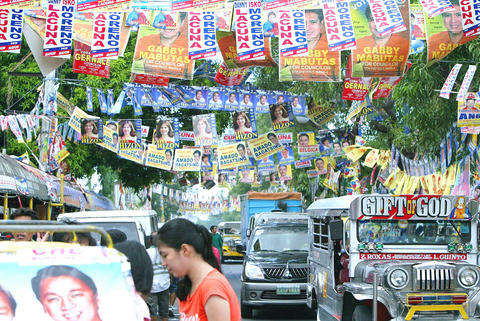
PHOTO: EPA
"There was confusion in many areas. The elections have not improved," he said.
The fatalities took the death toll to 121 since campaigning for the midterm elections began four months ago. By comparison, the 2004 election left 189 dead.
But warnings that communist rebels might try to disrupt the balloting with a rash of attacks proved to be unfounded with security forces on their highest alert level.
"We have noted a relatively peaceful situation nationwide, and I am confident that this will be the ultimate outcome until after the entire election process is completed," national police Director General Oscar Calderon said.
Calderon said there were some pockets of violence, but claimed they weren't bad enough to dampen the spirits of the electorate.
"There are intense fights in all campaigns, but let us be gracious, win or lose," President Gloria Macapagal Arroyo said in a statement.
The Supreme Court designated 111 regional tribunals to handle allegations of fraud.
Filipinos were electing 12 out of 24 senators, all 236 House of Representatives members and nearly 17,500 governors, mayors and other local officials.
Election officials projected turnout at 75 percent of the 45 million registered voters as people took advantage of the day off, sunny skies and tight security. Counting is done by hand, so official results are weeks away, but opinion polls showed the opposition certain to hold onto control of the Senate.
Also see story:
Catholic Church still the boss

The National Chungshan Institute of Science and Technology yesterday showcased its locally developed variants of the Vision 60 robotic patrol dog, which it plans to deploy on the nation’s outlying territories in the South China Sea. The variants were produced under the Joint Lab project — created by the institute and domestic companies — and assembled with domestically produced motors, lenses and artificial intelligence (AI) systems alongside licensed tech from the US, Missile and Rocket Systems Research Division deputy director Jen Kuo-kang (任國光) told the media event at a military base in Taipei’s Dazhi (大直) area. Taiwan has built up its strengths

RIGHT DIRECTION: Taiwan’s efforts to prevent forced labor include a proposal to ‘fully prohibit’ employers from withholding workers’ documents, an official said Taiwan is to establish a mechanism to restrict imports of goods linked to forced labor, the Executive Yuan said yesterday, after the US proposed imposing additional tariffs on Taiwanese goods over labor concerns. “The Ministry of Labor and the Ministry of Economic Affairs are to establish an interministerial review procedure,” Executive Yuan spokesperson Michelle Lee (李慧芝) said at a news briefing in Taipei. “The government is to use the Foreign Trade Act [貿易法] as the legal basis to restrict imports of goods produced with forced labor” and bring its supply chain governance more in line with international standards on human rights, resilience

NOT IMMEDIATE: Taiwan has a chance to appeal the proposed 10 percent tariff before it starts, while other countries face a 12.5 percent tariff from the trade office Taiwan is among 60 economies determined by the US to have failed to impose or enforce a ban on the importation of goods produced with forced labor, according to a notice released on Tuesday by the Office of the US Trade Representative (USTR), which proposed imposing an additional 10 percent or more tariff on them. The USTR in a statement said that following an investigation, it had determined under Section 301 of the Trade Act of 1974 that the failure of the 60 economies to impose and effectively enforce a prohibition on the importation of goods produced with forced labor is

TIT-FOR-TAT: The US allegedly revoked the visa of a Chinese national working at Xinhua News Agency in the US in response to Beijing’s expulsion of Vivian Wang The Presidential Office yesterday condemned China for expelling a New York Times correspondent from Beijing following the newspaper’s interview with President William Lai (賴清德), saying the move highlighted Beijing’s suppression of press freedom and its threat to international news media. Taiwan has noted a series of recent incidents in which Beijing used similar tactics to “threaten and pressure international media outlets and journalists,” Presidential Office spokeswoman Karen Kuo (郭雅慧) said in a statement. “This concerns not only press freedom and freedom of expression, but also the safety of journalists, and Taiwan and relevant partners are paying close attention to the situation,” she


 RSS
RSS