


Iranian President Mahmoud Ahmadinejad yesterday defied Western threats to impose more sanctions over Iran's contested nuclear program, comparing its atomic drive to a "train with no brakes."
Ahmadinejad's declaration came a day before the UN Security Council's five permanent members plus Germany are to meet to discuss the possiblity of more punitive measures against Tehran.
"Iran has reached the technology to produce nuclear fuel and Iran's movement on this path is like a train on a one-way track with no room for stopping, reverse gear or braking," the president told a gathering of religious leaders.
"A while ago, we threw away the reverse gear and the brakes of the train and we announced to them that this Iranian train has no reverse gear or braking," the ISNA and Fars news agencies quoted Ahmadinejad as saying.
Sanctions
The UN Security Council in December imposed limited sanctions against Tehran over its refusal to suspend uranium enrichment, a process that the West fears could be used to make nuclear weapons.
A report by the UN atomic watchdog has confirmed that Iran is still continuing with uranium enrichment work in defiance of the UN Security Council, opening the way towards possible further sanctions.
The US has never ruled out the prospect of military action to halt Iran's nuclear program and US Vice President Dick Cheney reignited such speculation by saying that "all options are still on the table."
The US and Israel accuse Iran of seeking nuclear weapons. Tehran denies the charges, insisting its atomic program is peaceful.
"We have prepared ourselves for any situation, even if war happens," Deputy Foreign Minister Manouchehr Mohammadi told the ISNA news agency.
He added that Iran was prepared for talks with the US but without preconditions. US Secretary of State Condoleezza Rice has insisted she would only hold talks if Tehran first agreed to a suspension of enrichment.
"We have had unofficial meetings with Americans over Afghanistan and Iraq, but they say first Iran should accept US conditions and then the talks take place," Mohammadi said.
Ahmadinejad shrugged off the impact of a resolution against Iran, saying such a move would neither hurt the Islamic republic economically nor affect the progress of the nuclear program.
Rocket
Meanwhile, in a move likely to increase tensions, Iran said yesterday it had launched its first rocket into space.
"The first space rocket has been successfully launched into space," a state television anchor announced, without disclosing its range or the date of the launch.
"The rocket was carrying material intended for research created by the ministries of science and defence," Mohsen Bahrami, the head of Iran's aerospace research centre, told state television.
He did not give further details on the nature of the cargo. State television has yet to broadcast pictures of the launch.
The launch appears to be the first major step towards Iran's stated ambition of putting homemade satellites into space.
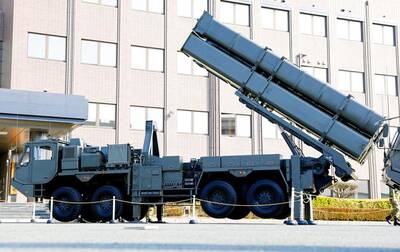
Japan has deployed long-range missiles in a southwestern region near China, the Japanese defense minister said yesterday, at a time when ties with Beijing are at their lowest in recent years. The missiles were installed in Kumamoto in the southern region of Kyushu, as Japan is attempting to shore up its military capacity as China steps up naval activity in the East China Sea. “Standoff defense capabilities enable us to counter the threat of enemy forces attempting to invade our country ... while ensuring the safety of our personnel,” Japanese Minister of Defense Shinjiro Koizumi said. “This is an extremely important initiative for
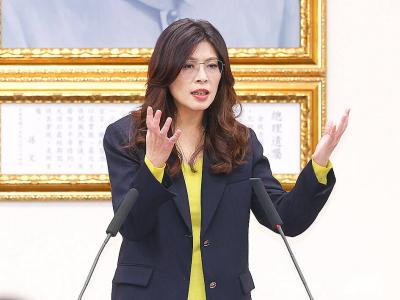
Chinese Nationalist Party (KMT) Chairwoman Cheng Li-wun (鄭麗文) today accepted an invitation from Chinese President Xi Jinping (習近平) to lead a delegation to China next month, saying she hopes to promote the peaceful development of cross-strait relations and bring stability to the Taiwan Strait. “I am grateful and happy to accept this invitation,” Cheng said in a statement from the KMT chairperson’s office. Cheng said she hopes both sides can work together to promote the peaceful development of cross-strait relations, enhance exchange and cooperation, bring stability to the Taiwan Strait and improve people’s livelihoods. At today's news conference, Cheng said any efforts to
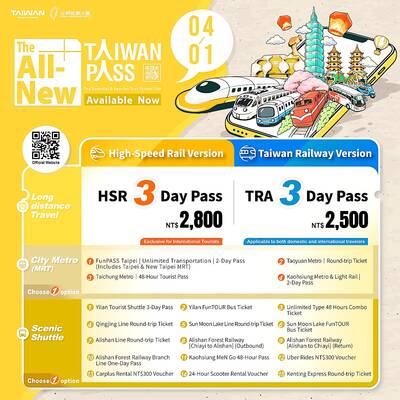
MORE POPULAR: Taiwan Pass sales increased by 59 percent during the first quarter compared with the same period last year, the Tourism Administration said The Tourism Administration yesterday said that it has streamlined the Taiwan Pass, with two versions available for purchase beginning today. The tourism agency has made the pass available to international tourists since 2024, allowing them to access the high-speed rail, Taiwan Railway Corp services, four MRT systems and four Taiwan Tourist Shuttles. Previously, five types of Taiwan Pass were available, but some tourists have said that the offerings were too complicated. The agency said only two types of Taiwan Pass would be available, starting from a three-day pass with the high-speed rail and a three-day pass with Taiwan Railway Corp. The former costs NT$2,800

The nation’s fastest supercomputer, Nano 4 (晶創26), is scheduled to be launched in the third quarter, and would be used to train large language models in finance and national defense sectors, the National Center for High-Performance Computing (NCHC) said. The supercomputer, which would operate at about 86.05 petaflops, is being tested at a new cloud computing center in the Southern Taiwan Science Park in Tainan. The exterior of the server cabinet features chip circuitry patterns overlaid with a map of Taiwan, highlighting the nation’s central position in the semiconductor industry. The center also houses Taiwania 2, Taiwania 3, Forerunner 1 and


 RSS
RSS