


A row between Canada and China over human rights sharpened late on Friday, when Canadian Prime Minister Stephen Harper warned Beijing against expanding the dispute into bilateral trade.
"I would point out to any Chinese official that just as a matter of fact, China had a huge trade surplus with this country, so it would be in the interest of the Chinese government to make sure any dealings on trade are fair and above board," Harper told reporters in Halifax.
The rebuke followed remarks by a Chinese envoy, cited in a local newspaper, in which the official said that Canada's strong human rights criticism of Beijing could threaten future trade between the two countries.
"The economic relationship goes hand in hand with the political relationship," said He Yafei (
"We need to have a sound political basis of mutual trust for the economic relationship to flourish. That's why we need to work harder to improve mutual trust," he told the Toronto-based newspaper.
His remarks come as Canada expressed deep concern over the fate of a dual Canadian-Chinese citizen, Huseyin Celil, 37, who was arrested and jailed in China on terrorism charges in March last year.
The imam alleged in a courtroom last week in Urumqi, Xinjiang Province, home to a large Muslim Uighur population that China considers rebellious, that Chinese secret police tortured and starved him, and threatened to bury him alive, according to reports.
Chinese foreign ministry spokesman Jiang Yu (
Canada has been denied consular access to him, because China does not acknowledge his Canadian citizenship.
But Harper said he thought "it's always the obligation of the government of Canada to vocally and publicly stand up for that Canadian citizen."
The diplomatic row was the latest in a series of irritants that have included talks between Canada's Secretary of State for Multicul-turalism Jason Kenney and the Dalai Lama, accusations that China is spying on Canadian corporations and Canada's failure to deport Chinese fugitive Lai Changxing (賴昌星), the alleged boss of a multi-billion-dollar smuggling ring and stalled trade negotiations.
"I cannot say Canada is squandering [the relationship] now, but in practical terms Canada is lagging behind in its relations with China," He Yafei told the Globe and Mail. "Trade is growing, but not fast enough. Investment is growing, but not fast enough. The overall relationship has room for improvement."
Celil fled China a decade ago, arrived in Canada in 2001 as a refugee and became a Canadian citizen, but Beijing refuses to acknowledge his Canadian citizenship and has denied Canadian diplomats access to him.
He was arrested in Uzbekistan in February last year while visiting his wife's parents and immediately deported to China.
His case was brought up during a meeting between Harper and Chinese President Hu Jintao (

DEFENDING DEMOCRACY: Taiwan shares the same values as those that fought in WWII, and nations must unite to halt the expansion of a new authoritarian bloc, Lai said The government yesterday held a commemoration ceremony for Victory in Europe (V-E) Day, joining the rest of the world for the first time to mark the anniversary of the end of World War II in Europe. Taiwan honoring V-E Day signifies “our growing connections with the international community,” President William Lai (賴清德) said at a reception in Taipei on the 80th anniversary of V-E Day. One of the major lessons of World War II is that “authoritarianism and aggression lead only to slaughter, tragedy and greater inequality,” Lai said. Even more importantly, the war also taught people that “those who cherish peace cannot

Taiwanese Olympic badminton men’s doubles gold medalist Wang Chi-lin (王齊麟) and his new partner, Chiu Hsiang-chieh (邱相榤), clinched the men’s doubles title at the Yonex Taipei Open yesterday, becoming the second Taiwanese team to win a title in the tournament. Ranked 19th in the world, the Taiwanese duo defeated Kang Min-hyuk and Ki Dong-ju of South Korea 21-18, 21-15 in a pulsating 43-minute final to clinch their first doubles title after teaming up last year. Wang, the men’s doubles gold medalist at the 2020 and 2024 Olympics, partnered with Chiu in August last year after the retirement of his teammate Lee Yang
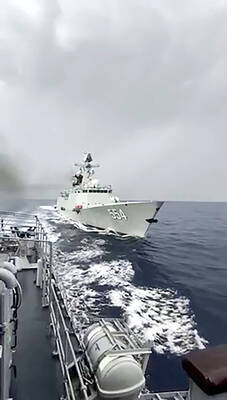
The Philippines yesterday criticized a “high-risk” maneuver by a Chinese vessel near the disputed Scarborough Shoal (Huangyan Island, 黃岩島) in a rare incident involving warships from the two navies. The Scarborough Shoal — a triangular chain of reefs and rocks in the contested South China Sea — has been a flash point between the countries since China seized it from the Philippines in 2012. Taiwan also claims the shoal. Monday’s encounter took place approximately 11.8 nautical miles (22km) southeast” of the Scarborough Shoal, the Philippine military said, during ongoing US-Philippine military exercises that Beijing has criticized as destabilizing. “The Chinese frigate BN 554 was

The number of births in Taiwan fell to an all-time monthly low last month, while the population declined for the 16th consecutive month, Ministry of the Interior data released on Friday showed. The number of newborns totaled 8,684, which is 704 births fewer than in March and the lowest monthly figure on record, the ministry said. That is equivalent to roughly one baby born every five minutes and an annual crude birthrate of 4.52 per 1,000 people, the ministry added. Meanwhile, 17,205 deaths were recorded, resulting in a natural population decrease of 8,521, the data showed. More people are also leaving Taiwan, with net


 RSS
RSS