


The labor union for state-controlled Taiwan Cooperative Bank voiced its strong opposition yesterday to the government's sudden removal of Sean Chen (陳沖) as chairman of the country's second-biggest lender. They also threatened to stage a strike over his sacking.
"It was too abrupt and we are all stunned," said Huang Che-huei (黃哲輝), a board member of Taiwan Cooperative that represents the bank's labor union.
"The government should give more respect to professionals, especially when the employees all recognize Chen's efforts and plans for the bank's future," Huang said.
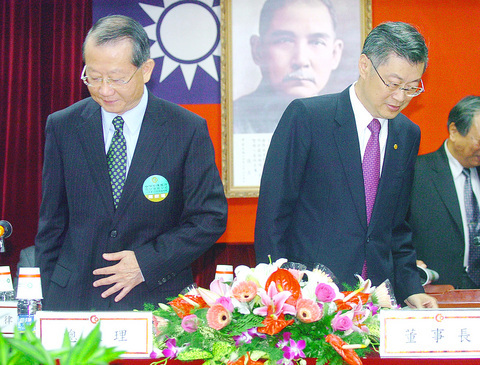
PHOTO: CHEN TSE-MING, TAIPEI TIMES
The Ministry of Finance announced on Thursday night that Bank of Taiwan chairman Hsu Teh-nan (許德南) would replace Chen, whose three-year term was due to expire on Dec. 31.
Chen's removal, coming one day before the bank was scheduled to hold an extraordinary general meeting to elect a new board of directors, created speculation that the move was triggered by political, not professional considerations.
Some speculated that Chen was not close enough to the pan-green camp politically.
"We believe that could be the reason," said one Taiwan Cooperative executive, speaking on condition of anonymity.
The Cabinet, however, rebuffed such speculation yesterday, saying that Chen's removal had nothing to do with politics.
"Every time we choose candidates for senior bank management, their professional skills are always our only concern. It is not fair to these professionals to be politically labeled," Government Information Office Minister and Cabinet Spokesman Cheng Wen-tsang (
"Many people have criticized the reshuffle by saying that Premier Su Tseng-chang (蘇貞昌) is trying to promote his own favorites as he gears up for the 2008 presidential election. Personnel reshuffles in banks have nothing to do with politics, for God's sake," Cheng said.
Despite a potential for awkwardness, Chen presided over yesterday's shareholders meeting.
"I was advised of my removal at noon on Thursday," he said. "I feel sorry that I will not able to realize my commitments to the employees."
Chen said that he had a premonition of his fate three months ago, when he declined Su's offer to become a minister without portfolio on Aug. 29.
Chu Yu-chun (朱玉君), an analyst who tracks the financial sector at SinoPac Securities Corp (永豐金 證券), said she believed political considerations play a role when it comes to appointing the heads of state-run financial institutions.
"The government would want someone obedient to execute its policy," Chu said.
Under Chen's leadership Tai-wan Cooperative has tried to secure more autonomy in its decision-making, such as its alliance with BNP Paribas and its plan to evolve into a financial holding firm, which could run counter to the government's plan to dispose the lender next year, Chu said.
Chen became chairman of Taiwan Cooperative in July 2004. The lender became a publicly traded company in November 2004 and began its privatization process in April last year.
Chen said he is proud of the bank's performance, citing earnings per share of NT$2.31 in the first 11 months of the year -- the highest among local banks -- and a healthy financial structure with a declining bad loan ratio of 2.2 percent and rising coverage ratio of 55 percent.
"At least people would not say that my stepping aside is because of incompetence," he said.
Meanwhile, the personnel change could create uncertainty about the strategic alliance with BNP Paribas. The two parties inked an agreement at the beginning of this month to form an asset management joint venture.
"I've known about the change," Laurent de Meyere, managing director of BNP Paribas Taipei Branch, who is on holiday outside the country, told the Taipei Times in a telephone interview yesterday.
He said he expects policy continuity.
But the bank's union held an ad hoc meeting yesterday to discuss the possibility of calling a strike to protest the shakeup and the potential for a takeover by predatory family-run financial groups.
At yesterday's shareholder meet-ing the union obtained four of the 19 board seats. The Ministry of Finance controls 11 seats; the other four went to institutional shareholders like the Taiwan Provincial Farmers Association (台灣省農會).
Shareholders also agreed to raise the capitalization of the bank to a maximum of NT$60 billion (US$1.84 billion) from the current NT$45 billion for future capital enhancement through fundraising.
Union members, however, said they are worried that the Tsai family would take the opportunity to boost their holdings from current combined 4.4 percent to gain more control of the bank.
The Tsai family controls Cathay Financial Holding Co (
"We will not give them an easy time if the Tsai family wants to take over us," said Huang, a union-appointed board member.
Additional reporting by Jimmy Chuang

A signaling system malfunction disrupted high-speed rail (HSR) services beginning at 8am today, with trains temporarily reduced to three northbound and three southbound trains per hour as authorities conduct inspections. The malfunction occurred on a section of track in Miaoli County during pre-operation checks early this morning, forcing northbound and southbound trains to use a single track, the HSR operator said. The regular schedule has been replaced with three hourly trains offering only nonreserved seating in each direction, stopping at every station, it said, adding that business class cars would still have reserved seating. Departures from terminal stations are scheduled at the top

Taiwan is still in the process of assessing the possibility of recruiting workers from Eswatini, the Ministry of Foreign Affairs said yesterday, adding that its goal is to help Eswatini upgrade its vocational training centers. If there are plans to recruit workers from Eswatini, safeguarding national security, protecting public health and ensuring the employment rights of Taiwanese would be prerequisites, Department of West Asian and African Affairs Director-General Yen Chia-liang (顏嘉良) told a news conference. Key considerations would also include filling labor shortages in specific industries, and fostering bilateral professional and technical exchanges, he said. Yen was asked about the progress of labor

A US uncrewed surface vessel (USV) encountered multiple Chinese warships during an autonomous transit of the Taiwan Strait, US defense company Seasats said in a statement on Wednesday. Seasats announced that a Lightfish USV had completed the first autonomous transit of the Taiwan Strait. Over five days, the USV traversed the entire length of the Strait while constantly monitoring surface vessel traffic, the company said. The Lightfish encountered multiple Chinese warships, one of which was a Chinese People’s Liberation Army Navy (PLAN) Type 056 corvette, it said. The Chinese vessels were operating “well within Taiwan’s exclusive economic zone without transmitting their identity via the

VERBOSE VESSELS: A CGA cutter and a China Coast Guard exchanged verbal barbs for more than a day in Taiwanese-controlled waters before the Chinese vessel left The Taiwanese and Chinese coast guards had a standoff near the strategically located Pratas Islands (Dongsha Islands, 東沙群島) in the north of the South China Sea, the Coast Guard Administration (CGA) said yesterday. The two sides engaged in intense radio exchanges over sovereignty claims during the 33-hour standoff. China Coast Guard vessel 3501 eventually left the restricted waters, 26.6 nautical miles (49.2km) west of the Pratas Islands, at 5pm yesterday, the CGA said. Lying approximately between southern Taiwan and Hong Kong, the Taiwan-controlled Pratas are seen by some security experts as vulnerable to Chinese attack due to their distance — more than


 RSS
RSS