


Mocking Chinese President Hu Jintao (
Wu made the remarks in a speech to more than 150 overseas Taiwanese delegates attending a conference held at the Howard Plaza Hotel in Taipei. The event was hosted by the Global Alliance for Democracy and Peace, a government-led organization that promotes Taiwan's interests abroad.
Citing the National Security Council and unnamed sources in the US intelligence community, Wu said that China now has more than 900 ballistic missiles targeting Taiwan deployed at five bases in Fujian Province, as well as 11 military satellites in orbit.
"I'm very moved by your calling on China to remove the missiles on its eastern seaboard," Wu said, referring to a statement that the alliance issued on Wednesday demanding that China cease targeting Taiwan with 820 missiles.
"But that's not enough," Wu said, adding that many of the missiles were deployed on mobile launchers.
"If China one day removed the missiles from its east coast, they could just transport them all back the next day," he said.
China has made leaps in the development of its cruise missile technology, and was racing to beef up its military while Taiwan's military saw little or no growth, Wu said.
"China's acquisition of long-range bombers and mid-air refuelers from Russia means that it seeks to project its military power beyond Taiwan, because Chinese fighter jets wouldn't need to refuel mid-air in a cross-strait attack. Taiwan is so close that it doesn't need such resources," he said, adding that Taiwan was a "stumbling block to projecting power" throughout Asia for China, and was thus a prime target.
Panning China's diplomatic behavior, Wu said that "100 percent of Sudan's oil goes to China, while the Sudanese government backs genocide in its Darfur region."
He described China-Sudan relations as "chummy."
"As the African summit in Beijing winds down, let's not forget that China is behind all the worst governments in Africa," Wu said, adding that Zimbabwe's President Robert Mugabe used Chinese firearms and artillery to "slaughter" Zimbabweans.
Wu also lashed out at the US for "mistaking" Taiwan's democratization as moves toward independence. He added that the government's efforts to amend the constitution, hold referendums, or otherwise promote democratic development had resulted in pressure from Beijing "and even the US."
As for cross-strait relations, Wu claimed the government was eager to open up the country to Chinese tourists because it wished to show the Chinese public that "Taiwan isn't at all how the Chinese media has depicted it."
Wu blamed the Chinese government for holding up negotiations on cross-strait tourism, but added that "some progress in opening ourselves up to China for tourism will happen very soon."
President Chen Shui-bian (
In his speech, Chen slammed China for threatening the country with its huge and growing military.
"Despite China's impressive economic rise, it has become more authoritarian, posing a grave threat to our sovereignty and abusing human rights like never before," Chen told a packed audience.
Chen also praised the alliance for promoting democracy abroad in Taiwan's name, saying that its peaceful, constructive activities stood in stark contrast to China's military buildup and hegemony.
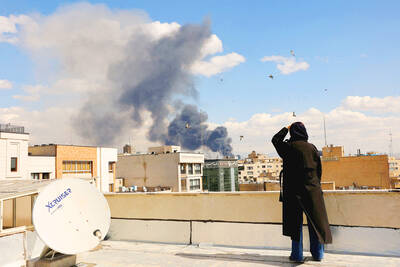
CHAOS: Iranians took to the streets playing celebratory music after reports of Khamenei’s death on Saturday, while mourners also gathered in Tehran yesterday Iranian Supreme Leader Ayatollah Ali Khamenei was killed in a major attack on Iran launched by Israel and the US, throwing the future of the Islamic republic into doubt and raising the risk of regional instability. Iranian state television and the state-run IRNA news agency announced the 86-year-old’s death early yesterday. US President Donald Trump said it gave Iranians their “greatest chance” to “take back” their country. The announcements came after a joint US and Israeli aerial bombardment that targeted Iranian military and governmental sites. Trump said the “heavy and pinpoint bombing” would continue through the week or as long
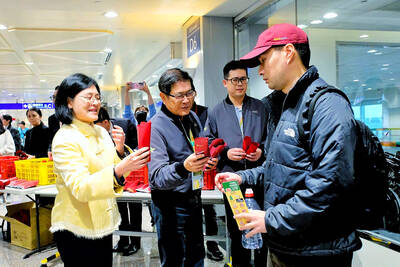
An Emirates flight from Dubai arrived at Taiwan Taoyuan International Airport yesterday afternoon, the first service of the airline since the US and Israel launched strikes against Iran on Saturday. Flight EK366 took off from the United Arab Emirates (UAE) at 3:51am yesterday and landed at 4:02pm before taxiing to the airport’s D6 gate at Terminal 2 at 4:08pm, data from the airport and FlightAware, a global flight tracking site, showed. Of the 501 passengers on the flight, 275 were Taiwanese, including 96 group tour travelers, the data showed. Tourism Administration Deputy Director-General Huang He-ting (黃荷婷) greeted Taiwanese passengers at the airport and
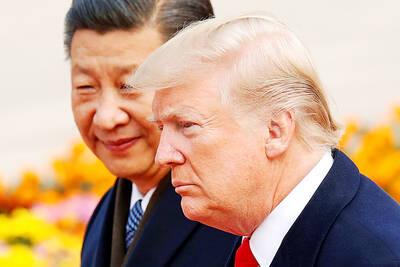
TRUST: The KMT said it respected the US’ timing and considerations, and hoped it would continue to honor its commitments to helping Taiwan bolster its defenses and deterrence US President Donald Trump is delaying a multibillion-dollar arms sale to Taiwan to ensure his visit to Beijing is successful, a New York Times report said. The weapons sales package has stalled in the US Department of State, the report said, citing US officials it did not identify. The White House has told agencies not to push forward ahead of Trump’s meeting with Chinese President Xi Jinping (習近平), it said. The two last month held a phone call to discuss trade and geopolitical flashpoints ahead of the summit. Xi raised the Taiwan issue and urged the US to handle arms sales to
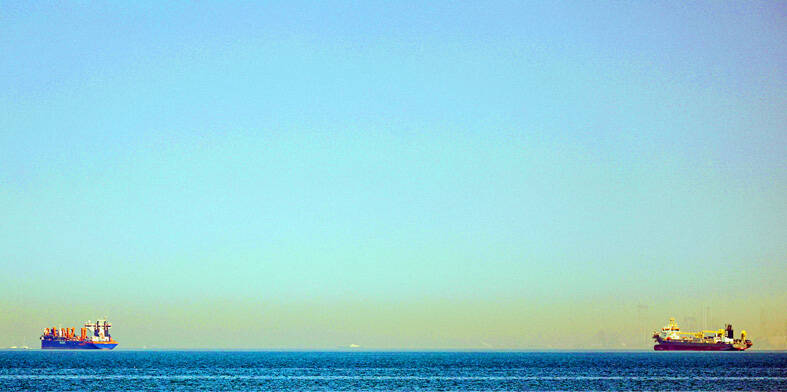
State-run CPC Corp, Taiwan (CPC, 台灣中油) yesterday said that it had confirmed on Saturday night with its liquefied natural gas (LNG) and crude oil suppliers that shipments are proceeding as scheduled and that domestic supplies remain unaffected. The CPC yesterday announced the gasoline and diesel prices will rise by NT$0.2 and NT$0.4 per liter, respectively, starting Monday, citing Middle East tensions and blizzards in the eastern United States. CPC also iterated it has been reducing the proportion of crude oil imports from the Middle East and diversifying its supply sources in the past few years in response to geopolitical risks, expanding


 RSS
RSS