


Thailand's new military leaders, who overthrew Prime Minister Thaksin Shinawatra and are moving to purge his followers, yesterday banned political party meetings and the establishment of new parties.
With Thaksin lying low in London, the coup makers also moved to place the tycoon-turned-politician's vast assets under scrutiny, amid mounting calls for his prosecution for alleged corruption.
Thaksin said in London he would take a "deserved rest," and urged the military to quickly arrange for new national elections.
Army commander General Sondhi Boonyaratkalin has said he would serve as de facto prime minister for two weeks whereupon the junta, which calls itself the Council of Administrative Reform, will choose a civilian to replace him. A constitution is to be drawn up and elections held in one year's time.
Thai media yesterday voiced concern over efforts by coup leaders to slap limits on press freedom as the generals mulled whether to stop them carrying expressions of public opinion.
"I want to know how free people are to express their opinions," an official from Chula radio, a university broadcaster, told the generals during a nearly two-hour meeting.
Army officials said they wanted television stations to stop broadcasting text messages from viewers, and to stop running other expressions of public opinion.
But General Palangoon Klaharn said the military would consider allowing TV stations just to screen the text messages before airing them.
The political bans announced on all Thai television stations yesterday are the latest moves by the junta to tighten control, even though no open opposition has surfaced to its Tuesday night takeover. It has also banned public gatherings of over four people and placed restrictions on the media.
The coup leaders, meanwhile, continued their purge of Thaksin's loyalists, bringing in Cabinet ministers Newin Chidchob and Yongyuth Tiyapairat for questioning.
Earlier, the junta said that Deputy Prime Minister Chitchai Wannasathit and Thaksin's top aide, Prommin Lertsuridej, had been detained. The Nation newspaper yesterday published a 100-name "watch list" of additional politicians, business people and others close to Thaksin who could be investigated.
The junta empowered Auditor-General Jaruvan Maintaka to investigative government corruption, which could lead to the confiscation of Thaksin's assets.
The US government, the EU and some Asian governments yesterday criticized the coup as a step backward for democracy.
Also see story:
Exiled Thai Muslim welcomes coup

The National Chungshan Institute of Science and Technology yesterday showcased its locally developed variants of the Vision 60 robotic patrol dog, which it plans to deploy on the nation’s outlying territories in the South China Sea. The variants were produced under the Joint Lab project — created by the institute and domestic companies — and assembled with domestically produced motors, lenses and artificial intelligence (AI) systems alongside licensed tech from the US, Missile and Rocket Systems Research Division deputy director Jen Kuo-kang (任國光) told the media event at a military base in Taipei’s Dazhi (大直) area. Taiwan has built up its strengths
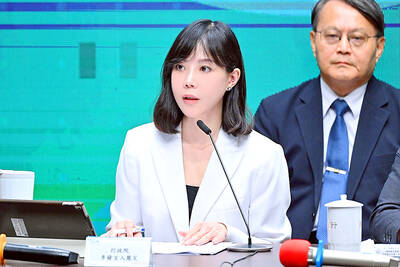
RIGHT DIRECTION: Taiwan’s efforts to prevent forced labor include a proposal to ‘fully prohibit’ employers from withholding workers’ documents, an official said Taiwan is to establish a mechanism to restrict imports of goods linked to forced labor, the Executive Yuan said yesterday, after the US proposed imposing additional tariffs on Taiwanese goods over labor concerns. “The Ministry of Labor and the Ministry of Economic Affairs are to establish an interministerial review procedure,” Executive Yuan spokesperson Michelle Lee (李慧芝) said at a news briefing in Taipei. “The government is to use the Foreign Trade Act [貿易法] as the legal basis to restrict imports of goods produced with forced labor” and bring its supply chain governance more in line with international standards on human rights, resilience

NOT IMMEDIATE: Taiwan has a chance to appeal the proposed 10 percent tariff before it starts, while other countries face a 12.5 percent tariff from the trade office Taiwan is among 60 economies determined by the US to have failed to impose or enforce a ban on the importation of goods produced with forced labor, according to a notice released on Tuesday by the Office of the US Trade Representative (USTR), which proposed imposing an additional 10 percent or more tariff on them. The USTR in a statement said that following an investigation, it had determined under Section 301 of the Trade Act of 1974 that the failure of the 60 economies to impose and effectively enforce a prohibition on the importation of goods produced with forced labor is

TIT-FOR-TAT: The US allegedly revoked the visa of a Chinese national working at Xinhua News Agency in the US in response to Beijing’s expulsion of Vivian Wang The Presidential Office yesterday condemned China for expelling a New York Times correspondent from Beijing following the newspaper’s interview with President William Lai (賴清德), saying the move highlighted Beijing’s suppression of press freedom and its threat to international news media. Taiwan has noted a series of recent incidents in which Beijing used similar tactics to “threaten and pressure international media outlets and journalists,” Presidential Office spokeswoman Karen Kuo (郭雅慧) said in a statement. “This concerns not only press freedom and freedom of expression, but also the safety of journalists, and Taiwan and relevant partners are paying close attention to the situation,” she


 RSS
RSS