


President Chen Shui-bian (陳水扁) arrived in Palau yesterday on the first leg of his Pacific island tour, a journey made more significant by his use of "Air Force One" and flying over Japan's aerospace.
A record 80 senior officials, including Vice President Annette Lu (呂秀蓮), Premier Su Tseng-chang (蘇貞昌) and Legislative Speaker Wang Jin-pyng (王金平), saw Chen off at the Sungshan Air Base in Taipei yesterday.
Su said he brought the entire Cabinet to see Chen off because the president has shown "steadfastness" in demonstrating the nation's sovereignty at a time of political turmoil at home.
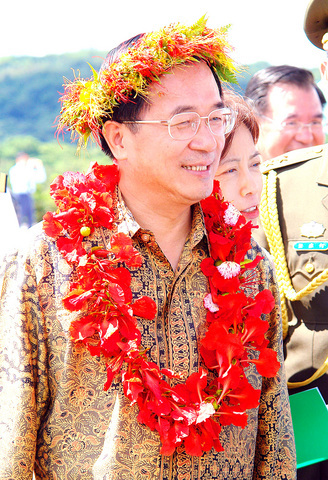
PHOTO: CNA
Presidential Office Deputy Secretary-General Liu Shih-fang (劉世芳), who accompanied Chen on the trip, confirmed that the president had planned to fly over Philippine air space en route to Palau and then through Japanese air space on his way home.
"However, media speculation had given China an opportunity to exert tremendous amount of pressure on the Philippines," Liu said. "We then asked the Japanese government about the possibility of flying through its airspace and obtained their approval yesterday [Saturday] afternoon."
Liu said that "Air Force One" yesterday passed through both Japanese and US air space and that was why the president extended his appreciation to the US and Japanese governments before his departure from Sungshan yesterday morning.
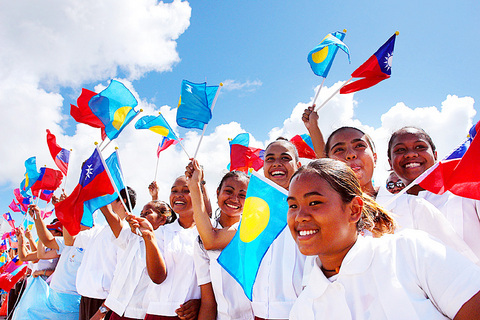
PHOTO: CNA
The "Air Force One" and a China Airlines plane carrying Chen's entourage and press corps took off at 8:30am. The president's plane was escorted by three F-16 jet fighters until it left the country's territorial air space.
During his three-day trip, Chen will attend a summit with the nation's six Pacific allies in Palau and is scheduled to deliver a speech to Nauru's parliament. He is due back in Taipei on Wednesday night.
When asked by reporters on "Air Force One" about his first trip on the plane, Chen said he felt "good and pleased."
Before departing Taipei, Chen delivered a speech at the air base, describing the trip as "a small step for Air Force One, but a giant step for `head of state' diplomacy.'"
"Air Force One is different from a commercial flight because it represents the nation's sovereignty," he said. "Former presidents did not take Air Force One on their overseas trips for technical or political reasons. Now we have the opportunity to use it, there is no reason not to take advantage of it."
Chen said the nation's international presence faces brazen suppression by China, but this does not mean that Taiwan must forsake its dignity and the right to pursue international activities.
Chen met with Palauan President Tommy Remengesau at the Presidential Office immediately after his arrival in Palau.
During the 30-minute meeting, Remengesau expressed gratitude to Chen, saying that the Taiwanese leader helped boost Palau's scuba diving industry by 42 percent. Chen took a scuba dive during a visit last January.
Chen, who is scheduled to participate in a fishing contest tomorrow, said that he hoped to catch a big fish so that the whole world would know that Palau is a good place to fish.
In a reference to his guest's domestic political woes, Remengesau said that he could empathize with Chen because he himself is facing call for his resignation following a fierce presidential election.
Later in the afternoon, Chen held bilateral talks with leaders of other allies, including President Kessai Note of Marshall Islands, Prime Minister Apisai Ielemia of Tuvalu and Solomon Islands Prime Minister Manasseh Sogavare.
Chen said he hoped that all six Pacific allies would be able to attend next year's summit in Majuro, Marshall Islands.
At the dinner party hosted by Remengesau last night, Chen said that his administration looks forward to establishing long-term cooperation and close interactions with the nation's allies for the development and prosperity of all.
also see stories:
Chen chides Ma over sit-in approval
Anti-Chen group cancels warmup
Pro-Chen group to hold preemptive rally
PROVOCATIVE: Chinese Deputy Ambassador to the UN Sun Lei accused Japan of sending military vessels to deliberately provoke tensions in the Taiwan Strait China denounced remarks by Japan and the EU about the South China Sea at a UN Security Council meeting on Monday, and accused Tokyo of provocative behavior in the Taiwan Strait and planning military expansion. Ayano Kunimitsu, a Japanese vice foreign minister, told the Council meeting on maritime security that Tokyo was seriously concerned about the situation in the East China and South China seas, and reiterated Japan’s opposition to any attempt to change the “status quo” by force, and obstruction of freedom of navigation and overflight. Stavros Lambrinidis, head of the EU delegation to the UN, also highlighted South China Sea
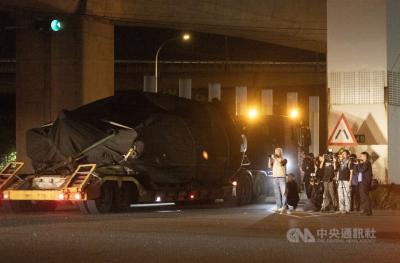
The final batch of 28 M1A2T Abrams tanks purchased from the US arrived at Taipei Port last night and were transported to the Armor Training Command in Hsinchu County’s Hukou Township (湖口), completing the military’s multi-year procurement of 108 of the tanks. Starting at 12:10am today, reporters observed more than a dozen civilian flatbed trailers departing from Taipei Port, each carrying an M1A2T tank covered with black waterproof tarps. Escorted by military vehicles, the convoy traveled via the West Coast Expressway to the Armor Training Command, with police implementing traffic control. The army operates about 1,000 tanks, including CM-11 Brave Tiger
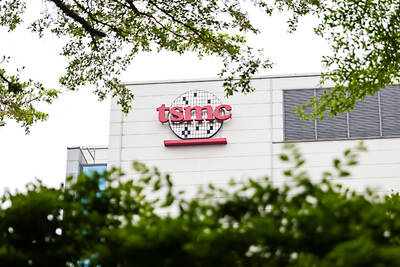
Taiwan Semiconductor Manufacturing Co (TSMC, 台積電), the world’s largest contract chipmaker, said it expects its 2-nanometer (2nm) chip capacity to grow at a compound annual rate of 70 percent from this year to 2028. The projection comes as five fabs begin volume production of 2-nanometer chips this year — two in Hsinchu and three in Kaohsiung — TSMC senior vice president and deputy cochief operating officer Cliff Hou (侯永清) said at the company’s annual technology symposium in Silicon Valley, California, last week. Output in the first year of 2-nanometer production, which began in the fourth quarter of last year, is expected to
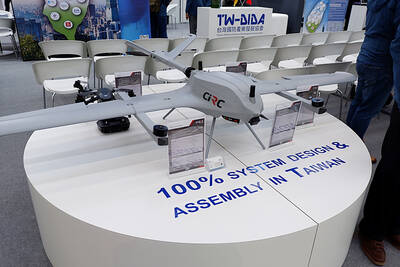
Taiwan’s drone exports surged past US$100 million in the first quarter, exceeding last year’s full-year total, with the Czech Republic emerging as the largest buyer, the Ministry of Economic Affairs said. Exports of complete drones reached US$115.85 million in the period, about 1.2 times the total recorded for all of last year, the ministry said in a report. Exports to the Czech Republic accounted for about US$100 million, far outpacing other markets. Poland, last year’s top destination, recorded about US$11.75 million in the first quarter. Taiwan’s drone exports have expanded rapidly in the past few years, with last year’s total


 RSS
RSS