


Civilians fled battered villages in southern Lebanon yesterday after Israel said it would halt its air strikes, but the Jewish state pledged to step up its offensive to root out Hezbollah guerrillas.
Fighting was heavy in the northeast corner of south Lebanon around Taibeh and other border villages. Constant Israeli artillery blasts -- not covered under the air halt -- shook the hills. Hezbollah guerrillas in the area fired a volley of rockets at the nearby Israeli town of Kiryat Shemona, their first since Israel's suspension began.
Israeli planes fired two bombs into Lebanon to support ground troops battling Hezbollah near the border and artillery shells hit two southern frontier villages, Ramiyeh and Aita Shaab, the UN peacekeeping force in Lebanon said.
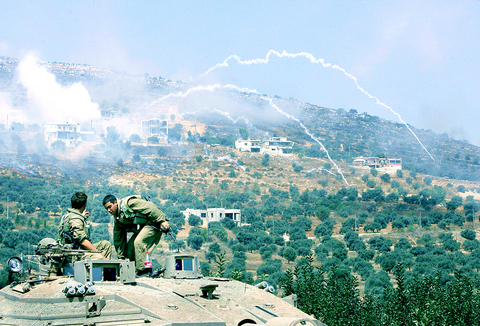
PHOTO: AP
US Secretary of State Condoleezza Rice said a ceasefire to end the 20-day-old war between Israel and Hezbollah could be forged this week, but Israel rejected any immediate truce.
"We must not agree to a ceasefire that would be implemented immediately," Israeli Defense Minister Amir Peretz told a heated parliamentary debate in Jerusalem. "If an immediate ceasefire is declared, the extremists will rear their heads anew."
An Israeli air strike destroyed a Lebanese military vehicle on the main southern coastal road, killing a soldier and wounding three at Qasmiyeh, north of the city of Tyre, security sources said.
Three Israeli soldiers were wounded when a missile hit their tank as they tried to rescue an armored troop carrier struck earlier by a Hezbollah anti-tank missile in the Kfar Kila area just inside Lebanon, the army said.
Another Israeli tank and armored vehicle were hit later yesterday, but there were no casualties, the army said.
Hezbollah said it had destroyed two Israeli tanks and damaged a third. It also said it had lost two fighters.
Peretz said Israel would expand and deepen its offensive against Hezbollah despite the suspension of aerial bombardment agreed after a strike on Sunday killed at least 54 civilians, including 37 children, in the village of Qana.
With the fear of bombardment eased, Lebanese Red Cross teams escorted by UN observers went to the village of Srifa to dig up more than 50 bodies believed still buried under rubble since Israeli strikes wiped out an entire neighborhood on July 19. The bodies have began decomposing, the Red Cross said.
Aid groups were also scrambling to take advantage to rush badly needed food, medicine and blankets to refugees and residents in towns and cities of the south, where supplies have been dwindling. Some convoys headed south, but humanitarian officials said the pause, which began only hours after it was announced, caught them off-guard.
A Hezbollah member of parliament said the Shiite Muslim group's rocket attacks on Israel would not cease until the Jewish state calls off its assault and pulls out its troops.
A senior Israeli political source said a ceasefire would only take effect once an international force had deployed.
The source added that Israel's 48-hour suspension of aerial attacks did not include retaliation for any Hezbollah rocket strikes, the assassination of the Shiite group's leaders or air support for Israeli ground forces in southern Lebanon.

‘NO SECURITY RISK’: The Railway Bureau reassured the public that the technicians’ activities were limited to technical guidance and did not involve sensitive systems The Railway Bureau yesterday said it had invited eight Chinese technicians to assist with an airport MRT construction project. The bureau issued the confirmation after an Internet user said Chinese nationals had entered the construction zone of Taiwan Taoyuan International Airport’s Terminal 3 project. They asked why “individuals from an enemy state” were allowed access to such a major national infrastructure project, which raised serious concerns over Taiwan’s industrial safety, sensitive systems and information security. The bureau’s Northern Region Engineering Branch Office said subcontractor Taiwan Handle Industrial Co (台灣手把工業) of the Taoyuan airport MRT’s “Contract No. CU05 Project A14 Station Civil, MEP &

The National Chungshan Institute of Science and Technology yesterday showcased its locally developed variants of the Vision 60 robotic patrol dog, which it plans to deploy on the nation’s outlying territories in the South China Sea. The variants were produced under the Joint Lab project — created by the institute and domestic companies — and assembled with domestically produced motors, lenses and artificial intelligence (AI) systems alongside licensed tech from the US, Missile and Rocket Systems Research Division deputy director Jen Kuo-kang (任國光) told the media event at a military base in Taipei’s Dazhi (大直) area. Taiwan has built up its strengths

TIT-FOR-TAT: The US allegedly revoked the visa of a Chinese national working at Xinhua News Agency in the US in response to Beijing’s expulsion of Vivian Wang The Presidential Office yesterday condemned China for expelling a New York Times correspondent from Beijing following the newspaper’s interview with President William Lai (賴清德), saying the move highlighted Beijing’s suppression of press freedom and its threat to international news media. Taiwan has noted a series of recent incidents in which Beijing used similar tactics to “threaten and pressure international media outlets and journalists,” Presidential Office spokeswoman Karen Kuo (郭雅慧) said in a statement. “This concerns not only press freedom and freedom of expression, but also the safety of journalists, and Taiwan and relevant partners are paying close attention to the situation,” she

NOT IMMEDIATE: Taiwan has a chance to appeal the proposed 10 percent tariff before it starts, while other countries face a 12.5 percent tariff from the trade office Taiwan is among 60 economies determined by the US to have failed to impose or enforce a ban on the importation of goods produced with forced labor, according to a notice released on Tuesday by the Office of the US Trade Representative (USTR), which proposed imposing an additional 10 percent or more tariff on them. The USTR in a statement said that following an investigation, it had determined under Section 301 of the Trade Act of 1974 that the failure of the 60 economies to impose and effectively enforce a prohibition on the importation of goods produced with forced labor is


 RSS
RSS