


A former Canadian Cabinet member and a human rights lawyer issued a report on Thursday alleging China harvests organs from unwilling live prison inmates, mostly Falun Gong practitioners, for transplants on a large scale.
The report's authors, Canada's former Secretary of State for the Asia-Pacific region David Kilgour and human rights lawyer David Matas, implicated dozens of hospitals and jails throughout China after a two-month investigation.
The pair also identified some 41,500 suspect transplants in China since 2000, saying they were unable to track the source of the organs used.
"We believe that there has been and continues today to be large scale organ seizures from unwilling Falun Gong practitioners," they wrote in their report.
"This is a form of evil that we have yet to see on this planet, a new form of evil," Matas told reporters on Thursday.
China, which has denied similar allegations, refused entry to both to investigate the claims further, he said.
The US-based lobby group The Coalition to Investigate the Persecution of the Falun Gong in China (CIPFG) asked the duo to investigate claims by several of their members.
China banned the spiritual group in 1999 and has vehemently denied the allegations of organ harvesting, accusing the group of spreading rumors in a bid to undermine the country's international relations and "social stability."
Kilgour and Matas said many of the claims were second-hand, but that there is enough evidence to warrant a broader investigation.
"There are investigative difficulties in establishing these allegations because ... the victim is dead, the perpetrator is not going to confess and the scene of the crime leaves no trace; it's an operating room," Matas said.
"I don't know if this is policy or corruption, but it's widespread," he added.
The two called on Chinese authorities, the UN and international human rights organizations to investigate the claims further.
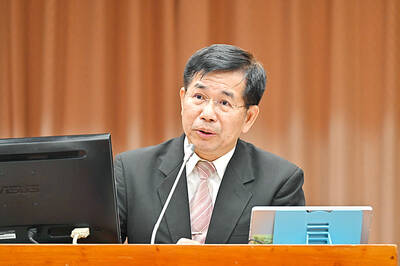
The International Industrial Talents Education Special (INTENSE) Program to attract foreigners to study and work in Taiwan will provide scholarships and a living allowance of up to NT$440,000 per person for two years beginning in August, Minister of Education Pan Wen-chung (潘文忠) told a meeting of the legislature’s Education and Culture Committee yesterday. Pan was giving an update on the program’s implementation, a review of universities’ efforts to recruit international students and promotion of the Taiwan Huayu Bilingual Exchanges of Selected Talent (BEST) program. Each INTENSE Program student would be awarded a scholarship of up to NT$100,000 per year for up to

‘MONEY PIT’: The KMT’s more than NT$2 trillion infrastructure project proposals for eastern Taiwan lack professional input and financial transparency, the DPP said The Democratic Progressive Party (DPP) caucus yesterday said it would ask the Executive Yuan to raise a motion to oppose the Chinese Nationalist Party (KMT) caucus’ infrastructure proposals and prepare to file for a constitutional interpretation if the KMT-dominated legislature forces their passage. The DPP caucus described the three infrastructure plans for transportation links to eastern Taiwan proposed by the KMT as “three money pit projects” that would cost more than NT$2 trillion (US$61.72 billion). It would ask the Executive Yuan to oppose public projects that would drain state financial resources, DPP caucus secretary-general Rosalia Wu (吳思瑤) said. It would also file for

BASIC OPERATIONS: About half a dozen navy ships from both countries took part in the days-long exercise based on the Code for Unplanned Encounters at Sea An unpublicized joint military exercise between Taiwan and the US in the Pacific Ocean last month was carried out in accordance with an international code, the Ministry of National Defense (MND) said yesterday. According to a Reuters report citing four unnamed sources, the two nations’ navies last month conducted joint drills in the Western Pacific. The drills were not made public at the time, but “about half-a-dozen navy ships from both sides, including frigates and supply and support vessels, participated in the days-long exercises,” Reuters reported, citing the sources. The drills were designed to practice “basic” operations such as communications, refueling and resupplies,

SELF-SUFFICIENCY: The project would only be the beginning, as Taiwan needs at least 120 satellites to ensure uninterrupted communication, Wu Tsung-tsong said The Taiwan Space Agency (TASA) yesterday said it plans to launch six low Earth orbit satellites starting in 2026 as part of the government’s plan to boost the resilience of the nation’s communications. The development of the technology gained attention after Ukrainians were able to access the Internet through Space Exploration Technologies Corp (SpaceX) CEO Elon Musk’s Starlink satellite service, despite their infrastructure being severely damaged in the war with Russia. Two of the satellites would be built by the government, while four would involve cooperation between TASA and private contractors. “Over the past 30 years, the satellite technology in Taiwan has


 RSS
RSS