


South Korean President Roh Moo-hyun yesterday condemned as "intolerable" an assault on opposition leader Park Geun-hye ahead of the country's mayoral and gubernatorial elections this month.
"In a democracy, terrorism or violence must not be tolerated under any circumstances in the electioneering. It is intolerable," Roh told a group of his aides, calling for a thorough probe of the incident.
Park, chairwoman of the main opposition Grand National Party (GNP), sustained an 11cm cut to her face on Saturday when a man armed with a box cutter attacked her while she was canvassing in downtown Seoul, police said.
The slash from her right ear to her jaw required Park to have some 60 stitches in a two-hour operation, but her life was not in danger, according to doctors at the Yonsei University's Severance Hospital where she was treated.
ATTACKER HELD
The attacker, identified only as Ji, 50, was being held by police for questioning. Police also detained another man, known as Park, for a disturbance nearby at the time of the assault.
Seoul police chief Han Jin-ho said in a report yesterday that the two denied knowing each other. Ji had previously been jailed for more than 14 years for eight separate violent crimes.
"Ji claims that he launched the attack out of anger at his unfair imprisonment for nearly 15 years despite his innocence and no help from the authorities despite his appeals," Han said.
"We will thoroughly investigate it," he said.
Police said Park, a second suspect in the case, was a supporter of the ruling Uri Party.
The Uri Party immediately revoked his party membership.
Park Geun-hye was recuperating yesterday after surgery at the Yonsei hospital and received a number of well-wishers, including former president Kim Yong-sam and other key party officials.
"The operation proceeded well. Luckily, her facial nerves did not get harmed," Tak Kwan-chol, one of the hospital's doctors, said yesterday.
RECUPERATION
Park will be hospitalized for at least a week, but won't be able to speak well for months due to her injuries, he said.
Park had been campaigning for the GNP candidates running in May 31 elections to select mayors and governors as well as local assembly seats.
Park, a daughter of former president Park Chung-hee who ruled from 1961 to 1979, is one of the leading candidates for next year's presidential elections.
The GNP is the country's largest opposition party, with 125 seats in the 297-member assembly. The ruling Uri Party has 142 seats.
Park Geun-hye's mother, Yook Young-soo, was fatally shot in 1974. Five years later, Park's father was assassinated by the then chief of the state intelligence agency.
Local reports suggested the attack on Park Geun-hye would actually increase support for the GNP in the upcoming elections.
Prime Minister Han Myung-sook ordered the prosecution and the police to launch a joint investigation into the incident and prepare safety guidelines for politicians and candidates running in the elections.
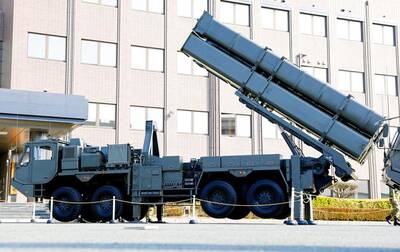
Japan has deployed long-range missiles in a southwestern region near China, the Japanese defense minister said yesterday, at a time when ties with Beijing are at their lowest in recent years. The missiles were installed in Kumamoto in the southern region of Kyushu, as Japan is attempting to shore up its military capacity as China steps up naval activity in the East China Sea. “Standoff defense capabilities enable us to counter the threat of enemy forces attempting to invade our country ... while ensuring the safety of our personnel,” Japanese Minister of Defense Shinjiro Koizumi said. “This is an extremely important initiative for
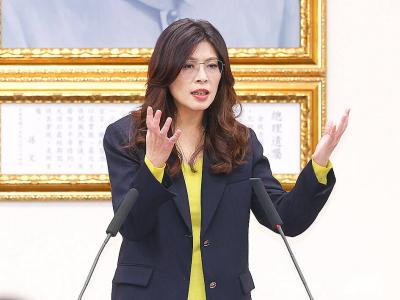
Chinese Nationalist Party (KMT) Chairwoman Cheng Li-wun (鄭麗文) today accepted an invitation from Chinese President Xi Jinping (習近平) to lead a delegation to China next month, saying she hopes to promote the peaceful development of cross-strait relations and bring stability to the Taiwan Strait. “I am grateful and happy to accept this invitation,” Cheng said in a statement from the KMT chairperson’s office. Cheng said she hopes both sides can work together to promote the peaceful development of cross-strait relations, enhance exchange and cooperation, bring stability to the Taiwan Strait and improve people’s livelihoods. At today's news conference, Cheng said any efforts to

MORE POPULAR: Taiwan Pass sales increased by 59 percent during the first quarter compared with the same period last year, the Tourism Administration said The Tourism Administration yesterday said that it has streamlined the Taiwan Pass, with two versions available for purchase beginning today. The tourism agency has made the pass available to international tourists since 2024, allowing them to access the high-speed rail, Taiwan Railway Corp services, four MRT systems and four Taiwan Tourist Shuttles. Previously, five types of Taiwan Pass were available, but some tourists have said that the offerings were too complicated. The agency said only two types of Taiwan Pass would be available, starting from a three-day pass with the high-speed rail and a three-day pass with Taiwan Railway Corp. The former costs NT$2,800

The nation’s fastest supercomputer, Nano 4 (晶創26), is scheduled to be launched in the third quarter, and would be used to train large language models in finance and national defense sectors, the National Center for High-Performance Computing (NCHC) said. The supercomputer, which would operate at about 86.05 petaflops, is being tested at a new cloud computing center in the Southern Taiwan Science Park in Tainan. The exterior of the server cabinet features chip circuitry patterns overlaid with a map of Taiwan, highlighting the nation’s central position in the semiconductor industry. The center also houses Taiwania 2, Taiwania 3, Forerunner 1 and


 RSS
RSS