


The International Crisis Group (ICG) is intending to change the name of Taiwan's "representation" in the organization in order to secure China's participation in its activities, President Chen Shui-bian (
"To our great regret, I've learned that the ICG has planned to invite China to join the organization and suggested that we change the name of our representation," Chen said. "Such a move is unfair to us as we are a long-term partaker in and major contributor to the organization."
Chen made the remarks while receiving members of the Belgian parliament at the Presidential Office yesterday morning.
ICG describes itself as "an independent, non-profit and non-governmental organization, with over 110 staff members on five continents, working through field-based analysis and high-level advocacy to prevent and resolve deadly conflict."
It currently refers to Taiwan on its Web site as the Republic of China (Taiwan) in its list of government funders.
In addition to inviting Beijing to work with the group, Chen said that the ICG plans to establish an office in Beijing.
Chen asked Belgian parliamentary member Alain Destexhe, who once served as a director of ICG, to voice concern over the issue in a bid to prevent Taiwan from being "mistreated" or excluded from the group.
David Wang (
"The problem is why do we have to suffer such indignities simply because China wants to join the body?" he said. "We sincerely hope that the organization will remain objective and neutral and not become a pawn of Beijing because the organization is set up to help defuse conflict, not create conflict."
Of potential embarrassment for the government is the fact that Minister of Foreign Affairs James Huang (
He is currently visiting Chad and was unavailable for comment.
Wang said that it was his understanding that the ICG had asked Taiwan to assign in Huang's place someone who is not an incumbent government official (a practice followed by other countries).
ICG is expecting a name from Taiwan in July, he said.
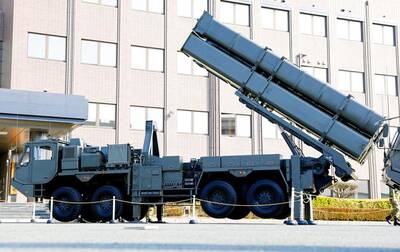
Japan has deployed long-range missiles in a southwestern region near China, the Japanese defense minister said yesterday, at a time when ties with Beijing are at their lowest in recent years. The missiles were installed in Kumamoto in the southern region of Kyushu, as Japan is attempting to shore up its military capacity as China steps up naval activity in the East China Sea. “Standoff defense capabilities enable us to counter the threat of enemy forces attempting to invade our country ... while ensuring the safety of our personnel,” Japanese Minister of Defense Shinjiro Koizumi said. “This is an extremely important initiative for
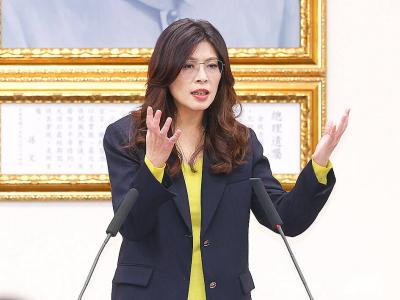
Chinese Nationalist Party (KMT) Chairwoman Cheng Li-wun (鄭麗文) today accepted an invitation from Chinese President Xi Jinping (習近平) to lead a delegation to China next month, saying she hopes to promote the peaceful development of cross-strait relations and bring stability to the Taiwan Strait. “I am grateful and happy to accept this invitation,” Cheng said in a statement from the KMT chairperson’s office. Cheng said she hopes both sides can work together to promote the peaceful development of cross-strait relations, enhance exchange and cooperation, bring stability to the Taiwan Strait and improve people’s livelihoods. At today's news conference, Cheng said any efforts to
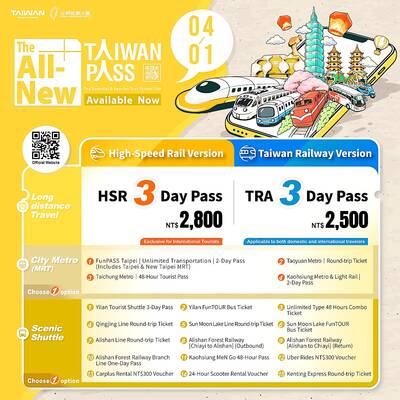
MORE POPULAR: Taiwan Pass sales increased by 59 percent during the first quarter compared with the same period last year, the Tourism Administration said The Tourism Administration yesterday said that it has streamlined the Taiwan Pass, with two versions available for purchase beginning today. The tourism agency has made the pass available to international tourists since 2024, allowing them to access the high-speed rail, Taiwan Railway Corp services, four MRT systems and four Taiwan Tourist Shuttles. Previously, five types of Taiwan Pass were available, but some tourists have said that the offerings were too complicated. The agency said only two types of Taiwan Pass would be available, starting from a three-day pass with the high-speed rail and a three-day pass with Taiwan Railway Corp. The former costs NT$2,800

The nation’s fastest supercomputer, Nano 4 (晶創26), is scheduled to be launched in the third quarter, and would be used to train large language models in finance and national defense sectors, the National Center for High-Performance Computing (NCHC) said. The supercomputer, which would operate at about 86.05 petaflops, is being tested at a new cloud computing center in the Southern Taiwan Science Park in Tainan. The exterior of the server cabinet features chip circuitry patterns overlaid with a map of Taiwan, highlighting the nation’s central position in the semiconductor industry. The center also houses Taiwania 2, Taiwania 3, Forerunner 1 and


 RSS
RSS