


A US Army officer was found guilty of negligent homicide late on Saturday over the death of an Iraqi general at a detention camp, but he was spared a murder conviction that could have sent him to prison for life.
A panel of six army officers also convicted Chief Warrant Officer Lewis Welshofer Jr, 43, of negligent dereliction of duty. He was acquitted of assault after six hours of deliberations.
Welshofer was accused of putting a sleeping bag over the head of Iraqi Major General Abed Hamed Mowhoush, sitting on his chest and using his hand to cover the general's mouth while asking him questions in 2003.
Welshofer, who stood silently and showed no reaction when the verdict was announced, faces a dishonorable discharge and up to three years in prison for negligent homicide and three months for negligent dereliction of duty. Sentencing was scheduled for today.
If convicted of the original murder charge, he could have been sentenced to life in prison.
The defense had argued a heart condition caused Mowhoush's death and that Welshofer's commanders had approved the interrogation technique.
"What he was doing he was doing in the open, and he was doing it because he believed the information in fact would save lives," attorney Frank Spinner said.
He said he was disappointed with the verdict and would decide after sentencing whether to appeal.
"The verdict recognizes the context in which these events took place," he said. "It was a very difficult time in Iraq. There was confusion, and they were not getting clear guidance from headquarters."
Welshofer and prosecutors left without commenting.
During the trial, prosecutor Major Tiernan Dolan described a rogue interrogator who became frustrated with Mowhoush's refusal to answer questions and escalated his techniques from simple interviews to beatings to simulating drowning, and finally, to death.
"He treated that general worse than you would treat a dog and he did so knowing he was required to treat the general humanely," Dolan said.
Welshofer used his sleeping bag technique in the presence of lower ranking soldiers, but never in the presence of officers with the authority to stop him, Dolan said.
The treatment of the Iraqi general "could fairly be described as torture," Dolan said.
In an e-mail to a commander, Dolan said, Welshofer wrote that restrictions on interrogation techniques were impeding the Army's ability to gather intelligence.
"Our enemy understands force, not psychological mind games," Dolan quoted from Welshofer's message.
Dolan said an officer responded by telling Welshofer to "take a deep breath and remember who we are."
Several prosecution witnesses, including one whose identity is classified and who testified in a closed session, had been granted immunity in exchange for their cooperation, Spinner noted. Two soldiers who were initially charged with murder in the case were also given immunity.

A signaling system malfunction disrupted high-speed rail (HSR) services beginning at 8am today, with trains temporarily reduced to three northbound and three southbound trains per hour as authorities conduct inspections. The malfunction occurred on a section of track in Miaoli County during pre-operation checks early this morning, forcing northbound and southbound trains to use a single track, the HSR operator said. The regular schedule has been replaced with three hourly trains offering only nonreserved seating in each direction, stopping at every station, it said, adding that business class cars would still have reserved seating. Departures from terminal stations are scheduled at the top

Taiwan is still in the process of assessing the possibility of recruiting workers from Eswatini, the Ministry of Foreign Affairs said yesterday, adding that its goal is to help Eswatini upgrade its vocational training centers. If there are plans to recruit workers from Eswatini, safeguarding national security, protecting public health and ensuring the employment rights of Taiwanese would be prerequisites, Department of West Asian and African Affairs Director-General Yen Chia-liang (顏嘉良) told a news conference. Key considerations would also include filling labor shortages in specific industries, and fostering bilateral professional and technical exchanges, he said. Yen was asked about the progress of labor

VERBOSE VESSELS: A CGA cutter and a China Coast Guard exchanged verbal barbs for more than a day in Taiwanese-controlled waters before the Chinese vessel left The Taiwanese and Chinese coast guards had a standoff near the strategically located Pratas Islands (Dongsha Islands, 東沙群島) in the north of the South China Sea, the Coast Guard Administration (CGA) said yesterday. The two sides engaged in intense radio exchanges over sovereignty claims during the 33-hour standoff. China Coast Guard vessel 3501 eventually left the restricted waters, 26.6 nautical miles (49.2km) west of the Pratas Islands, at 5pm yesterday, the CGA said. Lying approximately between southern Taiwan and Hong Kong, the Taiwan-controlled Pratas are seen by some security experts as vulnerable to Chinese attack due to their distance — more than
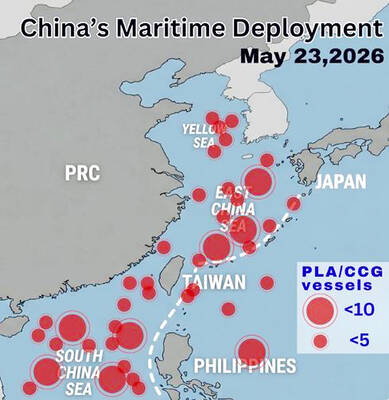
WARNING: China should stop engaging in actions that undermine regional peace and stability, as it would only build resentment among people across the Strait, the CGA said China has deployed more than 100 navy, coast guard and other vessels in waters from the Yellow Sea to the South China Sea and the western Pacific since US President Donald Trump and Chinese President Xi Jinping (習近平) met in Beijing, National Security Council Secretary-General Joseph Wu (吳釗燮) said yesterday. “In this part of the world, #China is the one & only PROBLEM wrecking the #StatusQuo & threatening regional peace & stability,” Wu wrote on X. In a separate post, he said Beijing was coercing Taiwan’s maritime domain, calling it illegal and provocative, after the Coast Guard Administration (CGA) expelled a


 RSS
RSS