


Lee Hsueh-lin (李學林) scored a game-high 15 points yesterday as Taiwan weathered a late rally to defeat Japan 60-55 in the East Asian Games men's basketball final.
Taiwan built a commanding 10-point lead by the end of the third quarter, only to see Japan come back in the last 10 minutes.
Japan, coming off a stunning 68-60 upset over China in the semifinals, closed the gap to just three points late in the game.
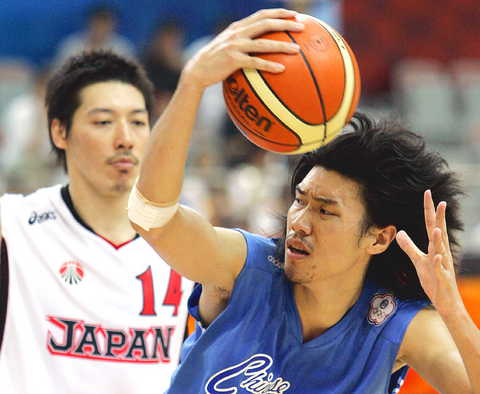
PHOTO: AP
Takuya Kawamura, who led Japan with 13 points, hit a key three-pointer with just 3.6 seconds left to cut the lead to 58-55, but forward Tien Lei (
"This was our most tense game of the year," said Taiwan coach Lee Yun-kung (
The game started evenly with the two teams tied 16-16 at the end of the first quarter. Both sides played tough man-to-man defense, limiting each other to outside shots.
But Taiwan had better success penetrating in the second quarter as Japan struggled with its shooting, pulling ahead 32-22 at the half.
Lee may have been the game's top scorer, but center Tseng Wen-ting (
Japan continued to shoot poorly in the third quarter, but Japan point guard Kei Igarashi made a dashing drive and then made a foul shot in the fourth to help narrow the score to 51-44. Igarashi played a vital role in Japan's win over China.
Japan scored a total of 20 points in the final quarter but it wasn't enough to erase the early deficit.
Japan coach Pavlicevic Zeljko said he tried out several new players who didn't shoot well.
"I gave a chance to three players, these young guys, and nobody made any shots from mid-range," he said.
The Chinese women's basketball team made some amends for the stunning loss by their male compatriots, beating Taiwan 71-67 in the gold medal match.
Earlier yesterday, China defeated South Korea 72-70 to win the bronze medal in men's basketball as NBA prospect Yi Jian-lian was on court to salvage the game, swiveling under the basket as he scored the winning points.
South Korea's Lee Kwang-jae had missed twice from the free-throw line with the scores locked 70-70 and 14 seconds to go.
Wang Shipeng had a game-high 30 points for China and Yi -- who was fouled out in the semifinal loss -- had seven points, 10 rebounds and three blocks.
soccer
China defeatedJapan 2-1, with Glasgow Celtic defender Du Wei scoring the winner to lead his side into the final against North Korea.
That is the last of 234 gold medals on offer over nine days.
North Korea had a 2-0 win over South Korea in the first major head-to-head contest since both agreed here to form a single team for the Asian Games and 2008 Olympics.
swimming
China won four of the last seven swimming finals yesterday to finish the East Asian Games meet with 33 gold medals, erasing Japan's reputation as the regional power in the pool.
Across all 17 sports with only seven finals to be determined on the final day of competition at Macau, China had 126 gold medals and 220 overall -- a massive lead over Japan, with 45 gold and 175 overall.
Japan, ranked third in swimming at last year's Athens Olympics, had seven swimming gold medals here, including one on the final day.
Wrapping up in the pool, Cai Li won the 50m freestyle in 22.85 and Japan's Takeshi Matsuda edged China's Wu Peng to win the men's 200m butterfly in 1:56.72.
Matsuda, the Asian record holder in the 400m freestyle, returned 10 minutes after the butterfly for his favored event but finished off the pace in third, behind Park Tae-hwan of South Korea.
The South Koreans picked up their second swimming gold when Jung Jiyeon won their women's 400m medley in 4:43.29, edging teammate Nam Yoo-sun.
China's two women's gold medalists were Yang Jieqiao in the 800m and the medley relay team.
In the last event, China led Japan and South Korea into the wall. The teams finished the swimming program in that order, and will finish the East Asian Games in that order. Taiwan was next with 11 gold medals overall.
Among the swimmers to shine as China asserted itself in swimming was 13-year-old Wang Qun, who collected a 100m-200m double in the women's breaststroke, including an upset over Olympic gold medalist Luo Xuejuan in the 100m.
Beijing Olympics
Cai Dalin, deputy head of China's delegation, said the Chinese used the games to train young athletes, and get used to new rules in some competitions like shooting and gymnastics ahead of the Beijing Olympics.
He identified Wang and Zhang Lin, who won the men's 1,500m in an Asian record and the added the 200m freestyle gold medal, as some of China's brightest hopes.
Zhang "lets us see China's hopes in the long-distance swimming events in 2008," Cui said.
Despite China's stellar performance here, Cui said China's overall standard in swimming still lagged behind that of Japan, which didn't field its strongest swimmers.
"Even though China won more gold medals ... we know clearly there's still a gap between China's swimming and Japan's," he said.
Organizers in Macau said the high cost of staging the was repaid in gold as Macau won 10 gold medals overall.

‘NO SECURITY RISK’: The Railway Bureau reassured the public that the technicians’ activities were limited to technical guidance and did not involve sensitive systems The Railway Bureau yesterday said it had invited eight Chinese technicians to assist with an airport MRT construction project. The bureau issued the confirmation after an Internet user said Chinese nationals had entered the construction zone of Taiwan Taoyuan International Airport’s Terminal 3 project. They asked why “individuals from an enemy state” were allowed access to such a major national infrastructure project, which raised serious concerns over Taiwan’s industrial safety, sensitive systems and information security. The bureau’s Northern Region Engineering Branch Office said subcontractor Taiwan Handle Industrial Co (台灣手把工業) of the Taoyuan airport MRT’s “Contract No. CU05 Project A14 Station Civil, MEP &

A US uncrewed surface vessel (USV) encountered multiple Chinese warships during an autonomous transit of the Taiwan Strait, US defense company Seasats said in a statement on Wednesday. Seasats announced that a Lightfish USV had completed the first autonomous transit of the Taiwan Strait. Over five days, the USV traversed the entire length of the Strait while constantly monitoring surface vessel traffic, the company said. The Lightfish encountered multiple Chinese warships, one of which was a Chinese People’s Liberation Army Navy (PLAN) Type 056 corvette, it said. The Chinese vessels were operating “well within Taiwan’s exclusive economic zone without transmitting their identity via the
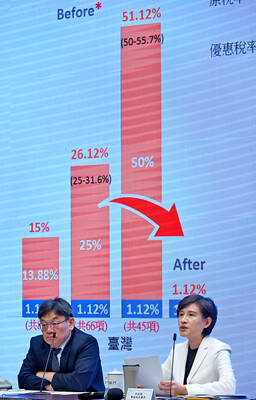
GREATER REACH? Auto parts and wood products would face tariffs of up to 15%, matching those targeting the EU, Japan and South Korea, Vice Premier said The US has announced that preferential tariff treatment for Taiwan’s non-semiconductor Section 232 goods would take effect retroactively from May 1, the Executive Yuan said yesterday. The US government yesterday posted a notice on the Federal Register’s public inspection Web site previewing tariff concessions for Taiwan under a memorandum of understanding (MOU) on Taiwan-US investment after two months of negotiations. The MOU signed on Jan. 15 stipulated three major preferential tariff arrangements: a 15 percent “reciprocal” tariff rate for Taiwan without stacking most-favored nation (MFN) rates; preferential Section 232 treatment for semiconductors and related products; and preferential Section 232 treatment for non-semiconductor

The National Chungshan Institute of Science and Technology yesterday showcased its locally developed variants of the Vision 60 robotic patrol dog, which it plans to deploy on the nation’s outlying territories in the South China Sea. The variants were produced under the Joint Lab project — created by the institute and domestic companies — and assembled with domestically produced motors, lenses and artificial intelligence (AI) systems alongside licensed tech from the US, Missile and Rocket Systems Research Division deputy director Jen Kuo-kang (任國光) told the media event at a military base in Taipei’s Dazhi (大直) area. Taiwan has built up its strengths


 RSS
RSS