


With the arms procurement bill still in limbo and the possibility of cross-strait unification at some point in the future, some Americans may be concerned that advanced military technology would fall into China's hands if Taiwan were to procure high-tech weapons from the US, Minister of National Defense Lee Jye (李傑) said yesterday.
Lee made the remarks in response to a query from Chinese Nationalist Party (KMT) Legislator Su Chi (
Su was referring to an editorial piece by Halloran in the Japan Times on Sept. 27.
The same piece appeared in the Taipei Times on Sept. 25. Halloran quoted anonymous US military officers as saying that the new commander of US forces in Asia and the Pacific, Admiral William Fallon, has urged Taiwan to acquire more strictly defensive weapons while seeking "to deter Beijing by reminding Chinese leaders that the US had the capability and resolve to help defend Taiwan."
Su said the article was credible and may indicate an adjustment in the US' attitude toward Taiwan.
"I do not have any such information form the Pacific Command, but because of a long-time boycott of the special arms bill, Americans have started feeling the pressure from the gradually increasing military imbalance in the Strait," Lee said.
"The information from the article may reflect some Americans' concern that selling high-tech arms to Taiwan might result in technology falling into the hands of the Chinese if the two countries reunify in the future," the minister added.
Lee, a former chief of the navy who has been promoting improvements to the country's submarine force, also said that Fallon may have a different view on Taiwan's defense requirements.
Democratic Progressive Party (DPP) Legislator Lee Wen-chung (
"Those defensive weapons mentioned in the article are mainly to prevent an amphibious invasion by China, but Taiwan has transformed its military strategy to fight its enemy outside its borders, and that is why Taiwan needs to procure the advanced weapons systems," Lee Wen-chung said.
In light of the strategies favored by the People's Liberation Army (PLA), Taiwan should pay more attention to the possibility of an attack from China that would paralyze Taiwan's command and control systems while minimizing bloodshed and economic damage, rather than a regular amphibious invasion, the DPP legislator said.
Lee Jye's remarks reflected concern among Taiwanese military experts about the possible withdrawal of the US' security commitments to Taiwan if the arms bill fails to be approved.
Bill Chang (

‘NO SECURITY RISK’: The Railway Bureau reassured the public that the technicians’ activities were limited to technical guidance and did not involve sensitive systems The Railway Bureau yesterday said it had invited eight Chinese technicians to assist with an airport MRT construction project. The bureau issued the confirmation after an Internet user said Chinese nationals had entered the construction zone of Taiwan Taoyuan International Airport’s Terminal 3 project. They asked why “individuals from an enemy state” were allowed access to such a major national infrastructure project, which raised serious concerns over Taiwan’s industrial safety, sensitive systems and information security. The bureau’s Northern Region Engineering Branch Office said subcontractor Taiwan Handle Industrial Co (台灣手把工業) of the Taoyuan airport MRT’s “Contract No. CU05 Project A14 Station Civil, MEP &

A US uncrewed surface vessel (USV) encountered multiple Chinese warships during an autonomous transit of the Taiwan Strait, US defense company Seasats said in a statement on Wednesday. Seasats announced that a Lightfish USV had completed the first autonomous transit of the Taiwan Strait. Over five days, the USV traversed the entire length of the Strait while constantly monitoring surface vessel traffic, the company said. The Lightfish encountered multiple Chinese warships, one of which was a Chinese People’s Liberation Army Navy (PLAN) Type 056 corvette, it said. The Chinese vessels were operating “well within Taiwan’s exclusive economic zone without transmitting their identity via the
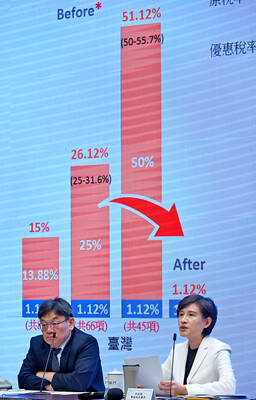
GREATER REACH? Auto parts and wood products would face tariffs of up to 15%, matching those targeting the EU, Japan and South Korea, Vice Premier said The US has announced that preferential tariff treatment for Taiwan’s non-semiconductor Section 232 goods would take effect retroactively from May 1, the Executive Yuan said yesterday. The US government yesterday posted a notice on the Federal Register’s public inspection Web site previewing tariff concessions for Taiwan under a memorandum of understanding (MOU) on Taiwan-US investment after two months of negotiations. The MOU signed on Jan. 15 stipulated three major preferential tariff arrangements: a 15 percent “reciprocal” tariff rate for Taiwan without stacking most-favored nation (MFN) rates; preferential Section 232 treatment for semiconductors and related products; and preferential Section 232 treatment for non-semiconductor

The National Chungshan Institute of Science and Technology yesterday showcased its locally developed variants of the Vision 60 robotic patrol dog, which it plans to deploy on the nation’s outlying territories in the South China Sea. The variants were produced under the Joint Lab project — created by the institute and domestic companies — and assembled with domestically produced motors, lenses and artificial intelligence (AI) systems alongside licensed tech from the US, Missile and Rocket Systems Research Division deputy director Jen Kuo-kang (任國光) told the media event at a military base in Taipei’s Dazhi (大直) area. Taiwan has built up its strengths


 RSS
RSS