


Water cups flew and lawmakers held shoving matches in what was likely the start of yet another acrimonious and unproductive legislative session yesterday.
Premier Frank Hsieh (
Chanting "Fight corruption, save Taiwan" and "Re-elect the president and the legislature," pan-blue lawmakers occuppied the legislative floor at 10:20am, holding placards and a white banner reading: "Re-elect the president, vice president, premier and legislature."
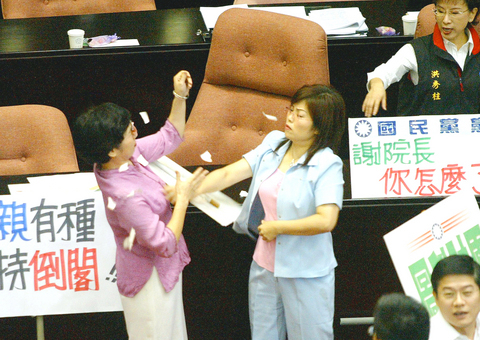
PHOTO: CNA
Pan-green lawmakers responded by chanting "Dismiss the legislature" and "Begin the session." In addition, some Democratic Progressive Party (DPP) lawmakers held signs reading "Pan-blues, please file a no-confidence vote" and "the government cannot operate in neutral gear."
The first round of lawmaking mayhem climaxed when DPP Legislator Wang Shu-hui (
Legislative Speaker Wang Jin-pyng (
The turmoil came after pan-blue lawmakers condemned Hsieh during the National Affairs Forum, which preceded yesterday's legislative sitting.
They demanded that Hsieh step down or take personal leave, to avoid any conflict of interest while an independent investigator conducts a probe into a riot last month by Thai workers in Kaohsiung, where Hsieh was formerly mayor.
In a bid to resolve the political stalemate, Wang called an emergency meeting with caucus leaders during the recess, during which the DPP caucus agreed to the KMT caucus' request to establish five commissions of inquiry to probe into different "corruption incidents," in exchange for the pan-blue camp's agreement to let Hsieh deliver his policy report.
The five commissions are to probe Kaohsiung City's mass rapid transit system, the north-south high-speed rail system, the release of the Chunghwa Telecom stake, the privatization of the Taiwan Business Bank and allegations of widespread insider trading on the stock market.
During round two of the legislative sparring, the pan-blue alliance reneged on its promise and resurrected its vocal portests during the afternoon session.
Shortly after that session began, DPP Legislator Lin Chung-mo (
DPP Legislator Kuan Pi-ling (
"Why can't I stand here, while opposition parties get to occupy the legislative floor?" she shouted.
The second round of the legislative session ended in style, with Huang Chao-shun and DPP Legislator Lee Ming-hsien (
Wang then ordered another recess, which lasted for about 15 minutes.
Round three then began, but the session was again disrupted at 3:15pm, when Hsieh tried to take the podium, only to have Huang Chao-shun complain that Wang had failed to inform the legislature of the agreement reached at noon.
Upset by the pan-blue camp's obstructions, the DPP caucus condemned the KMT, attributing the political deadlock to an internal conflict within the KMT.
"Today, KMT Chairman Ma Ying-jeou (
"Ma has proven that he has not only changed a lot after taking the KMT's helm, but that he also knows how to manipulate the legislature," he said.
Dismissing the DPP's accusations, KMT caucus whip Cho Po-yuan (
Meanwhile, the clashes inside the Legislative Yuan were matched by protests that took place outside the legislative compound.
Members of an "anti-arms procurement group" voiced opposition to pushing through the arms procurement bill to committee for review, while the Nuke-4 Referendum Initiative Association requested that the legislature lower the thresholds for constitutional amendments and ratification.
Other protesters included the members of the Taiwan Business Bank labor union.
Meanwhile, DPP Chairman Su Tseng-chang (蘇貞昌) yesterday called Ma an "irrational chairman" who indulged KMT lawmakers and allowed them to prevent Hsieh from giving his administration report.
"Ma has changed since he became the KMT chairman. His leadership of the KMT is so disappointing," Su said after the DPP's Central Standing Committee meeting.
"The chaotic legislative session proves that Ma is not a rational chairman," Su said.
"If Ma does not rectify this situation, I believe that the people of Taiwan will spurn the KMT in the elections," the DPP chairman said.
In response to this criticism, Ma yesterday said that "long-winded speeches" -- filibusters -- were one of the strategies often used in democratic countries.
"In democratic countries, the so-called `long-winded speech' is actually a strategy used by opposition parties to force the ruling party to make some concessions," Ma said.
Defending the KMT caucus for using an "acceptable" strategy to express its disagreement with the ruling party, Ma said that the "long-winded speech" measures were not necessarily equivalent to taking over the podium.
"I expect the caucus to take reasonable measures when making a stand against the ruling party," he said.
Additional reporting by Jewel Huang and Mo Yan-chih

Japan has deployed long-range missiles in a southwestern region near China, the Japanese defense minister said yesterday, at a time when ties with Beijing are at their lowest in recent years. The missiles were installed in Kumamoto in the southern region of Kyushu, as Japan is attempting to shore up its military capacity as China steps up naval activity in the East China Sea. “Standoff defense capabilities enable us to counter the threat of enemy forces attempting to invade our country ... while ensuring the safety of our personnel,” Japanese Minister of Defense Shinjiro Koizumi said. “This is an extremely important initiative for
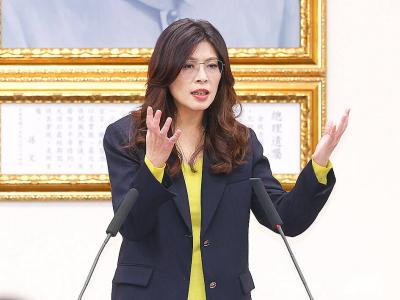
Chinese Nationalist Party (KMT) Chairwoman Cheng Li-wun (鄭麗文) today accepted an invitation from Chinese President Xi Jinping (習近平) to lead a delegation to China next month, saying she hopes to promote the peaceful development of cross-strait relations and bring stability to the Taiwan Strait. “I am grateful and happy to accept this invitation,” Cheng said in a statement from the KMT chairperson’s office. Cheng said she hopes both sides can work together to promote the peaceful development of cross-strait relations, enhance exchange and cooperation, bring stability to the Taiwan Strait and improve people’s livelihoods. At today's news conference, Cheng said any efforts to

MORE POPULAR: Taiwan Pass sales increased by 59 percent during the first quarter compared with the same period last year, the Tourism Administration said The Tourism Administration yesterday said that it has streamlined the Taiwan Pass, with two versions available for purchase beginning today. The tourism agency has made the pass available to international tourists since 2024, allowing them to access the high-speed rail, Taiwan Railway Corp services, four MRT systems and four Taiwan Tourist Shuttles. Previously, five types of Taiwan Pass were available, but some tourists have said that the offerings were too complicated. The agency said only two types of Taiwan Pass would be available, starting from a three-day pass with the high-speed rail and a three-day pass with Taiwan Railway Corp. The former costs NT$2,800

The nation’s fastest supercomputer, Nano 4 (晶創26), is scheduled to be launched in the third quarter, and would be used to train large language models in finance and national defense sectors, the National Center for High-Performance Computing (NCHC) said. The supercomputer, which would operate at about 86.05 petaflops, is being tested at a new cloud computing center in the Southern Taiwan Science Park in Tainan. The exterior of the server cabinet features chip circuitry patterns overlaid with a map of Taiwan, highlighting the nation’s central position in the semiconductor industry. The center also houses Taiwania 2, Taiwania 3, Forerunner 1 and


 RSS
RSS