


Taichung City police yesterday released a surveillance image of a man suspected of using cyanide to lace energy drinks that killed one man and sickened at least three others.
The affected drinks, Bullwild (蠻牛) and Paolyta B (保力達B), had apparently been tampered with at convenience stores and a drugstore.
"Police are looking for a male wearing a white shirt, baseball hat and dark glasses. He is about 170cm tall and about 30 years old," said Yen Wang-sheng (
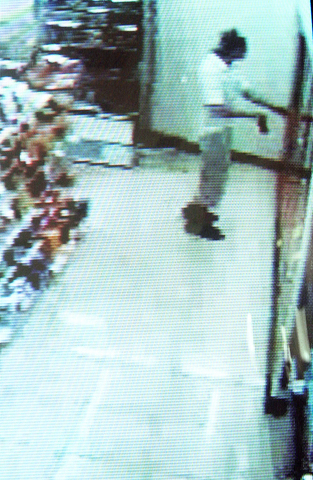
PHOTO: LIAO YAO-TUNG, TAIPEI TIMES
Yen said that "police checked about 2,000 video surveillance monitors from convenience stores in Taichung, and found the suspicious man entering [a number of] convenience stores, [and in one store] putting a beverage similar in appearance to Bullwild into a refrigerator and then leaving."
Yen said the suspect had appeared on video surveillance monitors at several of the convenience stores where the laced drinks were found.
Paolyta Co told police that it was not involved in any disputes and had not received any threats. Police were therefore still looking for a motive, Yen said.
Police suspect, however, that the perpetrator might be a former employee of the beverage company or someone attached to a rival company, he said.
Police have so far found nine bottles containing the poison. The caps on the tainted bottles had been replaced and all had stickers bearing the words, "I am poisonous. Don't drink," police said.
Taichung police on Wednesday night also discovered one bottle of Paolyta B with similar labeling at a Cosmed store.
Taichung Veterans General Hospital's toxicology department director Hung Tung-jung (洪東榮) yesterday said the bottle of Paolyta B had been laced with cyanide.
A 55 year-old man named Chou Yi-kuei (周乙桂) on Tuesday drank a bottle of Bullwild and passed out. Chou died late on Wednesday at the Taichung Veterans General Hospital.
Hung said a 33-year-old woman, Chao Shih-fang (趙世芳), and a 30-year-old man, Lee Feng-ming (李峰銘), would survive, but the cyanide might result in permanent brain damage.
A 58 year-old man surnamed Ko, who was slightly poisoned, had recovered well and left hospital, Hung said.
The owner of Paolyta Co, Lu Pai-tsang (呂百倉), yesterday told reporters the company estimated it would lose NT$100 million (US$3.2 million) over the incident.
He said Bullwild -- a Vitamin B fortified product popular with laborers -- would redesign its bottle and packaging within the month even if the suspect or suspects were caught.
Lu said that all Paolyta B and Bullwild drinks had been withdrawn from shops around the country as well as from Hong Kong and would be destroyed.
Lu said this included 200,000 boxes of Bullwild and 100,000 boxes of Paolyta B.
"The losses are really hard to estimate," he said yesterday.
The two beverages account for about 90 percent of the company's annual sales of between NT$3 billion and NT$4 billion.
Since Paolyta B is categorized as a pharmaceutical beverage and new packaging requires approval from the government, the company is unsure of exactly when the product can be put back on the shelves, Lu said.
Deemed as the company's cash cow, Bullwild and Paolyta B have each enjoyed market share of nearly 50 percent in their respective categories.
Although it is unknown what impact the incident will have on consumer confidence, major retailers have adopted a cautious approach by removing all of the company's other products.
Four of the five major convenience store chains -- 7-Eleven, FamilyMart, Nikomart and OK -- yesterday withdrew the Paolyta-manufactured lemon vodka Ice Fire and fruit-flavored vitamin C drinks.
Police yesterday continued to visit chemical retailers. As a permit is needed to purchase cyanide, police are investigating whether the perpetrator or perpetrators attained cyanide from these dealers.

‘NO SECURITY RISK’: The Railway Bureau reassured the public that the technicians’ activities were limited to technical guidance and did not involve sensitive systems The Railway Bureau yesterday said it had invited eight Chinese technicians to assist with an airport MRT construction project. The bureau issued the confirmation after an Internet user said Chinese nationals had entered the construction zone of Taiwan Taoyuan International Airport’s Terminal 3 project. They asked why “individuals from an enemy state” were allowed access to such a major national infrastructure project, which raised serious concerns over Taiwan’s industrial safety, sensitive systems and information security. The bureau’s Northern Region Engineering Branch Office said subcontractor Taiwan Handle Industrial Co (台灣手把工業) of the Taoyuan airport MRT’s “Contract No. CU05 Project A14 Station Civil, MEP &

A US uncrewed surface vessel (USV) encountered multiple Chinese warships during an autonomous transit of the Taiwan Strait, US defense company Seasats said in a statement on Wednesday. Seasats announced that a Lightfish USV had completed the first autonomous transit of the Taiwan Strait. Over five days, the USV traversed the entire length of the Strait while constantly monitoring surface vessel traffic, the company said. The Lightfish encountered multiple Chinese warships, one of which was a Chinese People’s Liberation Army Navy (PLAN) Type 056 corvette, it said. The Chinese vessels were operating “well within Taiwan’s exclusive economic zone without transmitting their identity via the
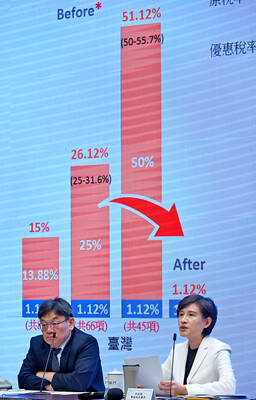
GREATER REACH? Auto parts and wood products would face tariffs of up to 15%, matching those targeting the EU, Japan and South Korea, Vice Premier said The US has announced that preferential tariff treatment for Taiwan’s non-semiconductor Section 232 goods would take effect retroactively from May 1, the Executive Yuan said yesterday. The US government yesterday posted a notice on the Federal Register’s public inspection Web site previewing tariff concessions for Taiwan under a memorandum of understanding (MOU) on Taiwan-US investment after two months of negotiations. The MOU signed on Jan. 15 stipulated three major preferential tariff arrangements: a 15 percent “reciprocal” tariff rate for Taiwan without stacking most-favored nation (MFN) rates; preferential Section 232 treatment for semiconductors and related products; and preferential Section 232 treatment for non-semiconductor

The National Chungshan Institute of Science and Technology yesterday showcased its locally developed variants of the Vision 60 robotic patrol dog, which it plans to deploy on the nation’s outlying territories in the South China Sea. The variants were produced under the Joint Lab project — created by the institute and domestic companies — and assembled with domestically produced motors, lenses and artificial intelligence (AI) systems alongside licensed tech from the US, Missile and Rocket Systems Research Division deputy director Jen Kuo-kang (任國光) told the media event at a military base in Taipei’s Dazhi (大直) area. Taiwan has built up its strengths


 RSS
RSS