


Viktor Yushchenko was sworn in as president of Ukraine yesterday, two months after massive protests over his loss in a fraud-plagued election plunged the ex-Soviet republic into political crisis.
Yushchenko, a Western-oriented reformer, took the oath of office in the Verkhovna Rada parliament, placing his hand on a copy of the constitution and on an antique Bible.
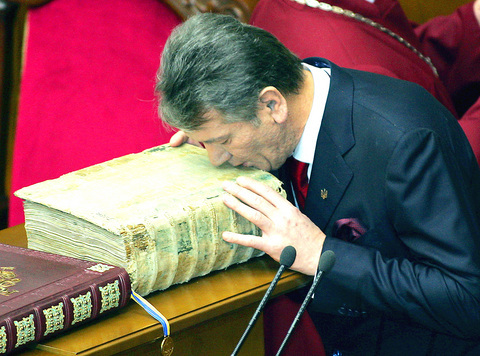
PHOTO: AP
After the oath, some deputies repeatedly shouted "Yu-shchen-ko, Yu-shchen-ko," an echo of the chanting that filled Kiev during the protest demonstrations. But others stood stonily unapplauding, a reflection of the deep political tensions that Yushchenko will face as the country's third post-Soviet leader.
Yushchenko was declared the loser of a Nov. 21 election that international observers said was badly marred by vote fraud. Hundreds of thousands of demonstrators poured into Kiev's streets to protest the vote and demonstrations went on for weeks.
The Supreme Court annulled the election and Yushchenko won a Dec. 26 court-ordered rerun, beating then prime minister Viktor Yanukovych, the Kremlin-supported leader, by 8 percentage points.
But Yanukovych raised a series of legal challenges to the revote, the last of which was rejected by the high court on Thursday, paving the way for the inauguration.
Yanukovych has vowed to take his complaints to the European Court of Human Rights. The court has no enforcement mechanism, but such a move could be an unwelcome shadow on Yushchenko's intentions to push for Ukraine's closer integration with the EU and NATO.
"The people of Ukraine had a fair election, with the handover of power, the Ukrainian nation has risen," Yushchenko said after taking the oath. "We have to work with the people and for the people."
Yushchenko later was to make his full speech from an outdoor stage at Independence Square, the central gathering point for demonstrators during the protests that became known as the "Orange Revolution" after Yushchenko's campaign color.
Tens of thousands of people had gathered at the square yesterday, hours before Yushchenko's speech.
NATO Secretary-General Jaap de Hoop Scheffer was one of many dignitaries, including representatives of more than 40 countries, who came to the inauguration. Another was Georgian Parliament Speaker Nino Burdzhanadze, a leader of the 2003 protests that forced a government change in her country and that became a model for Ukraine's demonstrators.
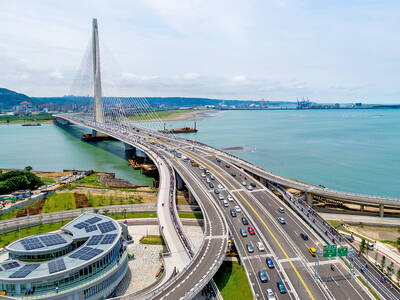
The Ministry of Transportation and Communications yesterday inaugurated the Danjiang Bridge across the Tamsui River in New Taipei City, saying that the structure would be an architectural icon and traffic artery for Taiwan. Feted as a major engineering achievement, the Danjiang Bridge is 920m long, 211m tall at the top of its pylon, and is the longest single-pylon asymmetric cable-stayed bridge in the world, the government’s Web site for the structure said. It was designed by late Iraqi-British architect Zaha Hadid. The structure, with a maximum deck of 70m, accommodates road and light rail traffic, and affords a 200m navigation channel for boats,
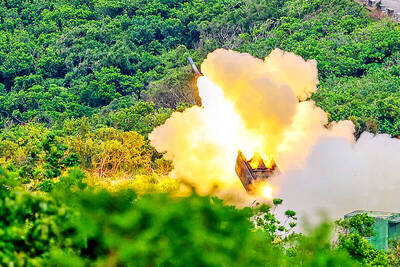
PRECISION STRIKES: The most significant reason to deploy HIMARS to outlying islands is to establish a ‘dead zone’ that the PLA would not dare enter, a source said A High Mobility Artillery Rocket System (HIMARS) would be deployed to Penghu County and Dongyin Island (東引) in Lienchiang County (Matsu) to force the Chinese military to retreat at least 100km from the coastline, a military source said yesterday. Taiwan has been procuring HIMARS and Army Tactical Missile Systems (ATACMS) from the US in batches. Once all batches have been delivered, Taiwan would possess 111 HIMARS units and 504 ATACMS, which have a range of 300km. Considering that “offense is the best defense,” the military plans to forward-deploy the systems to outlying islands such as Penghu and Dongyin so that
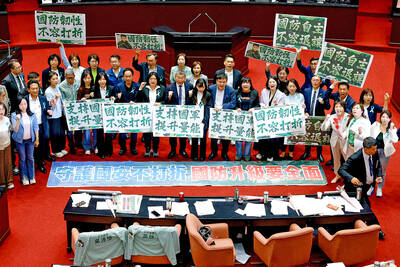
WHAT WAS ALL THAT FOR? Jaw Shaw-kong said that Cheng Li-wen had pushed for more drastic cuts and attacked him, just for the outcome to be nearly identical to his bill The legislature yesterday passed a supplementary budget bill to fund the purchase of separate packages of US military equipment, with the combined amount of spending capped at NT$780 billion (US$24.8 billion). The Chinese Nationalist Party (KMT) and Taiwan People’s Party (TPP) used their legislative majority to pass the bill, which runs until 2033 and has two main funding provisions. One was for NT$300 billion of arms sales already approved by the US for Taiwan on Dec. 17 last year, the other was for NT$480 billion for another arms package expected to be announced by Washington. The bill, which fell short of the NT$1.25
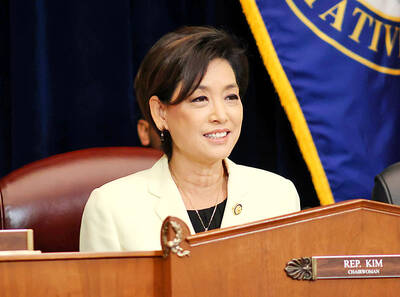
‘CLEAR MESSAGE’: The bill would set up an interagency ‘tiger team’ to review sanctions tools and other economic options to help deter any Chinese aggression toward Taiwan US Representative Young Kim has introduced a bill to deter Chinese aggression against Taiwan, calling for an interagency “tiger team” to preplan coordinated sanctions and economic measures in response to possible Chinese military or political action against Taiwan. “[Chinese President] Xi Jinping [習近平] has directed the People’s Liberation Army to be ready to invade Taiwan by 2027. China has a plan. America should have one too,” Kim said in a news release on Thursday last week. She introduced the “Deter PRC [People’s Republic of China] aggression against Taiwan act” to “ensure the US has a coordinated sanctions strategy ready should


 RSS
RSS