


The low-profile arrival of two officials from China's Taiwan Affairs Office yesterday coincided with speculations that a recent trip to China by the head of the nation's largest carrier, China Airlines (CAL) chairman Chiang Yao-chung (江耀宗), might be tied to the closely watched direct cross-strait flights for the Lunar New Year.
Li Xiaoyun (李小云), director of the Cross-Strait Economic and Technological Exchange Center under China's Taiwan Affairs Office, and Feng Chuozhe (馮卓志), president of Beijing's state-run Cross-Strait Travel Service, were greeted by an anonymous official upon their arrival at Chiang Kai-shek International Airport.
It is believed that Li and Feng are visiting Taiwan to discuss issues regarding the opening of direct charter flights for the Lunar New Year holidays and tourism policies. Li and Feng, however, said they were invited to make a sightseeing trip.
"We will travel around the island for sightseeing," Li said, adding that he and Feng received the invitation a long time ago but had postponed the trip until now for various reasons. This is Li's first trip to Taiwan, while Feng has visited on several previous occasions. Meanwhile, China Airlines (CAL) yesterday confirmed that its chairman, Chiang Yao-chung (江耀宗), was currently in China on a business trip but denied speculations that the trip had anything to do with the closely watched cross-strait chartered flights for the upcoming Lunar New Year.
CAL spokesman Roger Han (韓梁中) said that Chiang was slated to visit companies in the area but that the trip was strictly business.
"The trip is only for business purposes.Media reports [linking the trip to cross-strait chartered flights] are wrong and merely speculating," Han said.
According to the Chinese-language daily China Times, Chiang had formally reported the trip to the Minister of Transportation and Communications Lin Ling-san (林陵三) ahead of time but had not been asked to carry out any tasks on behalf of the government. According to the report, Chiang departed for China last Sunday and plans to stay for about a week.
News of Chiang's trip to China follows an abrupt halt on the carrier's privatization plans just last week. Lin announced last Tuesday that the government was to remain the airline's largest shareholder, while Premier Yu Shyi-kun had indicated that the carrier was needed to service diplomatic missions when necessary.
Lending further support to speculations of Chiang's involvement in efforts to establish cross-strait flights and direct links with China is his concurrent position as a chairman of the Straits Exchange Foundation (SEF), a semi-official organization that oversees and conducts cross-strait exchanges in lieu of the government. He is generally believed to align politically with the pan-green camp.
Mainland Affairs Council Vice Chairman Chiu Tai-san (
"Basically, if Chiang discusses cross-strait flights in China, it is without the council's authorization," Chiu said.
"The likelihood that talks with China about cross-strait chartered flights will be conducted by China Air is small. China Air is a business representative -- what would EVA Air or other carriers think?" Chiu said.
Whether cross-strait chartered flights are a viable option for the next Lunar New Year, during which the government estimates 100,000 Taiwanese businesspeople and their families will return home for the holiday, remains uncertain. While cross-strait flights during the Lunar New Year have occurred in the last two years, the flights had to make stopovers in Hong Kong and Macau and the routes could be serviced by Taiwanese airlines only.
Council Chairman Joseph Wu (
The council first proposed discussions for next year's Lunar New Year flights in September and announced a willingness to discuss the possibility of direct flights in both directions and serviced by both Taiwanese and Chinese carriers. However, the Taiwan Affairs Office has thus far refused official negotiations and insisted that cross-strait flights be viewed as domestic routes.
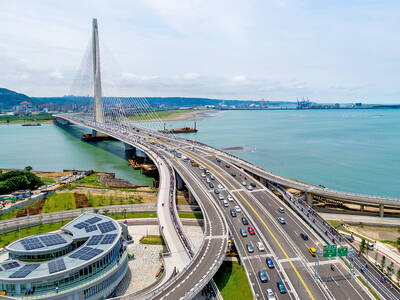
The Ministry of Transportation and Communications yesterday inaugurated the Danjiang Bridge across the Tamsui River in New Taipei City, saying that the structure would be an architectural icon and traffic artery for Taiwan. Feted as a major engineering achievement, the Danjiang Bridge is 920m long, 211m tall at the top of its pylon, and is the longest single-pylon asymmetric cable-stayed bridge in the world, the government’s Web site for the structure said. It was designed by late Iraqi-British architect Zaha Hadid. The structure, with a maximum deck of 70m, accommodates road and light rail traffic, and affords a 200m navigation channel for boats,
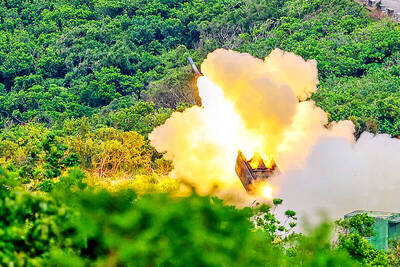
PRECISION STRIKES: The most significant reason to deploy HIMARS to outlying islands is to establish a ‘dead zone’ that the PLA would not dare enter, a source said A High Mobility Artillery Rocket System (HIMARS) would be deployed to Penghu County and Dongyin Island (東引) in Lienchiang County (Matsu) to force the Chinese military to retreat at least 100km from the coastline, a military source said yesterday. Taiwan has been procuring HIMARS and Army Tactical Missile Systems (ATACMS) from the US in batches. Once all batches have been delivered, Taiwan would possess 111 HIMARS units and 504 ATACMS, which have a range of 300km. Considering that “offense is the best defense,” the military plans to forward-deploy the systems to outlying islands such as Penghu and Dongyin so that
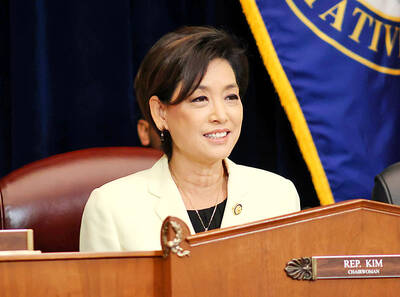
‘CLEAR MESSAGE’: The bill would set up an interagency ‘tiger team’ to review sanctions tools and other economic options to help deter any Chinese aggression toward Taiwan US Representative Young Kim has introduced a bill to deter Chinese aggression against Taiwan, calling for an interagency “tiger team” to preplan coordinated sanctions and economic measures in response to possible Chinese military or political action against Taiwan. “[Chinese President] Xi Jinping [習近平] has directed the People’s Liberation Army to be ready to invade Taiwan by 2027. China has a plan. America should have one too,” Kim said in a news release on Thursday last week. She introduced the “Deter PRC [People’s Republic of China] aggression against Taiwan act” to “ensure the US has a coordinated sanctions strategy ready should

TAIWAN ISSUE: US treasury secretary Scott Bessent said on the first day of meetings that ‘it wouldn’t be a US-China summit without the Taiwan issue coming up’ There were no surprises on the first day of the summit between US President Donald Trump and Chinese President Xi Jinping (習近平), the Mainland Affairs Council (MAC) said yesterday, as the government reiterated that cross-strait stability is crucial to the Asia-Pacific region, as well as the world. As the two presidents met for a highly anticipated summit yesterday, Chinese state media reported that Xi warned Trump that missteps regarding Taiwan could push their two countries into “conflict.” Trump arrived in China with accolades for his host, calling Xi a “great leader” and “friend,” and extending an invitation to visit the White House


 RSS
RSS