


President Chen Shui-bian (
Lien's attitude showed he had no faith in the people, Chen said.
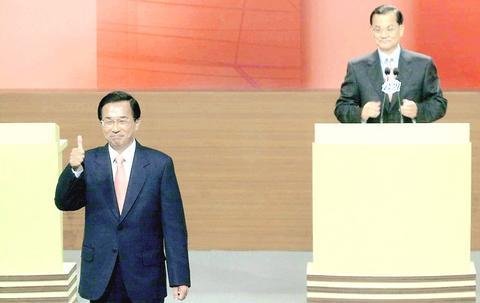
PHOTO: CHIANG YING-YING, TAIPEI TIMES
The referendum issue became the focal point of yesterday's debate.
Asked by Chen whether Lien will vote on the referendum, Lien said "I respect the people's right to vote on the referendum, but for me, it is an illegal and controversial referendum. I certainly won't cast my vote on it and I suggest Mr. Chen immediately stop it."
Chen, however, countered Lien's remarks, urging people to vote and calling Lien's attitude contradictory in asking people to exercise their democratic right by voting for him but to abrogate that right in the referendum vote.
"We hope Lien can stop being stubborn [on the referendum issue]. How can he not believe in people, while asking people to believe in him? How can he ask people to vote for him while he himself is not going to cast a [referendum] ballot? This is very contradictory," Chen said.
In addition to the referendum issue, cross-strait policies, personality traits and economic development also figured in yesterday's debate.
Chen again attacked Lien's statements about laying aside sovereignty issues when dealing with cross-strait interactions and said Lien's running mate James Soong's (
"Do you agree or not about your presidential running mate's proposal of a `one China' roof theory? If you agree, then what does Taiwan represent? Is it carpets or tiles that Taiwan has become [under this roof]?" Chen asked.
For his part, Lien blamed Chen's cross-strait policy for stalling progress on direct links over the past four years and promised to start a cross-party national development meeting to tackle the issue of the National Unification Guidelines (
Chen also said in his concluding speech that he will endeavor to normalize cross-strait relations by dispatching Taiwan's first representative to be stationed in Beijing and push for Taiwan's entry into the World Health Organization within two years of his re-election.
He said his biggest wish after May 20, the inauguration date of the new presidency, was to "shake hands and reconcile with [Chinese President] Hu Jintao (
On the economy, Lien urged people to support a second transition of political power to restore economic prosperity to the country under the KMT's administration.
Chen, however said a second transition of political power means a return of the KMT's "black-gold" money politics and corruption, which the Democratic Progressive Party administration has tried hard to eliminate.
Likening the revamping of the country to housecleaning, Chen said his administration has "cleaned the garbage left by the KMT, repaired the leaky roof, built new pillars for the house and polished the windows of the building."
Chen said a second political transition will mean that "we would hang up the 50-year-old curtains again ? and replace the new TV sets with the old TV picture tubes of this black-gold politics."
Lien yesterday again attacked Chen's character as "capricious," citing his inconsistency on the policies of whether to continue the construction of the Fourth Nuclear Power Plant.
Other issues discussed in the debate ranged from gender equality, the autonomy of Aborigines and revisions of compulsory military service to the rezoning of municipalities.
At the end, Chen also invited Lien to participate in another two rounds of debates in order to better present the policies of both parties to the people. However, Lien shied away from giving an answer to Chen's invitation.
Also see story:
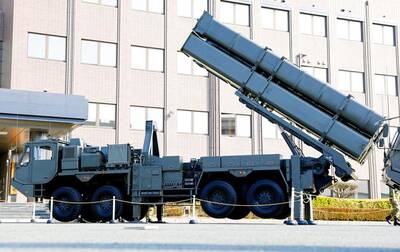
Japan has deployed long-range missiles in a southwestern region near China, the Japanese defense minister said yesterday, at a time when ties with Beijing are at their lowest in recent years. The missiles were installed in Kumamoto in the southern region of Kyushu, as Japan is attempting to shore up its military capacity as China steps up naval activity in the East China Sea. “Standoff defense capabilities enable us to counter the threat of enemy forces attempting to invade our country ... while ensuring the safety of our personnel,” Japanese Minister of Defense Shinjiro Koizumi said. “This is an extremely important initiative for
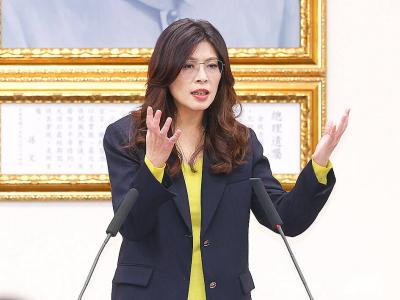
Chinese Nationalist Party (KMT) Chairwoman Cheng Li-wun (鄭麗文) today accepted an invitation from Chinese President Xi Jinping (習近平) to lead a delegation to China next month, saying she hopes to promote the peaceful development of cross-strait relations and bring stability to the Taiwan Strait. “I am grateful and happy to accept this invitation,” Cheng said in a statement from the KMT chairperson’s office. Cheng said she hopes both sides can work together to promote the peaceful development of cross-strait relations, enhance exchange and cooperation, bring stability to the Taiwan Strait and improve people’s livelihoods. At today's news conference, Cheng said any efforts to
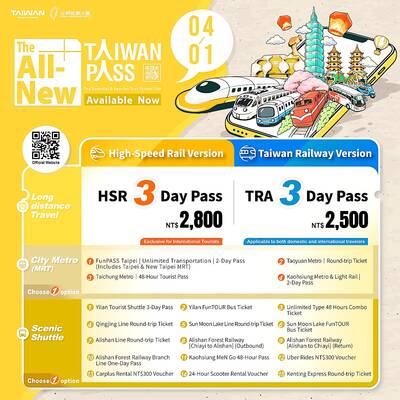
MORE POPULAR: Taiwan Pass sales increased by 59 percent during the first quarter compared with the same period last year, the Tourism Administration said The Tourism Administration yesterday said that it has streamlined the Taiwan Pass, with two versions available for purchase beginning today. The tourism agency has made the pass available to international tourists since 2024, allowing them to access the high-speed rail, Taiwan Railway Corp services, four MRT systems and four Taiwan Tourist Shuttles. Previously, five types of Taiwan Pass were available, but some tourists have said that the offerings were too complicated. The agency said only two types of Taiwan Pass would be available, starting from a three-day pass with the high-speed rail and a three-day pass with Taiwan Railway Corp. The former costs NT$2,800
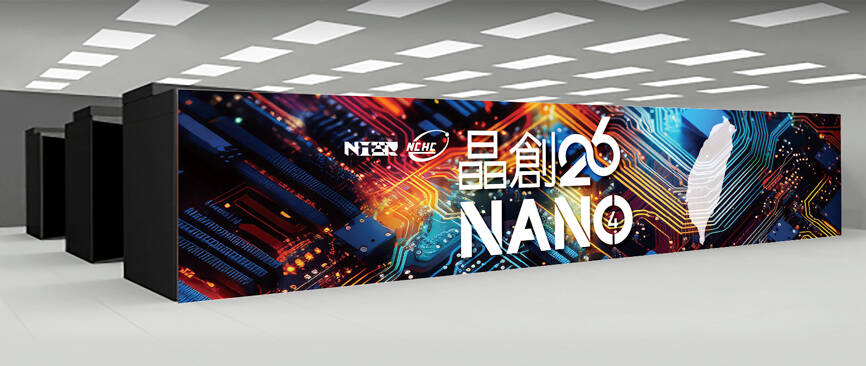
The nation’s fastest supercomputer, Nano 4 (晶創26), is scheduled to be launched in the third quarter, and would be used to train large language models in finance and national defense sectors, the National Center for High-Performance Computing (NCHC) said. The supercomputer, which would operate at about 86.05 petaflops, is being tested at a new cloud computing center in the Southern Taiwan Science Park in Tainan. The exterior of the server cabinet features chip circuitry patterns overlaid with a map of Taiwan, highlighting the nation’s central position in the semiconductor industry. The center also houses Taiwania 2, Taiwania 3, Forerunner 1 and


 RSS
RSS