


A 23-year-old woman who is the first Afghan in three decades to take part in a beauty pageant could face prosecution if she returns to her home country, a senior justice official said on Saturday.
Vida Samadzai, a candidate in yesterday's Miss Earth final in the Philippines, has said she entered the contest to raise awareness of the plight of women in the homeland she left eight years ago for the US.
But Fazel Ahmad Manawi, deputy head of Afghanistan's Supreme Court, said that Samadzai had betrayed Afghan culture and potentially broken the law.

PHOTO: AP
"I hope that this lady regrets her actions," Manawi said. He added that Afghan prosecutors may open an investigation, but refused to say what charges or penalty Samadzai could face.
Attempts to reach Samadzai in the Philippines were unsuccessful. Organizers of the Miss Earth pageant said initially that contestants were busy with rehearsals for yesterday's final judging.
Afghan law is based on Islamic principles, but stops short of the extremist interpretation of Islamic law which was applied by the former Taliban regime.
Despite the fall of the Taliban two years ago, many Afghan women still wear the all-covering burka robes that became an international symbol of the regime's hardline policies. Those who avoid the burka still respect Islamic tradition by covering their hair with a scarf.
In a radical departure from the traditional image of Afghan women, Samadzai paraded down a catwalk in a red bikini during the Miss Earth qualification last month, leading to criticism from the Afghan Supreme Court, which said such a display of the female body was un-Islamic. Samadzai later said she felt uncomfortable in skimpy attire but that the bathing suit contest was a necessary part of the competition.
Samadzai, who studies at California State University, Fullerton, left Afghanistan in 1996. It was not immediately clear whether she has any remaining family in the country.
She said she was "appointed" as a contestant by people aware of her work as a fund-raiser.
Samadzai's participation in the Miss Earth pageant has received little publicity in Afghanistan, where most of the impoverished population lacks access to outside media.
Several Afghan women approached on the streets of Kabul refused to speak when asked about Samadzai. In Afghan culture, women are usually wary of speaking to men in public.
However, in an office in the city, female employee Mazari Alamyar also criticized Samadzai.
"Every [Afghan] woman who is living in any country should respect Shariah [Islamic] law. We are Afghans, we are Muslims," she said. "We know that what was done by this woman was against Shariah law and we condemn it."
Najeba Sharief, Afghanistan's deputy minister for women's affairs, said she personally was displeased with Samadzai.
It is "too early" for beauty pageants when the majority of Afghan women face a tough daily struggle to survive, she said. "First, we should take other steps and after that, one day, we'll be able to turn to such activities."

NETWORK-MAPPING PROJECT: The database contains 170 detailed files of Taiwanese politicians and about 23 million records of household registration data in Taiwan China has developed a network-mapping project targeting political figures and parties in Taiwan to monitor public opinion during elections and to craft tailored influence campaigns aimed at dividing Taiwanese society, according to documents leaked by Chinese technology firm GoLaxy (中科天璣). The documents, collected by Taipei-based Doublethink Lab, showed a database was specifically created to gather detailed information on Taiwanese political figures, including their political affiliations, job histories, birthplaces, residences, education, religion and a brief biography about them. Several notable Taiwanese politicians are in the database, including President William Lai (賴清德), former president Tsai Ing-wen (蔡英文), Minister of Foreign Affairs Lin Chia-lung (林佳龍),

RECOGNITION: Former Fijian prime minister Mahendra Chaudhry said that Taiwan’s New Southbound Policy serves as a stabilizing force in the Indo-Pacific region Taiwan can lead the unification of the Chinese people, Nobel Peace Prize laureate and former Polish president Lech Walesa said in Taipei yesterday, adding that as the world order is changing, peaceful discussion would find good solutions, and that the use of force and coercion would always fail. Walesa made the remarks during his keynote address at a luncheon of the Yushan Forum in Taipei, titled “Indo-Pacific Partnership Prospects: Taiwan’s Values, Technology and Resilience,” organized by the Taiwan-Asia Exchange Foundation with the Ministry of Foreign Affairs. Walesa said that he had been at the forefront of a big peaceful revolution and “if
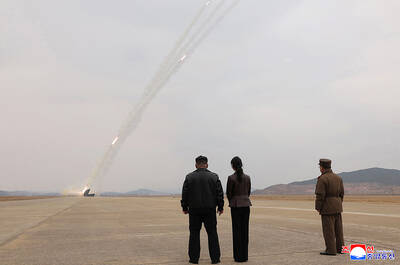
North Korea tested nuclear-capable rocket launchers, state media reported yesterday, a day after Seoul detected the launch of about 10 ballistic missiles. The test comes after South Korean and US forces launched their springtime military drills, due to run until Thursday. North Korean leader Kim Jong-un on Saturday oversaw the testing of the multiple rocket launcher system (MRLS), the Korean Central News Agency (KCNA) said. The test involved 12 600mm-caliber ultra-precision multiple rocket launchers and two artillery companies, it said. Kim said the drill gave Pyongyang’s enemies, within the 420km striking range, a sense of “uneasiness” and “a deep understanding

UPGRADED MISSILE: The Chungshan Institute of Science and Technology is reportedly to conduct a live-fire test of the Hsiung Feng III anti-ship missile on Thursday next week The US Army is planning to build new facilities to boost explosives production and strengthen its supply chain, a move aimed at addressing munitions shortages and supporting obligations to partners including Taiwan, Ukraine and Israel, Defense News reported. The army has issued a sources sought notice for a proposed Center of Excellence at the Blue Grass Army Depot in Kentucky, the report said. The facility would serve as a hub within the US industrial base for the production of key military explosives, including research department explosives (RDX) and high melting explosives (HMX), while also supporting research and development of next-generation materials. The proposed


 RSS
RSS