


Soong Mayling (宋美齡), also known as Madame Chiang Kai-shek, once the most powerful woman in China, has died in her sleep aged 105 in her home in New York, finally bringing down the curtain on one of the most turbulent chapters of Chinese history.
She caught a cold Wednesday and developed pneumonia symptoms "before going very peacefully" at home Thursday night, said Chiang Fang Chih-yi (蔣方智怡), widow of her husband's grandson Chiang Hsiao-yung (蔣孝勇).
She spent much of the time in semi-seclusion in her Manhattan apartment and made her last visit to Taiwan in 1995.
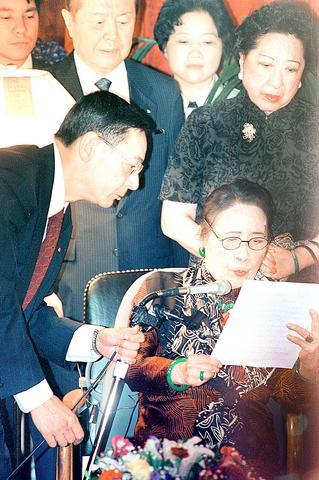
TAIPEI TIMES FILE PHOTO
Famed as much for her iron will as for her beauty, Soong lived through a century of turmoil in China and was feared for decades as a formidable force behind her husband, former president Chiang Kai-shek (
"She was probably the greatest lady in modern Chinese history," Andrew Hsia (
"As an old lady of 104 or 105, she was marvellous, very articulate. She recognized people, so I was impressed," said Hsia, who had met the former first lady twice in recent years.
Hsia said her niece and her niece's husband were with Soong when she died at her apartment in Manhattan, where she had lived with a few nurses and security guards.
Soong was born Feb. 12, 1898, on Hainan island -- but she was thoroughly Western in thought and philosophy. Brought up in a Methodist family, she studied in the US between the ages of 10 and 19, graduating with honors from Wellesley College in Massachusetts in 1917.
"The only thing Oriental about me is my face," she once said.
Soong met her husband around 1920, and married him Dec. 1, 1927, as he was crushing warlord armies to unify China under Chinese Nationalist Party (KMT) rule.
She later converted him to Methodism. The Chiangs' marriage was often stormy, in part because of her husband's infidelities.
She became her husband's spokeswoman and China's voice to the outside world, charming the American public with her impeccable English, spoken with a southern US accent, elegant silk dresses and extravagant jewelry.
She was also one of her husband's most prominent lobbyists in Washington. He couldn't speak English and disliked dealing with foreigners, so his wife became his spokeswoman, creating an image of an attractive young couple trying to steer China out of war.
During World War II, Soong brought the US congress to its feet with a passionate appeal for anti-Japanese aid. Her political adeptness as a roving ambassador for the war-ravaged country led the foreign press to dub her "the brains of China."
"The Madame fought a beautiful battle and has been received by heaven," said Chiang Fang Chih-yi, at an emotional news conference in Taipei.
The weeping Chang Fang praised the former first lady's humanitarian work, her founding of relief organizations and schools for orphans, and promotion of women's rights.
Those who have met her say Soong's charisma was matched only by her toughness. At a White House dinner with then president Franklin Roosevelt she was asked about a troublesome US union leader and how her government would deal with him.
The diminutive Soong silently drew a delicate finger across her throat.
A mystery over Soong's age was never resolved. The government says she was born on Feb. 12, 1898. But records at her former college in the US show she was born on June 5, 1897.
Soong is survived by the grandchildren and great grandchildren of her stepson Chiang Ching-kuo (蔣經國).
Also See Story:
The Dragon Lady who charmed the world
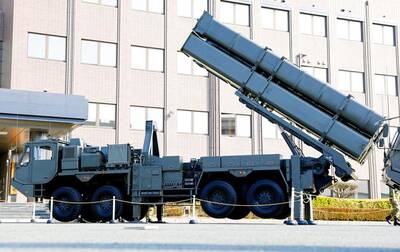
Japan has deployed long-range missiles in a southwestern region near China, the Japanese defense minister said yesterday, at a time when ties with Beijing are at their lowest in recent years. The missiles were installed in Kumamoto in the southern region of Kyushu, as Japan is attempting to shore up its military capacity as China steps up naval activity in the East China Sea. “Standoff defense capabilities enable us to counter the threat of enemy forces attempting to invade our country ... while ensuring the safety of our personnel,” Japanese Minister of Defense Shinjiro Koizumi said. “This is an extremely important initiative for
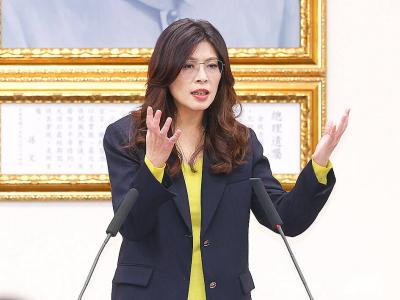
Chinese Nationalist Party (KMT) Chairwoman Cheng Li-wun (鄭麗文) today accepted an invitation from Chinese President Xi Jinping (習近平) to lead a delegation to China next month, saying she hopes to promote the peaceful development of cross-strait relations and bring stability to the Taiwan Strait. “I am grateful and happy to accept this invitation,” Cheng said in a statement from the KMT chairperson’s office. Cheng said she hopes both sides can work together to promote the peaceful development of cross-strait relations, enhance exchange and cooperation, bring stability to the Taiwan Strait and improve people’s livelihoods. At today's news conference, Cheng said any efforts to

MORE POPULAR: Taiwan Pass sales increased by 59 percent during the first quarter compared with the same period last year, the Tourism Administration said The Tourism Administration yesterday said that it has streamlined the Taiwan Pass, with two versions available for purchase beginning today. The tourism agency has made the pass available to international tourists since 2024, allowing them to access the high-speed rail, Taiwan Railway Corp services, four MRT systems and four Taiwan Tourist Shuttles. Previously, five types of Taiwan Pass were available, but some tourists have said that the offerings were too complicated. The agency said only two types of Taiwan Pass would be available, starting from a three-day pass with the high-speed rail and a three-day pass with Taiwan Railway Corp. The former costs NT$2,800

The nation’s fastest supercomputer, Nano 4 (晶創26), is scheduled to be launched in the third quarter, and would be used to train large language models in finance and national defense sectors, the National Center for High-Performance Computing (NCHC) said. The supercomputer, which would operate at about 86.05 petaflops, is being tested at a new cloud computing center in the Southern Taiwan Science Park in Tainan. The exterior of the server cabinet features chip circuitry patterns overlaid with a map of Taiwan, highlighting the nation’s central position in the semiconductor industry. The center also houses Taiwania 2, Taiwania 3, Forerunner 1 and


 RSS
RSS