


People First Party (PFP) Chairman James Soong (
"While it is impossible to restore the Taiwan Provincial Government as a whole, we would, however, consider and review the need to restore some of its mechanisms to better take care of people's needs and fight problems," Soong said, without explaining which functions he favored restoring.
Soong made the remarks in a speech at the launch of PFP Legislator Lu Hsueh-chang's (
The book describes the rise of the provincial government and the process by which amendments to the Constitution eliminated it.
PFP spokesman Hwang Yih-jiau (黃義交) said later that Soong didn't explain his remarks further because timing and Soong's current position meant it would be inappropriate.
"What Soong meant was that, if certain functions within the Taiwan Provincial Government were restored, such as ones overseeing the water and electricity supply, transport and so on, they could provide the linkage that would allow the government to efficiently solve people's problems," Hwang said.
Soong became the first and only directly elected governor of Taiwan Province in 1993.
His position was eliminated in 1998 after a National Development Council meeting in 1996 which suggested that the federal structure be downsized and the provincial government abolished.
"The Taiwan Provincial Government was an efficient government body. It was a mistake to abolish the Taiwan Provincial Government then," Soong told the audience, which included several former National Assembly representatives.
"Now many people are thinking that the abolishment of the Taiwan Provincial Government disturbed Taiwan's political structure and the government's ability to implement measures efficiently," Soong said.
At the book presentation, Lu praised Soong's efficiency in tackling problems as governor and took the opportunity to attack then-president Lee Teng-hui's (李登輝) decision to abolish the post.
"The purpose of the book is to unmask Lee's image as `Mr. Democracy' or the `Father of Taiwan,'" said Lu, who was a two-term National Assembly representative and was among those who disagreed with the elimination of the provincial government.
Lu wrote in the book that he believed Lee's decision to abolish the provincial government was in part a political move meant to undermine Soong's power base and promote Lee's personal political agenda -- the most important element of which was an independent Taiwan.
Saying that Lee's decision had killed the nation's most efficient governing body and thus contributed to the loss of competitiveness that can be seen today, Lu claimed that Lee loves Taiwan only by words while Soong, in his capacity as provincial governor attending to people's concerns, loves Taiwan through deeds.
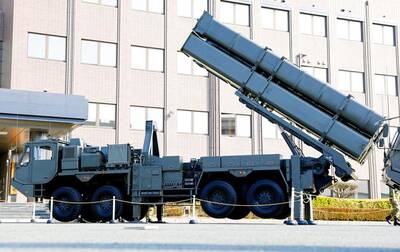
Japan has deployed long-range missiles in a southwestern region near China, the Japanese defense minister said yesterday, at a time when ties with Beijing are at their lowest in recent years. The missiles were installed in Kumamoto in the southern region of Kyushu, as Japan is attempting to shore up its military capacity as China steps up naval activity in the East China Sea. “Standoff defense capabilities enable us to counter the threat of enemy forces attempting to invade our country ... while ensuring the safety of our personnel,” Japanese Minister of Defense Shinjiro Koizumi said. “This is an extremely important initiative for
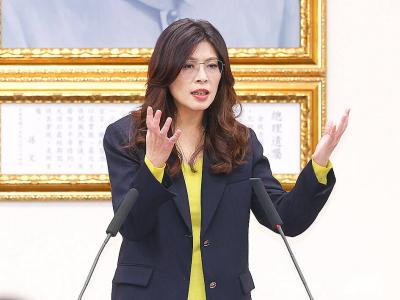
Chinese Nationalist Party (KMT) Chairwoman Cheng Li-wun (鄭麗文) today accepted an invitation from Chinese President Xi Jinping (習近平) to lead a delegation to China next month, saying she hopes to promote the peaceful development of cross-strait relations and bring stability to the Taiwan Strait. “I am grateful and happy to accept this invitation,” Cheng said in a statement from the KMT chairperson’s office. Cheng said she hopes both sides can work together to promote the peaceful development of cross-strait relations, enhance exchange and cooperation, bring stability to the Taiwan Strait and improve people’s livelihoods. At today's news conference, Cheng said any efforts to
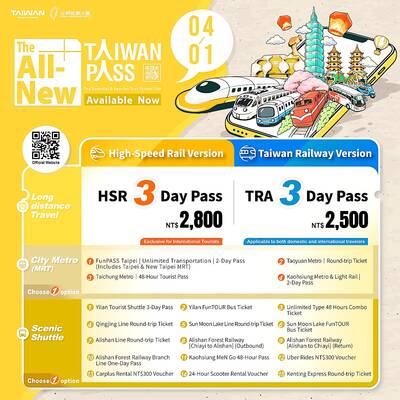
MORE POPULAR: Taiwan Pass sales increased by 59 percent during the first quarter compared with the same period last year, the Tourism Administration said The Tourism Administration yesterday said that it has streamlined the Taiwan Pass, with two versions available for purchase beginning today. The tourism agency has made the pass available to international tourists since 2024, allowing them to access the high-speed rail, Taiwan Railway Corp services, four MRT systems and four Taiwan Tourist Shuttles. Previously, five types of Taiwan Pass were available, but some tourists have said that the offerings were too complicated. The agency said only two types of Taiwan Pass would be available, starting from a three-day pass with the high-speed rail and a three-day pass with Taiwan Railway Corp. The former costs NT$2,800

The nation’s fastest supercomputer, Nano 4 (晶創26), is scheduled to be launched in the third quarter, and would be used to train large language models in finance and national defense sectors, the National Center for High-Performance Computing (NCHC) said. The supercomputer, which would operate at about 86.05 petaflops, is being tested at a new cloud computing center in the Southern Taiwan Science Park in Tainan. The exterior of the server cabinet features chip circuitry patterns overlaid with a map of Taiwan, highlighting the nation’s central position in the semiconductor industry. The center also houses Taiwania 2, Taiwania 3, Forerunner 1 and


 RSS
RSS