


More than 100,000 people are expected to take to streets in downtown Taipei today to campaign for the change of nation's name from "Republic of China" (ROC) to "Taiwan" as well as the usage of Taiwan as the official title for the country's bid to enter the UN.
The Alliance to Campaign for Rectifying the Name of Taiwan, the organizer of the march, yesterday released the latest tally of the number of people signing up for the campaign drive, which might draw as many as 120,000 people from all over the country to the rally.
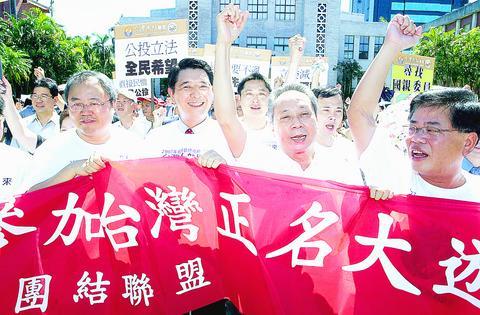
PHOTO: SEAN CHAO, TAIPEI TIMES
Supporters of 113 domestic and overseas groups will join the rally in front of the Presidential Office. The DPP and TSU, which have long been promoting Taiwan's sovereign status independent from China, have also mobilized more than 40,000 and 30,000 rank-and-file supporters respectively, party officials said.
Overseas participants from the US, Japan, Argentina, Paraguay, Costa Rica, Australia, New Zealand and South Africa would also attend the rally.
Using the slogan that "our mother's name is Taiwan," the campaign advocates the abolishment of the use of "ROC" or "China" as a nomenclature representing Taiwan, and demands that the title of the country, company's names and the names of social groups using the word "China" should be replaced with "Taiwan" to reflect the reality that China, officially known as the People's Republic of China, does not govern Taiwan.
The alliance listed a total of 245 private groups, companies and institutions whose names need to be corrected including China National Petroleum Corp, China Steel, China Shipbuilding, China Airlines, the Chinese-language newspaper China Times, China Television, China Television Company, Farmers Bank of China and the KMT, whose full name actually translates as the "Chinese Nationalist Party" (中國國民黨).
The campaign also appeals to the government to use Taiwan as the official title for its overseas organizations, to apply for membership of the UN under the name of Taiwan.
It also asks the government to write a constitution for Taiwan rather than the outdated and much amended Constitution of 1947 currently in use, and change the nation's official name to the "Republic of Taiwan" or simply "Taiwan."
Marchers will gather in six locations -- Chiang Kai-shek Memorial Hall, National Taiwan University, the 228 Memorial Park, Chungshan Football Stadium, Sun Yat-sen Memorial Hall and Taipei City Hall -- at 11am and start the march at noon before reaching to the Presidential Office at 3pm.
Former president Lee Teng-hui (
The DPP yesterday released a poll of public opinion on the nation's sovereignty according to which 63.2 percent of the public support the idea that Taiwan and China are "one country on each side of the Taiwan Strait," and 70.3 percent agreed that a national plebiscite to be held to decide whether Taiwan should change its status quo or the nation's name.
The KMT criticized the campaign drive as advocating Taiwan independence and accused the DPP and TSU of being "historical criminals" and being "unethical" by trying to annihilate the existence of the ROC, which, it said, has existed since 1911.

‘NO SECURITY RISK’: The Railway Bureau reassured the public that the technicians’ activities were limited to technical guidance and did not involve sensitive systems The Railway Bureau yesterday said it had invited eight Chinese technicians to assist with an airport MRT construction project. The bureau issued the confirmation after an Internet user said Chinese nationals had entered the construction zone of Taiwan Taoyuan International Airport’s Terminal 3 project. They asked why “individuals from an enemy state” were allowed access to such a major national infrastructure project, which raised serious concerns over Taiwan’s industrial safety, sensitive systems and information security. The bureau’s Northern Region Engineering Branch Office said subcontractor Taiwan Handle Industrial Co (台灣手把工業) of the Taoyuan airport MRT’s “Contract No. CU05 Project A14 Station Civil, MEP &

The National Chungshan Institute of Science and Technology yesterday showcased its locally developed variants of the Vision 60 robotic patrol dog, which it plans to deploy on the nation’s outlying territories in the South China Sea. The variants were produced under the Joint Lab project — created by the institute and domestic companies — and assembled with domestically produced motors, lenses and artificial intelligence (AI) systems alongside licensed tech from the US, Missile and Rocket Systems Research Division deputy director Jen Kuo-kang (任國光) told the media event at a military base in Taipei’s Dazhi (大直) area. Taiwan has built up its strengths

TIT-FOR-TAT: The US allegedly revoked the visa of a Chinese national working at Xinhua News Agency in the US in response to Beijing’s expulsion of Vivian Wang The Presidential Office yesterday condemned China for expelling a New York Times correspondent from Beijing following the newspaper’s interview with President William Lai (賴清德), saying the move highlighted Beijing’s suppression of press freedom and its threat to international news media. Taiwan has noted a series of recent incidents in which Beijing used similar tactics to “threaten and pressure international media outlets and journalists,” Presidential Office spokeswoman Karen Kuo (郭雅慧) said in a statement. “This concerns not only press freedom and freedom of expression, but also the safety of journalists, and Taiwan and relevant partners are paying close attention to the situation,” she

NOT IMMEDIATE: Taiwan has a chance to appeal the proposed 10 percent tariff before it starts, while other countries face a 12.5 percent tariff from the trade office Taiwan is among 60 economies determined by the US to have failed to impose or enforce a ban on the importation of goods produced with forced labor, according to a notice released on Tuesday by the Office of the US Trade Representative (USTR), which proposed imposing an additional 10 percent or more tariff on them. The USTR in a statement said that following an investigation, it had determined under Section 301 of the Trade Act of 1974 that the failure of the 60 economies to impose and effectively enforce a prohibition on the importation of goods produced with forced labor is


 RSS
RSS